
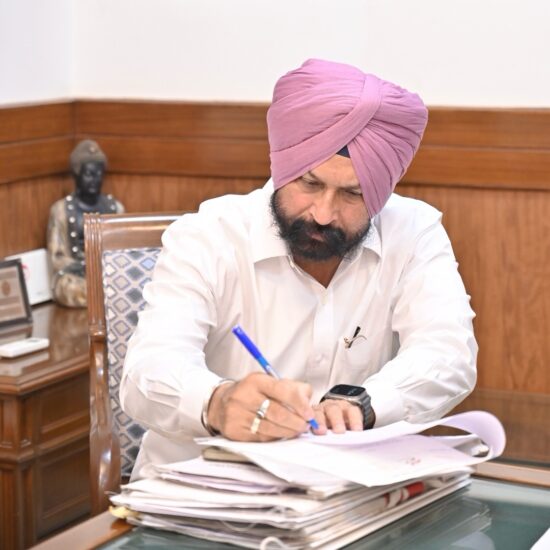
Former Punjab IPS officer Gurinder Dhillon has raised serious questions over the alleged occupation or misuse of spaces meant for economically weaker sections (EWS), questioning whether private developers can operate in a manner that appears to override constitutional and legal safeguards.
In a strongly worded post, Dhillon specifically questioned the role of DLF and asked: “Is DLF an authority above the Constitution and the constitutional authorities?” He alleged that the situation reflects what he described as a nexus operating openly in spaces intended for economically weaker sections.
Dhillon invoked the Constitution as the ultimate safeguard of citizens’ rights, describing it as the “Dharmaraj” of the nation and suggesting that the constitutional framework could appear helpless when legal and administrative mechanisms fail to protect vulnerable sections of society.
A major point raised by Dhillon was the existence of 664 civil suits carrying status quo orders. He argued that the large number of cases and continuing disputes require an urgent institutional response rather than prolonged litigation that, in his view, could leave economically weaker residents without effective relief.
Dhillon proposed two possible courses of action. First, he called for immediate enforcement action, using the term “bulldozer action,” provided such action is legally authorized and not obstructed. Second, he referred to Article 142 of the Constitution, which empowers the Supreme Court to pass orders necessary for doing “complete justice” in matters before it.
Dhillon expressed confidence that the Supreme Court could consider extraordinary constitutional relief for EWS beneficiaries if the matter were properly placed before it. His reference to Article 142, however, should be understood in the context of the Supreme Court’s constitutional jurisdiction and the facts and legal proceedings of any particular case; it does not by itself authorize administrative action outside the judicial process.
He also pointed to an important distinction involving people facing genuine financial hardship. According to Dhillon, the state government has powers to consider appropriate action in compassionate cases where financial circumstances are involved. Such decisions, however, would remain subject to the applicable law, government policy and individual facts.
The allegations and legal issues surrounding the 664 civil suits, the status-quo orders, the EWS spaces and the role attributed to DLF would require examination of the underlying court records, land-use documents, government notifications and orders of the competent authorities before definitive conclusions can be drawn.
The controversy nevertheless raises a broader governance question: when land or facilities are earmarked for economically weaker sections, who is ultimately responsible for ensuring that the intended beneficiaries actually receive the protection promised to them by law?
Dhillon’s intervention puts that question directly before the constitutional and administrative authorities, while also highlighting the tension between prolonged civil litigation, enforcement action and the constitutional obligation to provide effective justice to vulnerable citizens.
Punjab Outlook Investigative Analysis: The central issue is not merely the existence of hundreds of court cases, but whether legal protections created for economically weaker sections are being effectively implemented on the ground. Any solution must operate within the Constitution, judicial orders and applicable law while ensuring that EWS beneficiaries are not left without meaningful protection.