
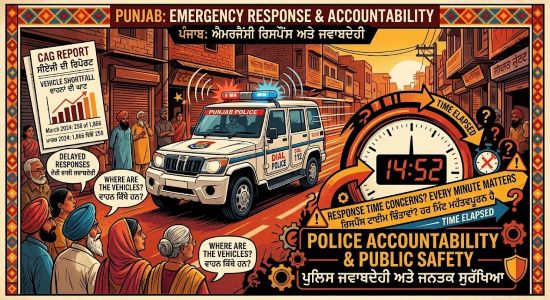
When a woman is facing sexual violence, a family is under attack, a person is being kidnapped, or someone is fighting for their life, every minute matters. Yet an important question continues to trouble the public: Why does police assistance sometimes arrive after the crime has occurred, rather than when it could still prevent further harm? Registering a case, arresting suspects and conducting an investigation are essential duties, but the first responsibility of the police is to protect human life and respond promptly when citizens call for help.
Punjab needs an honest discussion about police preparedness, emergency response, accountability and public safety. Citizens have every right to ask whether distress calls are being treated with urgency, whether the nearest available police team is dispatched immediately, and whether avoidable delays are being investigated. The issue is not simply how many cases are registered or how many arrests are made. It is also whether the system responds effectively when people are in immediate danger.
A Timeline of Documented Concerns
The issue of emergency response in Punjab is not merely a matter of public perception. The Comptroller and Auditor General of India (CAG), in its Report No. 7 of 2025, examined the implementation of Punjab’s Dial 112 emergency response system. The audit identified significant shortcomings in resources, oversight and operational arrangements.
According to the audit, Punjab had deployed only 258 emergency response vehicles against a requirement of 1,866 by March 2024. This represented a substantial gap in the resources intended to support emergency services. The report also highlighted shortcomings in the system’s monitoring and implementation. These findings do not establish that police arrived late in every individual crime case, but they raise legitimate questions about the state’s capacity to provide timely emergency assistance.
The audit also highlighted weaknesses in oversight. The required state-level committee was constituted after the project had begun, and its meetings fell far short of the prescribed frequency. Effective emergency response requires more than a helpline number. It requires adequate vehicles, trained personnel, clear operating procedures, reliable communications and regular monitoring.
In May 2026, the Punjab and Haryana High Court also expressed concern about cases involving prolonged delays in registering FIRs for cognizable offences. Delayed registration and delayed arrival at a crime scene are separate issues, but both can affect victims’ access to justice. The authorities must ensure that complaints are handled promptly and that preliminary inquiries are not used to justify unlawful or unnecessary delays.
Why Does Police Assistance Sometimes Arrive Late?
One possible reason is a shortage of emergency vehicles and personnel. If the nearest police team is unavailable or too far away, the response may be delayed even when the control room receives the call promptly. The substantial vehicle shortfall identified by the CAG makes it important to examine whether the resources available in each district are adequate for its population and geographical needs.
Another concern is the handling of emergency calls. A call must be received, the location identified, the nature of the danger assessed, and a suitable team dispatched. Any breakdown in this chain can waste valuable time. The police leadership should examine time-stamped call records, dispatch logs and vehicle-location data to establish where delays occur.
Coordination is equally important. An emergency involving sexual violence, kidnapping, domestic abuse or an armed attack may require police officers, medical teams and other emergency services to work together. Confusion over jurisdiction, poor communication or a lack of clear procedures should never be allowed to obstruct urgent assistance.
Accountability is another essential part of the discussion. When a serious delay occurs, authorities should establish whether it resulted from circumstances beyond the officers’ control, inadequate resources, a communication failure or negligence. Where an inquiry establishes misconduct or avoidable negligence, appropriate action should follow under the law.
Rape and Sexual Assault Cases Require Immediate Action
In cases involving rape or sexual assault, the victim’s immediate safety must be the priority. Police must respond urgently when there is an ongoing threat, help secure medical assistance where needed, protect the victim from further harm and preserve relevant evidence. Complainants must be treated with dignity, and their privacy must be protected.
No victim should have to make repeated calls for help while facing an immediate threat. Nor should a family be left uncertain about whether assistance has been dispatched. If a specific case involves allegations that police ignored a distress call or arrived after an avoidable delay, the authorities should conduct a prompt and impartial examination of the available records.
It is also important not to assume that every delayed response proves deliberate negligence. Traffic, distance, simultaneous emergencies and inaccurate location details can affect arrival times. These circumstances should be documented and assessed fairly. The purpose of accountability is to identify the truth, correct failures and prevent similar incidents—not to assign blame without evidence.
What Punjab’s Government and Police Leadership Must Do
The government should publish district-wise emergency response data, including the time a call was received, the time a police team was dispatched and the time officers arrived at the scene. Average response times alone can conceal serious delays in individual emergencies, so the data should also explain how exceptional delays are reviewed.
Punjab should address shortages of emergency vehicles and personnel through a time-bound plan. Police control rooms should maintain reliable digital records, and serious incidents involving alleged delays should receive mandatory reviews. The police leadership should also strengthen coordination with medical and other emergency services, ensure sensitive handling of sexual-violence complaints, and publish periodic reports on corrective action.
Citizens should be able to see whether the shortcomings identified by the CAG have been addressed. An audit should not end with a report; it should lead to measurable improvements in the services people depend on during emergencies.
What Punjabi Poets Remind Us About Justice
Punjab’s literary tradition has long given voice to human suffering, injustice and the dignity of ordinary people. The poetry of Shiv Kumar Batalvi is remembered for its profound expression of pain, while Pash challenged injustice and encouraged people to question oppressive conditions.
Their broader literary spirit reminds us that society cannot remain indifferent when a vulnerable person suffers. These are thematic references to their work, not direct quotations from their poems.
The demand for timely police assistance is not an attack on the police as an institution. It is a demand that an institution entrusted with public safety fulfil its responsibility. Constructive criticism, transparent records and fair accountability can help strengthen public confidence.
Conclusion: Public Safety Cannot Wait
The CAG’s findings on Punjab’s Dial 112 system provide a documented basis for asking difficult questions about emergency preparedness. The shortage of vehicles and weaknesses in oversight deserve serious corrective action. Concerns about delayed FIR registration also reinforce the need for prompt, lawful and accountable police procedures.
The people of Punjab deserve more than assurances after a tragedy. They deserve an emergency response system that works when a life is at risk, a woman needs protection or a family urgently calls for help.
The central question remains: When a citizen calls the police during a rape, kidnapping or violent attack, how long does it take for help to arrive—and who is held accountable when an avoidable delay puts a life at greater risk?
Public safety is not a favour granted by the government. It is a fundamental responsibility of the state and its police force.
Disclaimer: This article and accompanying images are for informational and illustrative purposes only. Some visuals may be AI-generated or digitally enhanced and may not depict actual events or persons.Views expressed are based on publicly available information and analysis