
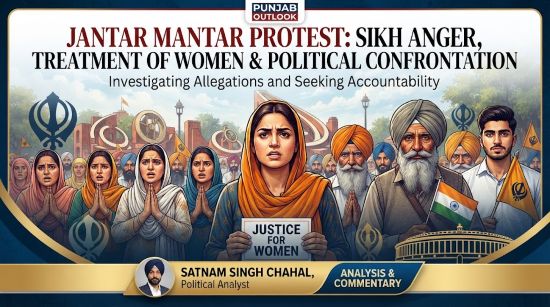
Punjab Outlook Political Analysis-The initial protest at Jantar Mantar has raised serious questions about the handling of demonstrators, respect for Sikh religious sentiments, the treatment of women and the wider image of India. The incident should not be examined merely as a confrontation between the police and protesters; it also demands an assessment of what the government and the protesting community gained or lost, and whether the situation could have been handled through dialogue rather than force.
The reported entry of police personnel into Gurdwara Bangla Sahib with uncovered heads and shoes has caused deep anguish among many Sikhs. For the Sikh community, a Gurdwara is a sacred place governed by religious discipline and traditions of respect. Any alleged disregard for these traditions can create anger that extends well beyond those directly involved in a protest. Critics may interpret the incident as evidence of a failure to understand Sikh religious sensitivities, potentially deepening mistrust between sections of the Sikh community and the BJP. However, the extent of that political impact will depend on the facts established and the response of the authorities.
The reported mistreatment of girls and other women during the protest raises another serious concern. Every woman participating in a demonstration has the right to dignity, safety and lawful treatment, regardless of her political views or the cause she supports. If women were manhandled or their complaints ignored, the authorities must investigate the allegations, identify those responsible where misconduct is established and ensure accountability. The use of force must remain lawful, necessary and proportionate. Young protesters, too, must be treated according to the law rather than subjected to intimidation or collective punishment.
The government must answer a fundamental question: what was achieved through confrontation that could not have been achieved through dialogue? If the objective was to restore order, the authorities must explain whether the action was necessary and proportionate and whether less confrontational alternatives were considered. A government may succeed in dispersing a gathering, but dispersal alone does not resolve the grievances that brought people onto the streets. If the action leaves behind greater resentment, damaged trust and unanswered questions, the underlying dispute may become more difficult to resolve.
The protesters must also assess their gains and losses. A demonstration can bring national attention to a grievance, mobilise public opinion and compel authorities to respond. But if the protest becomes associated with clashes, disorder or allegations of misconduct, the original demands risk being overshadowed by the confrontation itself. The most effective response is to maintain peaceful discipline, document alleged violations, seek legal remedies and present clear demands that the authorities cannot easily ignore.
The international dimension cannot be dismissed. In an era when videos and eyewitness accounts circulate rapidly across borders, scenes involving religious sites, police action and the alleged mistreatment of women can attract scrutiny from the global Sikh diaspora and human-rights observers. Such incidents can raise questions about India’s commitment to religious respect, civil liberties and the right to peaceful assembly. Whether the country has suffered lasting reputational damage will depend on the verified facts, the transparency of the investigation and the government’s response.
Ultimately, neither the government nor the protesters should treat the confrontation as a contest in which one side must humiliate the other. The government has a responsibility to protect public order while respecting fundamental rights and religious sentiments. Protesters have a responsibility to remain peaceful and lawful while demanding accountability. An independent inquiry, transparent findings and meaningful dialogue would serve the public interest far better than political accusations and further escalation.
The central question remains: did the confrontation resolve the dispute, or did it create new wounds that will take much longer to heal? The answer must emerge from verified evidence, accountability and a willingness to respect democratic dissent.
Editorial note: Allegations concerning police conduct and the treatment of women should be checked against reliable reporting, eyewitness accounts and official responses before publication as established facts.