
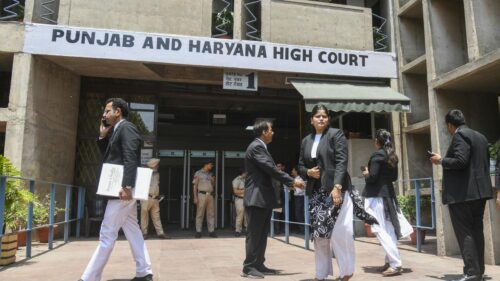
 A government’s diary is usually written in its own Secretariat: Cabinet meetings, inaugurations, the Chief Minister’s tour programme. For the next ten days, the Punjab Government’s diary is being written elsewhere, in the cause lists of the Punjab and Haryana High Court. Two dates are circled. Monday, 28 September, when a public interest petition on the funds of the Greater Mohali Area Development Authority (GMADA) returns before the Chief Justice’s Bench. Monday, 5 October, when the same Bench expects the State’s Chief Secretary in person over unpaid dearness allowance, and takes up a challenge to the State’s new monthly assistance scheme for women. In between, the Enforcement Directorate (ED) spent the better part of three days inside GMADA’s headquarters in Mohali.
All the matters before the High Court are pending, and none has been decided. The questions discussed here are the Court’s questions, and the answers belong to the State’s affidavits. Nothing in this column presumes illegality in any petition, or guilt on anyone’s part in the ED’s investigation.
The Deposit That Was Read as Revenue
The GMADA petition, Jaskirat Singh and Others v. State of Punjab and Others (CWP-PIL-260-2026), turns on ₹6,400 crore that GMADA deposited in the State Treasury under the food-security provision of the land acquisition law of 2013. Where multi-crop irrigated land is acquired, that provision requires either an equivalent area of wasteland to be developed for agriculture, or an amount equal to the land’s value to be deposited with the Government for investment in agriculture. The petitioners rely on a communication of 3 June 2026 from the Accountant General (Audit-I), Punjab, objecting that the deposit has been absorbed into the State’s general revenues instead of being held apart.
The order of 15 September is notable on two counts. The Bench asked the Accountant General, Kumar Abhay, to attend in person, and he did. He told the Court that the deposit ought to have been kept in the Public Account as a dedicated fund, and that absorbing it into the Consolidated Fund to meet general deficits was a serious accounting impropriety. The State had replied to his office on 31 July, he said, but the issues remained unexplained.
The Advocate General put the State’s case squarely. Punjab, he argued, has invested ₹94,443 crore in food security since 2013, so appropriating the ₹6,400 crore involves no impropriety, and nothing requires the sum to sit in the Public Account. He also questioned whether the petition is bona fide.
The Bench left maintainability open and called for a specific affidavit on three points: whether a deposit made for a distinct statutory purpose can be absorbed into the Consolidated Fund to finance general deficits; what GMADA’s total liability under the food-security provision comes to; and the justification for successive borrowings for the Aerotropolis project, including why ₹191 crore is proposed to be paid to a private entity for arranging a ₹15,000 crore loan. The order also records the petitioners’ submission that ₹2,000 crore raised earlier for Aerotropolis lay unutilised.
A letter now circulating among correspondents adds a wrinkle. Dated 25 March 2026 and issued by the Directorate of Housing and Urban Development to the District Treasury Officer, SAS Nagar, on the strength of a Finance Department communication of 26 February, it directs that the ₹6,400 crore be shifted out of the Housing receipt head in which it was first booked. The destination is a newly opened sub-head, captioned “Deposit for investment in agriculture for enhancing food security in lieu of land acquired”. The caption itself describes the money as a deposit held for a purpose. The new sub-head, however, sits under Major Head 0075 (Miscellaneous General Services) and the minor head “Sale of Land and Property”, a revenue-receipt head within the Consolidated Fund rather than the Public Account. Whether a change of caption amounts to a change of custody is a question the State’s affidavit may well have to answer.
These remain questions. A specific affidavit, however, is a demanding instrument, and a generality that would satisfy a newspaper will not satisfy the Bench on the 28th.
Dearness Allowance: Deferred or Delayed?
The second matter is older and, for the Chief Secretary, more personal. On 22 September the Bench of Chief Justice Ashwani Kumar Mishra and Justice Rohit Kapoor directed the Chief Secretary, K A P Sinha, to appear on 5 October, while hearing pleas of non-compliance with its 3 August order. That order required pending dearness allowance and dearness relief to be released at the rates paid to All India Services officers serving in the State, with 6 per cent simple interest on any unpaid amount after the deadline, and directed the Chief Secretary to ensure scrupulous compliance and file an affidavit. No compliance affidavit had been filed.
The State has a remedy, and it has used it, up to a point. Its special leave petition (SLP) in the Supreme Court, filed on 1 September, argues that paying roughly ₹14,191 crore within a fortnight is constitutionally impossible; by the State’s own Liquidation Plan, that sum is phased over five financial years. The Supreme Court Registry pointed out defects in the SLP, and those defects had not been removed. On 10 September the Bench told the State’s counsel not to try to hoodwink the Court. On 22 September the State sought two more weeks to cure the defects and said it was trying to resolve the matter amicably. The personal appearance falls away only if the State secures relief from the Supreme Court before 5 October.
The next ten days therefore leave two outcomes. Either the SLP is cured, listed and heard, or the Chief Secretary stands before the Bench.
One Bench, Two Heads of Account
The same two judges will hear both matters, a week apart. In one, the State argues that the discipline of the Consolidated Fund makes an immediate payment to its employees impossible. In the other, it defends the absorption of a statutorily earmarked deposit into that same Consolidated Fund. The two positions are not necessarily inconsistent in law, but reconciling them before one Bench will require care, and the reconciliation is the State’s to offer.
Fiscal Calisthenics, Then and Now
The practice itself is not new, and no party can claim clean hands. Successive governments of every stripe have treated cash-rich boards, authorities and corporations as a second treasury, usually through a “loan” to tide over an overdraft or a ways-and-means squeeze. Under the Optimum Utilisation of Vacant Government Land (OUVGL) scheme, first introduced in 1997, government land was transferred to the undivided PUDA (the Punjab Urban Planning and Development Authority) and borrowed against; during the SAD-BJP government, ₹2,000 crore was raised by mortgaging the transferred properties to banks, and nearly half of those properties were still unsold in 2025. In 2012 the SAD-BJP Finance Minister, Parminder Singh Dhindsa, acknowledged that ₹2,000 crore received from the Centre for sponsored schemes during the government’s previous tenure had been diverted, and undertook to restore it. The Congress government’s White Paper of June 2017 recorded that the State’s procuring agencies had diverted funds from the cash credit limit meant for wheat and paddy procurement. The Rural Development Fund, levied on foodgrain purchases for rural infrastructure, was reportedly applied during the Congress government to repay the Mandi Board’s borrowing for the farm-loan waiver, some ₹4,700 crore in all, and during the earlier Akali government to the Chief Minister’s Sangat Darshan programmes; the Centre has withheld the fund since 2021, alleging misuse. The present government, for its part, borrowed over ₹2,500 crore from the Housing Department in 2025 through an overdraft facility against GMADA’s vacant properties, sought a further ₹1,000 crore from GMADA, and directed departments to deposit ₹1,441.49 crore in the treasury, with the Punjab Pollution Control Board, an autonomous body, told to transfer ₹250 crore. A senior official said at the time that previous governments had done the same.
What has changed is the scrutiny, which this time is far more precise and surgical. Earlier episodes were argued in the Vidhan Sabha, in White Papers and in the Centre’s correspondence over the Rural Development Fund, and they were settled politically, if at all. The GMADA question comes from the State’s own Accountant General, in person, is anchored to a single sub-section of a central statute, and must be answered on affidavit before the Chief Justice’s Bench. That a practice has been followed by every government does not settle whether it was permissible, and nor does it prove that it was not. (The writer served as Chief Administrator, PUDA, from 1999 to 2002, and as Principal Secretary, Finance, from 2010 to 2012, and has seen this practice from both ends of the file.)
Mothers, Daughters and the Electoral Roll
On the same Monday, 5 October, the same Bench takes up a public interest petition against the Mukh Mantri Mawan Dheeyan Satkar Yojana, notified on 2 April 2026. The scheme pays ₹1,500 a month to women of the Scheduled Castes and ₹1,000 a month to other women registered as voters in Punjab. The petitioner, the Harbakhsh Charitable Society, does not attack the scheme on fiscal grounds. Its argument is about purpose. Making a Punjab voter identity card mandatory for the benefit, it contends, shows that the scheme is a quid pro quo for votes. A voter card, it concedes, may serve as one proof of identity among several; it is the mandatory requirement that it objects to. On 24 September the Additional Advocate General opposed the petition and sought time to take instructions on why the voter card is mandatory, and the Bench adjourned the matter to 5 October.
The State has an answer available. A monthly payment to every adult woman was among the Aam Aadmi Party’s promises before the 2022 elections, and a government that delivers its manifesto, however late, is doing what governments are elected to do. The electoral roll is also the one register of adult residents that the State does not have to build. Which reading the Court prefers, if it reaches the question at all, will depend on what the State says about that single eligibility condition.
Land Pooled, Rules Stayed, Farmhouses Stalled
These matters have a recent history behind them. The Land Pooling Policy, 2025, notified on 14 May 2025 to pool some 65,000 acres for townships and industrial estates, was stayed by the High Court on 7 August 2025 because no social or environmental impact assessment had been carried out. Four days later, on 11 August, the Government withdrew the policy and reversed the letters of intent and registrations issued under it.
The Unified Building Rules, 2025, notified in December 2025, met a similar fate. Stayed by the High Court, they were withdrawn in April 2026, and the Department of Housing and Urban Development returned to amending the PUDA Building Rules of 2021, most recently by the Second Amendment Rules of 7 September 2026.
The farmhouse policy for land delisted from the Punjab Land Preservation Act, 1900 (PLPA) in the Shivalik-Kandi belt, the Low Impact Green Habitats (LIGH) Policy of 20 November 2025, covers nearly 55,000 hectares across Mohali, Ropar, Nawanshahr, Hoshiarpur and Gurdaspur. The National Green Tribunal (NGT) has stayed it, has since extended the stay, and has fixed 14 December for the next hearing; until the stay is vacated, no farmhouse can be permitted under it. Separately, the Department of Tourism assured the NGT that its Farm Stay Policy, 2026 would not extend to delisted or PLPA-protected land, and amended that policy accordingly on 15 September. The Department of Housing and Urban Development, however, continues to pursue its farmhouse policy for the delisted areas.
None of these outcomes is a finding that the State acted unlawfully. In two of the three cases the Government withdrew before any court reached the merits, and the third remains on hold. They do show a pattern: policies notified in haste, challenged within weeks, and then withdrawn or rewritten after a court or tribunal intervened.
Searches Are Not Sentences
Separately, and on a matter wholly distinct from all these petitions, the ED began searches under the Prevention of Money Laundering Act, 2002 on 22 September at 26 premises across Delhi, Mohali, Chandigarh, Panchkula and Ludhiana, in connection with Tirupati Infraprojects and associated entities, with surveys at the offices of GMADA and the Department of Housing and Urban Development. Reports say the inquiry covers, among other things, an alleged waiver of over ₹100 crore in dues to a realtor developing a food court on a 1.3-acre site in Mohali. On the Punjab Government’s petition, the High Court directed that a warrant officer be appointed to inspect the search sites and report. The operation ended on 24 September; the ED took away more than 30 bags of documents and hard discs, no GMADA official was taken into custody, and senior officers were back at work. The Aam Aadmi Party has called the searches political vendetta timed ahead of the Assembly elections. A search is an investigative step, and the law presumes every officer and every firm named in these reports innocent. By the reports, the ED is expected to summon officials on the basis of the documents it seized; what those documents establish will be for a court to decide.
What the Fortnight Asks of the State
The matters before the High Court ask for the same thing: candour on affidavit. The ₹6,400 crore question needs an answer grounded in the statute and the accounting rules. The dearness allowance question needs either a Supreme Court order or a compliance affidavit by 5 October, because a Chief Secretary cannot bring the Bench another request for time. The women’s scheme needs a plain explanation of one eligibility condition. The State has every right to defend its choices, with the Assembly elections only months away, provided it does so in the form the Court has asked for.
The Alternative Universe of the Ballot
All of this charts the turbulence the State Government faces in the courts. Elections, however, are fought in an altogether different universe. The waves, the ripples and even the occasional tremor from the courtrooms of Chandigarh may travel there, but they arrive weakened, and they meet a voter who keeps her own ledger. A woman receiving a monthly stipend, a household on free electricity, a farmer at the tail end of a canal who now finds water reaching his fields, and a citizen who no longer meets a demand for money at the tehsil, the police station or the block office will weigh those things against affidavits she will never read. Set against the less than credible performance and promises of the opposition parties, that voter may well choose the Aam Aadmi Party candidate once again. The High Court will decide what the State may lawfully do. The voter will decide who does it next.