
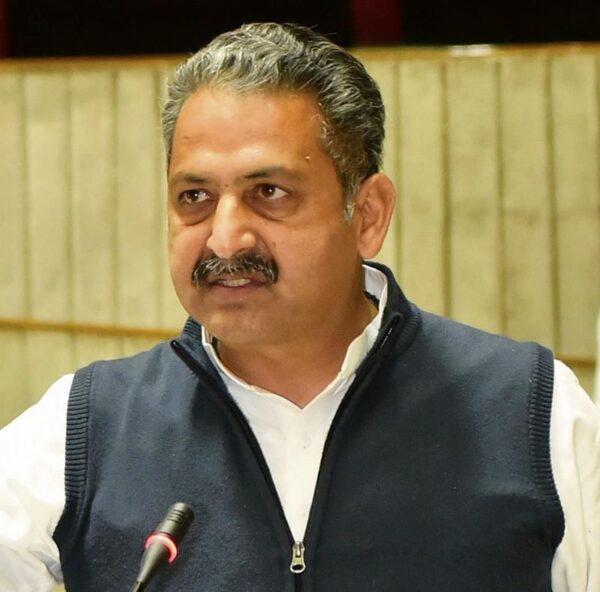
The reported possibility of Vijay Inder Singla replacing Amarinder Singh Raja Warring as president of the Punjab Pradesh Congress Committee has brought renewed attention to the Congress party’s leadership question in Punjab. However, becoming the state Congress chief is one thing; rebuilding a party organisation, bringing competing leaders together, reconnecting with voters and preparing for the next Assembly election is an entirely different challenge. If Singla is being considered for this responsibility, he would be entering a position that demands far more than political experience, personal contacts or a respectable electoral background. It would require sustained organisational work, political patience and the ability to manage a party where several senior leaders have their own ambitions, support bases and views about the road ahead.
The central question is not simply whether Vijay Inder Singla can replace Raja Warring. It is whether a change of president, by itself, can resolve the deeper organisational and political difficulties confronting the Punjab Congress. Leadership changes can generate headlines and temporarily raise expectations, but voters ultimately judge a party by its public engagement, the credibility of its leadership, its response to local problems and the clarity of its political message. A new president would have to demonstrate that the change represents a serious effort at organisational renewal rather than merely another adjustment at the top.
A Leadership Crisis That Has Been Building for Months
The speculation surrounding Singla’s possible elevation comes after months of disagreement within the Punjab Congress. Reports published on September 30 and October 1, 2026, said that Raja Warring had offered his resignation and that the party high command was considering a successor. Vijay Inder Singla emerged as one of the leading contenders, alongside Pargat Singh and Sukhjinder Singh Randhawa, while Charanjit Singh Channi remains an important figure in the party’s internal power equations. The final appointment should be distinguished from the names circulating in political reports until the Congress formally announces its decision.
This development reflects a problem that has troubled the Punjab Congress for a considerable period: the difficulty of reconciling competing leadership ambitions under one organisational structure. The disagreements are not merely about who occupies the president’s chair. They also concern influence over candidate selection, campaign planning, district-level appointments, communication with the central leadership and the distribution of political responsibilities ahead of the 2027 Assembly elections. A new president would have to address these competing demands while ensuring that the party continues to function as a united organisation.
The Congress high command had attempted a compromise earlier in 2026 by retaining Warring as state president while assigning Channi the campaign committee leadership, Singla the election management and coordination committee, Randhawa the core committee and Dr Amar Singh the manifesto committee. However, the arrangement did not settle the disagreements, and subsequent reporting described continuing dissatisfaction among different camps.This experience underlines the limits of distributing titles and responsibilities without establishing a shared political direction.Vijay Inder Singla’s Experience and the Expectations Before Him
Vijay Inder Singla is a former Sangrur MP and former Punjab cabinet minister who has handled portfolios including education, public works and information technology. He has also held organisational responsibilities within the Congress. These experiences could provide him with an understanding of government administration, party coordination and the practical demands of election management. Reports have also described him as a leader with access to the party’s central leadership.
Yet administrative experience and organisational access do not automatically translate into the ability to unite a politically divided state unit. If Singla becomes president, his immediate task would be to establish credibility among leaders and workers who may have supported other contenders. He would need to convince them that the new arrangement offers genuine participation rather than a redistribution of authority among a small group of influential politicians.
He would also have to demonstrate that his leadership extends beyond meetings in Chandigarh and Delhi. District presidents, block-level office-bearers, former legislators, sitting MLAs, former ministers, youth workers and grassroots volunteers would all expect clarity about their roles. A party organisation cannot be rebuilt through press statements alone. It requires regular contact with workers, functioning local committees, a reliable grievance mechanism and a willingness to listen to people who do not necessarily enjoy access to senior leaders.
One of the most difficult responsibilities for a new Punjab Congress president would be managing the relationship between Warring and Channi, while also accommodating Randhawa, Partap Singh Bajwa, Pargat Singh, Sukhpal Singh Khaira and other influential leaders. Each has a political constituency, personal supporters and views about the party’s future. Their disagreements cannot simply be erased by announcing a new name.
The challenge would be to create a working arrangement in which senior leaders can disagree privately without allowing those disagreements to become public demonstrations of organisational weakness. If one group feels marginalised, it may resist decisions, question appointments or pursue a separate political course within the party. If the president attempts to accommodate everybody without setting clear rules, decision-making could become slow and ineffective. Conversely, if authority is concentrated too narrowly, the leadership may face further resistance.
Singla would therefore need to establish transparent procedures for decision-making, consultation and conflict resolution. Candidate selection, organisational appointments and campaign responsibilities would be particularly sensitive. The credibility of the new leadership would depend partly on whether workers believe that these decisions are being made through consistent criteria rather than personal loyalty or factional bargaining.
The background to this leadership debate is the Congress defeat in the 2022 Punjab Assembly elections, when the party won 18 of the state’s 117 seats and the Aam Aadmi Party formed the government. Warring took charge of the state Congress unit shortly after that defeat.Since then, the party has faced the difficult task of rebuilding its standing while addressing questions about leadership, organisation and its public message.
With the next Assembly election approaching in 2027, the available time for organisational repair is limited. The new president would need to ensure that the party’s criticism of the AAP government is supported by detailed evidence, credible alternatives and a clear explanation of what a Congress government would do differently. Raising questions about employment, public finances, agriculture, industry, education, healthcare, drug abuse and law and order is only one part of the task. The party must also explain its own proposed solutions and establish why voters should consider those proposals credible.
Punjab’s voters will not necessarily judge the Congress by the identity of its president alone. They will also look at the conduct of its elected representatives, the accessibility of its leaders, the consistency of its positions and the seriousness with which it engages with local problems. A leadership change can create an opportunity, but it cannot substitute for a coherent programme or sustained work at the constituency level.
Another factor in the leadership discussion is the social and regional composition of Punjab politics. News reports have identified Singla as a Hindu leader associated with the Malwa region, while Pargat Singh and Randhawa are Jat Sikh leaders from different parts of the state. Channi is a prominent Dalit leader. Reporting has suggested that community representation and the distribution of leadership roles may form part of the high command’s calculations.
Representation matters in a state as socially and regionally diverse as Punjab, but it cannot be reduced to arithmetic alone. A leader’s community background may influence political perceptions, yet organisational credibility, public engagement, local relationships and policy positions also matter. If Singla is selected partly to balance the party’s leadership structure, he would still have to establish relationships across communities, regions and competing political groups.The important test would be whether the Congress can combine representation with meaningful participation. Leaders from different backgrounds must have clearly defined responsibilities, and workers must see a functioning organisation rather than a collection of separate political camps.
Can a New President Rebuild the Party Organisation?
A change at the top can become an opportunity to review the party’s organisational machinery. The new leadership would need to examine the performance of district and block committees, strengthen communication with local workers, identify constituencies where the party has lost its organisational presence and establish measurable goals for public outreach. It would also need to identify emerging leaders who can communicate effectively with young voters, farmers, industrial workers, traders, employees and the Punjabi diaspora.
Equally important would be the relationship between the state unit and the Congress high command. Decisions taken in Delhi may provide overall direction, but a state election requires a detailed understanding of local issues and political conditions. A president who depends entirely on central instructions could struggle to respond quickly to constituency-level developments. On the other hand, a state unit operating without coordination with the central leadership could generate further confusion. Finding a workable balance between the two would be essential.
The party would also need a disciplined communications strategy. Public statements by individual leaders should reinforce, rather than contradict, the official position. Disagreements over tickets, campaign responsibilities or leadership roles should be addressed through established party mechanisms wherever possible. Persistent public disputes risk diverting attention from the issues voters expect politicians to address.
What Would Success Look Like for Singla?
If appointed, Singla’s early performance could be judged through a series of observable developments rather than the initial excitement surrounding his name. Would rival camps participate in common organisational meetings? Would district and block committees become more active? Would the party establish a coordinated programme of public engagement? Would its leaders present consistent positions on major issues? Would grassroots workers feel that their concerns are reaching the leadership?
These are practical questions because a state Congress president must do more than coordinate senior politicians. The position requires the ability to convert political resources into an effective organisation. A leader may have access to senior figures in Delhi, but that access becomes useful only when it produces decisions, resolves disputes and strengthens the party’s presence on the ground.Singla would also have to balance the immediate need for unity with the longer-term question of leadership and policy. An organisation can appear united for a photograph or a public meeting without resolving the disagreements that affect its day-to-day functioning. Durable unity requires agreed procedures, mutual accountability and a shared understanding of the campaign’s priorities.
Conclusion: The Real Test Begins After the Appointment
The possible elevation of Vijay Inder Singla as Punjab Congress president is therefore about much more than replacing Raja Warring. It presents the Congress with an organisational test at a critical stage before the 2027 Assembly elections. The central leadership must decide not only who should lead the state unit but also how the party intends to manage competing ambitions, strengthen its grassroots network and present a credible political alternative to the electorate.
For Singla, if selected, the responsibility would be substantial. He would have to build trust among leaders who may not have supported his candidature, bring workers back into an active organisational framework and demonstrate that the Congress can move beyond internal disputes. His administrative and organisational experience would be relevant, but the results would depend on how effectively that experience is translated into collective action.
Replacing a president is an administrative decision. Rebuilding a political party is a much longer process. The real measure of Singla’s leadership, should he receive the appointment, would not be the headlines generated on the day of his selection. It would be whether, in the months ahead, the Punjab Congress becomes more coordinated, more responsive to public concerns and better prepared to present its case before the voters.
Punjab Outlook Political Analysis: The central question is not simply who occupies the Congress president’s chair, but whether the party can turn a leadership change into meaningful organisational renewal before Punjab votes again.Referanced; NDTV,Tribune,Indian express
Disclaimer: This article and accompanying images are for informational and illustrative purposes only. Some visuals may be AI-generated or digitally enhanced and may not depict actual events or persons.Views expressed are based on publicly available information and analysis