
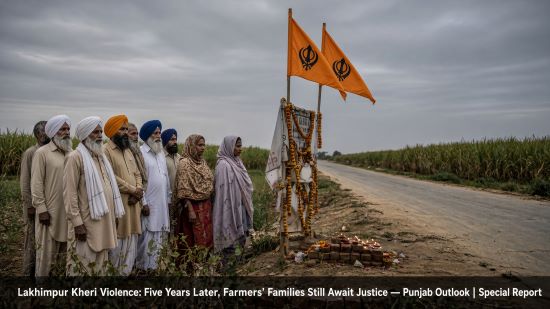
Five years after the tragic violence at Lakhimpur Kheri in Uttar Pradesh, the incident continues to raise difficult questions about accountability, the criminal justice system, and the long wait for justice faced by the families of the deceased farmers. The deaths of four farmers and a journalist during the violence on October 3, 2021, became one of the most controversial episodes of the farmers’ protest against the now-repealed farm laws. The case drew national attention because Ashish Mishra, son of then Union Minister of State for Home Affairs Ajay Mishra Teni, was among those accused in the case.
For the families who lost their loved ones, the passage of five years has not erased the pain or answered their questions. Behind the headlines and political arguments are households whose lives were permanently changed by the deaths of their family members. The demand for justice is not simply a political slogan; it is a demand for accountability, a fair trial, and confidence that the law applies equally, regardless of a person’s political connections or social position.
Timeline: From the October 2021 tragedy to the 2026 trial
October 3, 2021 — The incident
The violence occurred in Tikunia village in Lakhimpur Kheri district on October 3, 2021, during protests linked to the visit of Uttar Pradesh Deputy Chief Minister Keshav Prasad Maurya. A convoy of vehicles allegedly ran over protesting farmers. Four farmers and a journalist died in the incident and subsequent violence, while two BJP workers and a vehicle driver were also killed in the retaliatory violence. The incident led to two criminal cases and a prolonged legal battle.
October 4, 2021 — Criminal cases registered
Police registered a case against Ashish Mishra and other accused in connection with the deaths and violence. A separate case was registered against farmers over the subsequent killings. Investigations, arrests and legal proceedings followed, placing the incident at the centre of a national debate about the farmers’ movement and accountability.
October 2021 — Supreme Court scrutiny
The Supreme Court took suo motu cognisance of the matter and sought a status report from the Uttar Pradesh government on the investigation, the registration of cases and arrests. The intervention brought additional judicial scrutiny to a case that had generated widespread public concern.
February–April 2022 — Initial bail order overturned
The Allahabad High Court initially granted bail to Ashish Mishra in February 2022. The victims’ families challenged the decision, and in April 2022 the Supreme Court set aside the bail order, observing that the victims had not received a fair and effective hearing. The matter was sent back to the High Court for reconsideration.
January 25, 2023 — Interim bail granted
The Supreme Court granted Ashish Mishra interim bail subject to conditions, including restrictions on his presence in Uttar Pradesh and Delhi during the initial period. The bail arrangement was subsequently extended. This became a significant turning point in the case, as the accused was no longer continuously in custody while the trial remained pending.
July 22, 2024 — Bail made absolute, subject to conditions
The Supreme Court made Mishra’s bail absolute while retaining restrictions, including a direction that he stay away from Lakhimpur Kheri while the trial continued, except as permitted for court proceedings. Bail did not amount to acquittal, and the criminal proceedings continued.
May 2026 — Supreme Court questions trial delays
The Supreme Court expressed concern about the slow pace of the trial, noting that no witness had been examined for approximately two months. At the hearing, concerns were also raised by the victims’ side about witnesses not appearing and the need to ensure the proceedings moved forward without unnecessary delay.
August 6, 2026 — Request for relaxation of bail conditions rejected
The Supreme Court rejected Ashish Mishra’s request for further relaxation of his bail conditions, including permission to visit his hometown for family functions. The court found no ground to grant the requested relief at that stage. The decision did not resolve the underlying criminal trial.
September 2026 — Supreme Court orders change of public prosecutor
As the fifth anniversary approached, the Supreme Court directed the Uttar Pradesh government to replace the public prosecutor conducting the case involving the deaths of the farmers. The victims’ side had raised concerns that important eyewitnesses were being given up during the trial. The court also referred allegations concerning the presiding judge to the Allahabad High Court for appropriate consideration. This development renewed questions about the pace and conduct of the proceedings.
October 3, 2026 — Five years later
According to reporting published on the fifth anniversary, 87 of the 103 witnesses in the principal case had testified, including 20 who had turned hostile. All 14 accused in that case were reported to be out on bail, while witness examination remained incomplete. The separate case arising from the retaliatory killings had progressed further, with final arguments expected to begin. These developments illustrate the contrasting progress of the two proceedings.
The central question: When will justice be delivered?
Five years is a long time for families who lost their loved ones in a single day of violence. Every adjournment, every dispute over witnesses and every additional legal proceeding extends the uncertainty for those seeking accountability. Although the right to bail is a legal question distinct from guilt or innocence, the duration of the trial raises legitimate questions about the capacity of the justice system to deliver timely outcomes in cases attracting intense public attention.
The Lakhimpur Kheri case also carries significance beyond the immediate parties. The farmers’ movement brought together people from different regions and backgrounds around concerns over agricultural policy and the future of farming. The deaths at Tikunia deepened tensions between protesters and the authorities, making a transparent and credible judicial process especially important.The families of the deceased deserve a trial in which evidence is properly examined, witnesses are able to testify without intimidation, and every accused receives a fair hearing. Justice must not be determined by political affiliation, public pressure or the social standing of the individuals involved. It must rest on evidence, due process and the law.
The question is no longer simply what happened on October 3, 2021. It is whether the institutions responsible for investigating and adjudicating the case can complete their work in a reasonable time, with public confidence in the outcome.For the families who have spent five years waiting, the demand remains straightforward: a fair trial, accountability established through the evidence, and a final judicial outcome without further unnecessary delay. Justice delayed cannot restore the lives lost, but a credible and timely verdict can help uphold the principle that every citizen deserves equal protection under the law.
Referances:Hindustan Times,Indian express
Editorial note: Ashish Mishra is an accused person who is out on bail; bail does not establish guilt or innocence. The allegations must be determined by the court through the ongoing trial.