
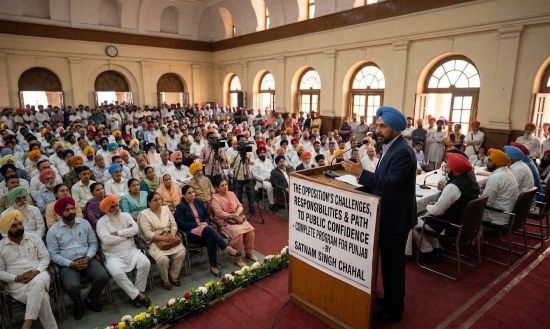
The 2027 Punjab Assembly election will be an important test for the ruling Aam Aadmi Party and every opposition party seeking to present an alternative government. In 2022, AAP won 92 of the state’s 117 Assembly seats, while Congress won 18 and the Shiromani Akali Dal won just three. The BJP secured two seats. These results demonstrated the scale of the political change that took place in Punjab. For the opposition, the challenge is not simply to criticise the government but to establish credibility, demonstrate unity where possible and present a practical programme for the state’s future.
The opposition has several issues it can raise in examining the government’s record. These include the continuing drug problem, gangster-related violence, unemployment, farmers’ concerns, rising public debt, industrial development and delays in fulfilling certain election promises. However, dissatisfaction with the government does not automatically translate into support for an opposition party. Voters also consider the opposition’s own record, its leadership, internal discipline, candidate quality and whether its proposed solutions are realistic. The central challenge is to turn public concerns into a credible and constructive alternative.
Unity and leadership are major challenges
One of the difficulties facing the opposition is that it is divided among several parties and political formations. Congress, the Shiromani Akali Dal, the BJP and newer Panthic groups have different political identities, support bases and policy priorities. Recent reporting on the run-up to the 2027 election has highlighted internal factional disputes and competition among these parties.
Congress, in particular, must demonstrate that its state leadership and senior leaders can work together with discipline. Public disagreements, competing claims to leadership and uncertainty over candidates can weaken the party’s ability to communicate a consistent message. The party needs clear responsibility at the state and district levels, regular coordination and a transparent process for resolving internal disputes. Its leaders should demonstrate through their conduct that the interests of Punjab and the organisation come before individual ambitions.
The Shiromani Akali Dal faces a different challenge. The party once occupied a central position in Punjab politics, but its performance declined sharply in recent Assembly elections. Rebuilding public trust requires more than rallies and a change in publicity strategy. The party needs to address the reasons for its declining support, listen to criticism of its previous government and demonstrate accountability for decisions that damaged its relationship with sections of the Sikh community and the farming population. Its historical connection with Punjab’s regional politics and Sikh institutions may remain relevant, but that legacy alone cannot substitute for public confidence.
The BJP must also address the question of its political acceptance across Punjab. It has its own national political identity and organisational resources, but its relationship with farmers, rural voters and sections of the Sikh community remains important to its prospects. The party needs to explain how its policies would protect Punjab’s agricultural economy, federal interests, industry and social harmony. A political programme designed for Punjab must directly address the state’s particular circumstances rather than rely exclusively on national-level messaging.
Newer Panthic political formations may raise issues involving Sikh identity, religious institutions, civil liberties and Punjab’s constitutional and political interests. Their presence could change the political debate, but fragmentation among parties seeking support from overlapping constituencies may also complicate the contest. Reporting in October 2026 has identified the emergence of Akali Dal (Waris Punjab De) as one factor reshaping the state’s political landscape.
The opposition must present its own programme for Punjab
The opposition cannot build a credible public case by discussing only the failures of the AAP government. It must explain what it would do differently if elected. Punjab needs a clear economic programme that addresses employment, industrial investment, agricultural reform, water conservation, education, healthcare and public finances. Voters should be able to understand what each party proposes, how the policies would be financed and what measurable results it expects to achieve within five years.
The drug crisis should be one of the central subjects of public debate. Opposition parties can demand transparent information about trafficking networks, convictions, rehabilitation services and the availability of drugs. They should ask whether major suppliers and financiers are being prosecuted and whether enforcement is reducing drug availability. However, they must also present their own practical plan for prevention, treatment, rehabilitation and the protection of vulnerable young people. Repeating slogans about making Punjab drug-free will not be enough; the public needs measurable commitments and regular progress reports.
Law and order is another important area of scrutiny. Opposition representatives should raise documented cases of shootings, extortion, gangster activity and threats to citizens, while demanding transparent investigations and accountability. They should also explain how they would strengthen police investigations, improve intelligence coordination, protect witnesses and reduce political interference in policing. Public safety must be treated as a fundamental responsibility of government rather than merely a subject for political speeches.
Employment deserves equally serious attention. Punjab’s young people need opportunities that allow them to build a future in their own state. Opposition parties should propose a comprehensive industrial development plan, including incentives for genuine investment, support for small businesses, vocational training and expansion of sectors capable of generating sustainable employment. They should distinguish between permanent jobs, temporary work and announced investment proposals. A credible programme would establish measurable targets and explain how progress would be reported publicly.
Agriculture must remain central to any opposition programme. Farmers face concerns over income security, crop diversification, groundwater depletion, rising input costs and access to markets. Opposition parties should publish clear proposals on these matters and explain which responsibilities belong to the Punjab government and which require action by the Union government. They should also address rural debt, agricultural research, food processing and alternative crops. Farmers need a long-term strategy that protects their livelihoods without further exhausting the state’s natural resources.
Punjab’s financial condition requires a responsible alternative as well. The opposition should scrutinise borrowing, subsidies, interest payments and public expenditure, but it should also explain how it would manage these obligations if elected. Simply promising more benefits while criticising the government’s debt is not a complete economic policy. Voters deserve to know which programmes would be maintained, where expenditure could be improved, how revenue could be increased and what investments would generate long-term economic returns.
The opposition must also make Punjab’s constitutional and federal interests a priority. Disputes involving river waters, Chandigarh, state powers, agricultural policy and relations with the Union government deserve serious, evidence-based discussion. Parties should explain their positions clearly and demonstrate how they would pursue Punjab’s interests through constitutional, legislative and administrative channels. These questions should not be reduced to slogans or used selectively according to which party is in power at the state or national level.
Congress: The challenge of credibility and internal discipline
Congress has a significant historical presence in Punjab and was the principal opposition party after the 2022 Assembly election. Its challenge is to demonstrate that it can offer a coherent alternative administration. This requires a united state leadership, clear policy commitments, stronger district organisations and a credible explanation of what it learned from its previous tenure. The party must address questions about its own record rather than assume that dissatisfaction with AAP will automatically benefit Congress.
Congress leaders should also demonstrate that internal differences can be resolved without damaging the organisation publicly. A party that expects to govern a state must show that it can coordinate decisions, select candidates through a credible process and maintain discipline. Its public programme should be based on Punjab’s needs, with clear commitments concerning employment, public safety, agriculture, healthcare, education and financial management.
Akali Dal: Rebuilding trust and regional credibility
For the Shiromani Akali Dal, the challenge involves rebuilding its political organisation and reconnecting with sections of the Sikh community, farmers and rural Punjab. The party must openly engage with criticism of its previous period in government, particularly on issues that affected public confidence. It needs to demonstrate that accountability, internal reform and Punjab’s interests are more important than the preservation of individual political positions.
The Akali Dal can place regional rights, agricultural interests, federalism and Sikh institutional concerns at the centre of its programme. But it must provide practical policies and demonstrate that its future decisions would be more transparent and responsive to the public. Its historical role in Punjab politics may provide a foundation, but renewed public confidence depends on its present conduct and future commitments.
BJP: Addressing Punjab-specific concerns
The BJP must explain how its policies would address Punjab’s distinctive political, agricultural and economic concerns. It needs to engage seriously with farmers, rural communities, traders, industrialists and different sections of society. Its programme should address agricultural markets, investment, employment, public safety and relations between the state and Union governments.
Any proposed alliance with the Akali Dal would also require clarity about seat-sharing, leadership, policy commitments and how disagreements would be resolved. Reports in October 2026 have described renewed discussions about a possible BJP–Akali Dal alliance, but the final political arrangements and their public reception should not be assumed in advance.
The importance of a common minimum programme
Opposition parties do not necessarily need to merge or abandon their individual identities to engage in constructive public debate. They can articulate their own positions while identifying areas where they share concerns, such as drugs, employment, agricultural sustainability, government accountability and protection of Punjab’s interests.
If parties consider electoral alliances, they would need to resolve difficult questions concerning leadership, constituencies, candidate selection and policy priorities. Any agreement should be transparent about its objectives and should offer voters a clear explanation of how a future government would function. An alliance based only on opposition to the incumbent, without a coherent programme for governance, would leave important questions unanswered.
The opposition should also avoid personal attacks and unverified allegations. Serious criticism is more credible when supported by government records, audit findings, court orders, official statistics and documented public statements. Where allegations remain unresolved, they should be presented as allegations rather than established facts. This approach would allow the public to distinguish evidence-based scrutiny from political rhetoric.
A more accountable relationship with the public
Opposition parties need to maintain regular contact with residents throughout the state, including between elections. Public meetings, constituency visits, consultations with farmers and business organisations, and discussions with teachers, healthcare workers and young people can help identify problems that may not be reflected in speeches from political headquarters.
They should also publish written reports explaining what they have found, which questions they have raised in the Assembly and what responses they have received. Constituency representatives can make their work more transparent by reporting on local development, public services and unresolved complaints. This would give voters a basis for evaluating both the ruling government and those seeking to replace it.
Conclusion: Punjab needs a credible alternative, not merely criticism
The 2027 Assembly election will take place in a political environment shaped by AAP’s record in government, the opposition parties’ own histories, leadership questions and competing visions for Punjab. Recent reporting describes a fragmented political field in which several parties are seeking to strengthen their organisations and rebuild public support. An October 2026 survey also illustrates that dissatisfaction with individual aspects of governance does not automatically translate into a consolidated opposition vote. Such surveys are snapshots of opinion, not reliable predictions of the final result.
For the opposition, the fundamental challenge is to demonstrate that it can provide effective administration, financial responsibility, public safety, economic opportunities and accountable leadership. Congress must address unity and credibility; the Akali Dal must rebuild public trust; the BJP must explain its Punjab-specific priorities; and other political formations must clarify their policies and role.
Punjab’s future should be the central issue of the political debate. The people deserve clear commitments on drugs, employment, agriculture, industrial growth, education, healthcare, public finances and civil liberties. Every party should explain what it proposes, how it will pay for its commitments and how the public will be able to measure its performance.
The public should judge the government by its record and the opposition by the quality of its alternative. Ultimately, Punjab needs a political culture in which parties compete through policies, evidence, accountability and service to the people—not merely through accusations against their rivals.
Disclaimer: This article and accompanying images are for informational and illustrative purposes only. Some visuals may be AI-generated or digitally enhanced and may not depict actual events or persons. Views expressed are based on publicly available information and analysis