
Republished on the eve of the Punjab Day, 1 November 2026, the sixtieth anniversary of the day the Punjab Reorganisation Act, 1966 took effect. First published in The KBS Chronicle on 19 June 2026; revised, and enlarged with a section on the Indus Waters Treaty.
The Dismemberment of the Punjab
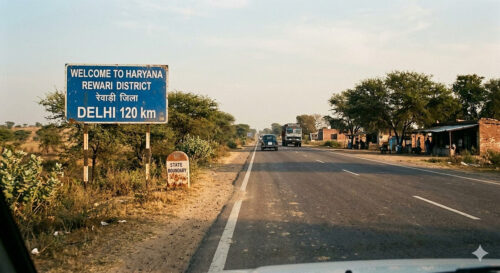
Somewhere on the Jaipur–Delhi highway, in the earlier years of this millennium, I passed a signboard.
Welcome to Haryana. Rewari District. Delhi: 120 km. It was an ordinary piece of road furniture. It stopped me cold.
Rewari. One hundred and twenty kilometres from Delhi. And once — within living memory, within the lifetime of men still among us — this was Punjab.
That signboard has stayed with me as no political treatise has. It does what maps and statistics cannot: it puts the body back into the landscape and forces the question that Punjab has spent exactly sixty years avoiding. How did we get here? Who brought us here? And are we ever going to say so?
There is a conversation that Punjab has never had honestly with itself. It concerns not those outside who diminished this State — Delhi’s bureaucrats, Haryana’s litigants, Rajasthan’s lobbyists — but the choices made within Punjab that handed them the knife.
The Punjab Reorganisation Act, 1966 is routinely described, even by its critics, as something that happened to Punjab. The framing is comfortable, and it is only half true. What took effect on the first of November, 1966 — the most consequential trifurcation of a State in independent India’s history — was not merely a conspiracy visited upon a helpless people. It was also the logical conclusion of a political agitation mounted by Punjabis, led by Punjabis, for Punjabis — or so they claimed. The Punjabi Suba Morcha secured what it demanded. The State it produced was Punjab’s reward. And Punjab has been paying the price ever since.
Historians have avoided the question, and politicians have buried it: who were the guilty men? Sixty years on, it deserves a direct answer.
What Undivided Punjab Was
Before November 1966, Punjab was not merely a larger State on the map. It was a different category of political entity altogether. It sent twenty-two members to the Lok Sabha — against thirteen today — and that parliamentary weight was not decorative. It was leverage. Punjab’s voice in national economic decisions, in river water allocations, in industrial policy, in the disposition of Chandigarh, carried a heft that the Little Punjab of today can scarcely imagine. The State’s per-capita income ranked it first among the major Indian States. The headworks and canal heads of the Sutlej, the Beas and the Ravi lay within its territory, and with them the command of its own irrigation destiny. Chandigarh was its capital without equivocation. Milestones were written in Punjabi and English. Till Class V, every child learnt Punjabi.
The industrial corridor flanking Delhi to the north — barren land on which factories could have been built at minimal cost — fell to what became Haryana. The Hindi-speaking plains that contributed to Punjab’s revenue base and its political mass were excised. The hill districts that went to Himachal Pradesh — Kangra, Kullu, Shimla, Lahaul and Spiti — took with them the upper reaches of the Beas and a stake, today, in the Yamuna basin and the Kishau Dam.
In exchange, Punjab received the Punjabi Suba.
The Architects and Their Argument
The Shiromani Akali Dal under Master Tara Singh and then Sant Fateh Singh made linguistic identity the fulcrum of the demand. The argument was, on its surface, not unreasonable: Punjabi-speaking people deserved a State where Punjabi was the official language. The Sikhs had a legitimate grievance that the States Reorganisation Commission had refused them, in 1955–56, what had been given to nearly every other major linguistic group in India.
But the manner in which the demand was prosecuted, and the terms on which it was finally conceded, carried the seeds of Punjab’s present subordination.
First, by insisting on a purely linguistic basis for reorganisation, the Akali leadership handed Haryana exactly the instrument it needed. The Census of 1961 — in which a large part of the urban Hindu population of undivided Punjab returned Hindi as its mother tongue, a deliberate political act — was the direct consequence of an environment that made language the price of territorial inclusion. The demand, in other words, incentivised the very demographic arithmetic that shrank the Punjabi-speaking area.
Second, the Morcha made no serious effort to settle the terms of separation. Water rights, industrial assets, the status of Chandigarh, the exact line of the boundary — all were left to the Union Government, to commissions, to tribunals and courts. The Centre did not hesitate to fill the space. The Punjab Boundary Commission under Justice J.C. Shah recommended that Kharar tehsil, Chandigarh included, go to Haryana; New Delhi instead made Chandigarh a Union Territory, and it has remained one. The same Act then gave the Union control of the Bhakra and Beas works, through the Bhakra Management Board — today’s BBMB. Punjab has been contesting those provisions for decades. It has not won.
Third, and most telling: as one Akali leader of that era is remembered to have said — Sannu bhawen Gurdaspur Zilla teh Ambarsar Zilla mile, sannu Punjabi Suba chahi da veh — give us even just Gurdaspur and Amritsar, so long as we get our Punjabi Suba. The territorial claims that would have protected Punjab’s resource base were set aside for the symbolism of a linguistic homeland. No river, no industrial corridor, no parliamentary seat was thought worth contesting if the Punjabi Suba banner could be raised.
The Inheritance
Haryana was still searching for a name for itself when the reorganisation was signed. It had mounted no morcha of its own. Its leaders had stated that they did not speak Punjabi — a claim of debatable accuracy — and waited. They received, without a sacrifice to match the Akalis’: a State, a share of the river waters, the industrial land flanking Delhi, and a claim on Chandigarh that persists to this day.
Himachal Pradesh accepted its portion without contest. It sits today in the Yamuna basin as a party to the Kishau Dam consortium. Punjab is not even in the room.
Punjab’s per-capita income, once first among the major States, has slid well down the table. Its river water cases are pending. Its capital remains shared. Its parliamentary delegation has fallen from twenty-two to thirteen. The drug crisis, the agrarian distress, the fiscal strain — these are downstream consequences of a political diminishment that began in 1966 and has never been reversed.
Terms Before Tunnels: The Chenab and a Second Chance
History rarely offers a State a second chance at the same mistake. Punjab now has one.
The Indus Waters Treaty, signed by Pandit Nehru and Field Marshal Ayub Khan on 19 September 1960, six years before the trifurcation, gave India the three eastern rivers — the Sutlej, the Beas and the Ravi — and left the three western rivers, the Indus, the Jhelum and the Chenab, to Pakistan, save for limited Indian uses. The Punjab of 1966 thus inherited a share of the eastern rivers only, and then, under the very Act that created it, lost the management of even those to the Centre.
On 23 April 2025, in the wake of Pahalgam, the Union Government placed the Treaty in abeyance. On 31 August 2026 the Court of Arbitration at The Hague held that the abeyance had no legal effect; India has declined the tribunal’s jurisdiction, and the abeyance stands. More to the point, it is acquiring concrete. The Chenab–Beas Link Tunnel — some 8.7 kilometres under the Himalayan watershed at Koksar, tendered by NHPC in May 2026 at about ₹2,352 crore — will carry Chandra water, the upper Chenab, into the Beas system. A western river feeding an eastern one. (Nothing new under the sun, incidentally: the Treaty itself financed the link canals by which Pakistan carried Chenab water into its Ravi and Sutlej commands.)
Who, then, has the first claim on the western waters that India chooses to use? The answer must begin with the riparians: the Union Territories of Jammu and Kashmir and of Ladakh, through which the Indus, the Jhelum and the Chenab flow, and Himachal Pradesh, in whose Lahaul valley the Chandra and the Bhaga rise. Their drinking water, their irrigation, their hydropower come first. That is not generosity. It is the riparian principle — the same principle Punjab has invoked for sixty years against claims on the Ravi and the Beas, and which it cannot honestly invoke on one river and disown on another.
Thereafter, Punjab. Partly on merit — its depleted aquifers, its share of the national granary, the Ravi waters that still slip across the border for want of works. Partly on logic — for the moment Chenab water enters the Beas, it becomes Beas water, and Punjab is the riparian of the Beas. As I have argued elsewhere, and have suggested to the Government of India, the abeyance should be converted into an Act of Parliament abrogating the Treaty in respect of the western rivers — the internal act of a sovereign republic over waters that rise and flow within its own territory — together with a statutory Western Rivers Development Authority to plan, fund and allocate their use, on the model of the BBMB. A draft of such a Bill has been placed before the Union Government and before the readers of this Chronicle.
Here lies the lesson of 1966. The Morcha won its banner and left the water to be settled later; later, the Centre settled it. If Chenab water reaches the Beas with its allocation left to some future tribunal, the old queue will form again at Bhakra and at Harike, and Punjab will once more be a litigant in a dispute over water that passes through its own canals. Haryana and Rajasthan are entitled to a hearing, and nothing here denies them one. But the riparian claims, Punjab’s among them, must be written into law before the tunnel is bored through — not argued over after the concrete has set.
The Verdict
I served this State in its civil administration for thirty-seven years, including a tenure as Principal Secretary, Irrigation. I say plainly: the leadership of the Punjabi Suba Morcha bears a moral and political responsibility for the terms on which undivided Punjab was dismembered — a grave failure of stewardship of a people’s interests. This is not said in anger. It is a verdict rendered by sixty years of consequences.
The guilty men were not villains. Many were sincere. Some were brave. But sincerity and bravery in the service of a strategically ruinous bargain do not constitute leadership. They constitute a catastrophe dressed in the language of sacrifice.
Punjab deserves the honest reckoning it has never had — and, on its sixtieth birthday, the chance not to repeat the error. The bill, presented over six decades in lost water, lost seats, lost factories and lost standing, remains unpaid. The Chenab offers a first instalment, if Punjab insists on the terms this time.
The Rewari signboard still stands. One hundred and twenty kilometres from Delhi. Welcome to Haryana.