
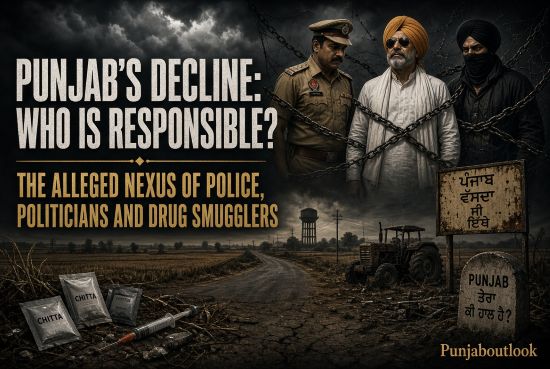
 Punjab is facing a serious question that goes beyond the failure of any one government: who is responsible for the continuing drug crisis, the alleged criminalisation of parts of society, corruption within the enforcement system and the growing loss of public confidence in institutions? A disturbing poster circulating on social media raises three major questions: Is there an understanding between politicians, sections of the police and drug traffickers? Why do allegations of police involvement in the drug trade repeatedly surface? And why have successive governments failed to establish lasting accountability?
The history of Punjab’s drug crisis contains several major cases involving serving and former police officials, allegations of political protection, official audit findings and lengthy investigations. These developments deserve serious examination. However, allegations, FIRs, chargesheets, court findings and convictions must be treated separately. Every accused person cannot automatically be declared guilty.
2011–2012: Early warnings about the drug problem
Former Punjab DGP (Prisons) Shashi Kant publicly raised concerns about the availability of drugs and alleged political patronage of the drug trade, including inside Punjab’s prisons. His disclosures brought the issue into public debate and raised questions about the functioning of the police and prison administration. He also claimed that he had prepared a list of allegedly corrupt officers in 2007 and submitted it to the then government. The controversy surrounding this alleged list continued for years, with questions being raised about why its contents and the action taken were never made fully transparent.
March 2013: The Jagdish Singh Bhola drug racket
The arrest of former wrestler and Punjab Police DSP Jagdish Singh Bhola in March 2013 became a major turning point in Punjab’s drug controversy. The investigation exposed the involvement of a serving police officer in a major synthetic drug trafficking network. The racket was initially reported to involve approximately ₹700 crore, while subsequent investigations and public discussions referred to much larger amounts. The case raised a fundamental question: if an officer entrusted with enforcing the law could become involved in an alleged drug trafficking network, how extensive could the problem be? Bhola was convicted in 2019.
2015: The Inderjit Singh controversy
Another major controversy emerged involving Inspector Inderjit Singh of the Punjab Police. Investigations brought serious allegations against him, including links with drug traffickers, manipulation of NDPS cases, extortion and misuse of police authority. There were also allegations that innocent people had been implicated and evidence manipulated. The case raised serious questions about internal police accountability and the possibility of criminal elements operating with the assistance of people inside the enforcement system.
June 2017: Questions about police involvement
The registration of a case against Inspector Inderjit Singh involving allegations of drug possession and trafficking, illegal weapons, extortion and manipulation of official records once again brought the alleged police–smuggler connection into the spotlight. Reports also indicated that dozens of drug-related cases had been registered against Punjab Police personnel during the preceding years. These developments raised an uncomfortable question: who investigates those entrusted with investigating drug traffickers when allegations emerge against police officials themselves?
March 2018: CAG findings expose weaknesses in investigations
A Comptroller and Auditor General report presented in the Punjab Vidhan Sabha highlighted serious deficiencies in the handling of NDPS cases. According to reported audit findings, 532 out of 756 accused acquitted during 2016–17 were acquitted because of deficiencies involving police testimonies. The report also highlighted delays ranging from 23 to 476 days in sending seized drug samples to laboratories. Such findings raised serious concerns about investigation quality, evidence handling and the ability of the prosecution system to secure convictions against drug traffickers.
2019: Conviction in the Bhola drug case
The conviction of Jagdish Singh Bhola demonstrated that major drug trafficking cases could result in judicial consequences. However, one conviction could not resolve Punjab’s wider drug problem. The state continued to face questions about the networks operating behind drug distribution, financial support, political influence and the effectiveness of enforcement agencies.
December 2021: Bikram Singh Majithia booked under the NDPS Act
A case was registered against senior Shiromani Akali Dal leader Bikram Singh Majithia under the NDPS Act in December 2021. The allegations concerned facilitating drug traffickers and involvement in drug-related financial and distribution networks. The case became a major political controversy in Punjab. It also demonstrated how the drug issue had become closely connected with political battles between the state’s major parties. The allegations and legal proceedings must be distinguished from a final judicial finding of guilt.
March 2023: High Court opens sealed reports
The Punjab and Haryana High Court opened three sealed reports concerning alleged police involvement in drug trafficking. The reports brought renewed attention to the role of certain police officers, including former Tarn Taran SSP Raj Jit Singh and Inspector Inderjit Singh. The development was significant because it brought questions about the alleged involvement of police officials into the judicial spotlight.
April 2023: Action against former SSP Raj Jit Singh
The Punjab Government directed the DGP to examine the role of police officers who might have directly or indirectly assisted drug trafficking. Former Tarn Taran SSP Raj Jit Singh was subsequently booked in connection with allegations involving criminal conspiracy, protection of dismissed Inspector Inderjit Singh and extortion. These allegations required investigation and judicial determination. The development once again raised questions about whether the problem was restricted to individual officers or reflected deeper weaknesses in institutional accountability.
2024: The controversy surrounding the alleged list of corrupt officers
The issue of Shashi Kant’s alleged list of corrupt police officers again attracted public attention. His earlier claims about submitting a list to the government in 2007 raised questions about whether the authorities had investigated the information properly. Punjab needs transparency on such matters because allegations involving senior officials cannot be allowed to disappear into administrative files without clear explanations.
2025: Majithia investigation takes another turn
The filing of a reported 40,000-page chargesheet in the Bikram Singh Majithia case in August 2025 marked another important development. The investigation also included Canada-based alleged drug trafficker Satpreet Singh Thiara, known as Satta. The case brought the drug controversy back into political focus, particularly because of its connections with earlier investigations. However, filing a chargesheet is not the same as establishing guilt, which remains a matter for the courts.
2026: The ₹19,900 Punjab Police constable salary controversy
Another issue highlighted in the circulating poster concerns the salary of newly recruited Punjab Police constables. The 2026 recruitment notification provides for a minimum monthly pay of ₹19,900 during the first three years of service. The figure needs to be understood correctly as monthly starting pay, not an annual increment. The question of pay and service conditions deserves serious consideration because police personnel are expected to confront organised crime, drug trafficking, gangsters and dangerous criminal networks. The government must ensure that honest police personnel receive fair compensation, proper facilities, professional training and protection from political interference.
The wider controversy over police pay also involves legal questions concerning previously admissible benefits for earlier recruitment batches. The Punjab and Haryana High Court’s July 2026 proceedings concerning amended pay rules brought this issue into further focus.The real question: Is there an alleged nexus between politicians, police officials and drug traffickers?
Punjab cannot afford to ignore the repeated appearance of police officials in major drug investigations. The Bhola case, the Inderjit Singh investigation and the subsequent proceedings involving other officials demonstrate why credible allegations of police involvement require independent scrutiny. However, it would be wrong to accuse the entire Punjab Police. Thousands of honest officers work under difficult conditions and deserve respect. The investigation must identify those individuals who may have misused their authority and ensure that they face the law if their guilt is established.
Political accountability is equally important. Governments have changed, chief ministers have changed and police leadership has changed, but the drug problem continues to trouble Punjab. Every political party promises to eliminate drugs when seeking public support. Yet the people want measurable results, transparent investigations and accountability for anyone found protecting traffickers. No political party should be allowed to use the drug crisis merely as an election slogan while avoiding scrutiny of its own period in power.
Another important question concerns the financial networks behind drug trafficking. Arresting small-time sellers and drug users cannot be the only measure of success. Investigations must reach the major suppliers, financial networks, properties, cross-border connections and those who organise and finance the trade. Punjab needs an enforcement strategy that targets the entire criminal network rather than concentrating only on the weakest links.
The state also needs an independent investigation into credible allegations of police–drug trafficker connections, public disclosure of the status of important investigations wherever legally permissible, stronger protection for honest officers, proper service conditions for police personnel and a comprehensive rehabilitation programme for drug-dependent individuals. Regular public reports should explain the number of arrests, convictions, acquittals, pending cases and financial recoveries. Publicity campaigns and announcements cannot replace actual results.
The most disturbing aspect of Punjab’s drug crisis is not simply the availability of drugs. It is the repeated appearance of allegations involving people and institutions that are supposed to protect society. When a police officer is accused of protecting a trafficker, the credibility of the entire enforcement system comes under scrutiny. When political leaders are accused of providing protection to criminal networks, public confidence in political institutions suffers. When investigations continue for years without clear answers, ordinary citizens begin losing faith in the system.
Punjab’s youth cannot be sacrificed to the drug trade, and the future of the state cannot be left at the mercy of criminals and corrupt elements. The people deserve to know why successive governments have failed to dismantle the major drug networks and whether anyone in a position of authority has helped those networks survive.
The most important question remains: If the police are responsible for catching criminals, who will investigate those within the system who are accused of protecting them?
Punjab must be saved through truth, justice, independent investigations and accountability—not through political slogans, blame games or government-funded publicity campaigns. The future of Punjab’s younger generation depends on whether the authorities are prepared to confront the problem honestly and take action against everyone found guilty, regardless of political connections or official position.Punjab needs a drug-free future, an accountable police system and political leadership that puts the interests of its people above everything else.
Disclaimer: This article and accompanying images are for informational and illustrative purposes only. Some visuals may be AI-generated or digitally enhanced and may not depict actual events or persons.Views expressed are based on publicly available information and analysis