
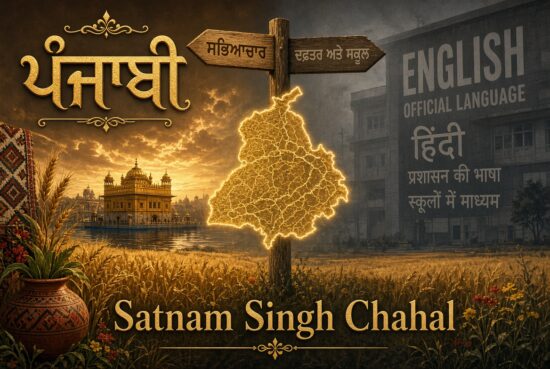
By Satnam Singh Chahal | Special Analysis-Punjabi is not merely a language of everyday communication. It represents the identity, history, culture, heritage and collective pride of Punjab and its people. Through the teachings of the Sikh Gurus, the writings of Sufi saints, poets, scholars and literary figures, Punjabi has earned recognition across the world. Yet an uncomfortable question confronts Punjab today: Why must the people of a state created around a distinct Punjabi identity repeatedly struggle to secure the rightful place of their own mother tongue?
The Punjab Government has not officially eliminated Punjabi from the Punjab Civil Services (PCS) examination. The requirement of having passed Punjabi at the Class 10 level continues under the applicable state rules. However, allegations surrounding the reduced representation of Punjabi language and Punjab-related subjects in the 2025 PCS examination have triggered a fresh debate.
Following the examination held in December 2025, objections were raised by organisations, including Misl Satluj, alleging that Punjabi-language questions in the CSAT paper had declined compared with earlier examinations. Concerns were also expressed about the representation of Punjab’s history, geography, economy and cultural heritage. In January 2026, protests were reportedly held outside the Punjab Public Service Commission office in Patiala. These allegations deserve a transparent response from the government and the PPSC. They should be examined on the basis of the actual examination papers, official syllabus and applicable recruitment rules.
The issue is not whether candidates from other states should be allowed to compete for government jobs in Punjab. Every eligible Indian citizen has the right to participate in competitive recruitment under the law. The real question is whether officers appointed to serve the people of Punjab should have an adequate understanding of its language, history, culture and social conditions. How can an administrator effectively understand the problems of farmers, labourers, elderly citizens and ordinary villagers if the language spoken by the people remains outside their practical understanding?
Other States Offer Important Lessons
A look at other Indian states provides important examples of how regional languages are connected with cultural identity and public life.
In Tamil Nadu, Tamil occupies a central position in education, administration, literature and cultural expression. In Karnataka, Kannada organisations and institutions actively promote the use and recognition of Kannada. Maharashtra has consistently emphasised the importance of Marathi in public life and administration. In West Bengal, Bengali literature, language and cultural traditions remain an important part of the state’s identity.
These examples do not suggest that one language should replace another. Rather, they demonstrate that respecting one’s mother tongue does not mean opposing other languages. A society can embrace English, Hindi and international languages while simultaneously protecting and promoting its own linguistic heritage.
Another important example is the controversy surrounding Punjabi as a compulsory subject in CBSE-affiliated schools in Punjab. In February 2025, concerns emerged over the proposed changes in the treatment of Punjabi as a compulsory subject for Class 10 students. The Punjab Government subsequently reiterated that Punjabi must remain compulsory in accordance with the Punjab Learning of Punjabi and Other Languages Act, 2008.
The government made it clear that students studying in schools affiliated with different education boards in Punjab must pass Punjabi at the prescribed level. This raises an obvious question: If Punjabi is compulsory at the school level, why should its appropriate importance in higher administrative examinations become a matter of controversy?
Punjab already has the Punjab Official Language Act, 1967, along with subsequent amendments and provisions intended to promote Punjabi in government offices and public institutions. In October 2022, the government also prescribed a minimum qualifying requirement of 50 per cent marks in the Class 10-level Punjabi language examination for Group C recruitment.
These provisions demonstrate that Punjabi has an established legal and administrative status. However, legislation alone cannot guarantee the practical use and respect of a language.
Declaring Punjabi an official language on paper is not enough. It must be used meaningfully in government departments, public-sector institutions, educational establishments and administrative proceedings.
The Punjab Government and PPSC should ensure transparency regarding the PCS examination syllabus, question papers and the representation of Punjabi-related subjects. Punjabi language, Punjab’s history, geography, economy, culture and social structure should receive appropriate attention in accordance with the objectives of the examination.
Candidates educated through the Punjabi medium must not face discrimination. Recruitment examinations should provide equal opportunities to students from rural backgrounds, government schools and economically weaker sections.
The government must also ensure that ordinary citizens can communicate with public offices and obtain services in Punjabi without unnecessary difficulties. Even today, many people face practical problems when government applications, documents and administrative procedures are available primarily in English.
When citizens cannot comfortably communicate with their own government in their mother tongue, the official-language status of Punjabi risks becoming little more than a formality.
It is equally important to understand that promoting Punjabi does not mean opposing Hindi, English or any other language.
Punjabi students should learn English to expand their employment and international opportunities. Hindi can facilitate communication with people in other parts of the country, while foreign languages can open doors to education, business and global opportunities.
However, progress should never require people to abandon their mother tongue.
Punjabi must not remain restricted to conversations at home, cultural festivals, songs and religious gatherings. It should become a strong language of education, administration, courts, science, technology, commerce and employment.
Universities, particularly Punjabi University, Patiala, the Punjab Language Department and other educational institutions, must receive the necessary support to develop Punjabi terminology, digital resources, modern educational material and professional literature.
The younger generation should be encouraged to write, read, research and conduct professional activities in Punjabi. The language must be made relevant to modern careers and technological developments rather than being treated merely as a subject associated with tradition.
The responsibility for protecting Punjabi cannot be placed on one government, one political party or one organisation. Successive governments have made promises about promoting the language, but the real test is how much Punjabi is actually used in administration, education and public services.
Political leaders who proudly deliver speeches in Punjabi must also demonstrate their commitment through government policies and institutional decisions. Punjabi should not become an issue that receives attention only during elections, cultural programmes or public celebrations.
The people of Punjab, writers, journalists, teachers, universities, social organisations and the Punjabi diaspora must collectively raise their voices for the language.
The ultimate question is directed at the Punjab Government, political parties and intellectual community: If Punjabi cannot receive its rightful position in Punjab itself, on what moral basis can we expect to promote and protect it internationally?
Punjabi does not belong to any particular government, political party or institution. It is the shared heritage of millions of people across Punjab and the global Punjabi diaspora.
Governments will change, political leaders will come and go, but Punjabi must continue to flourish for generations.
The objective should not merely be to save Punjabi from decline. The real mission must be to make Punjabi a confident, modern and respected language of education, administration, professional life and future generations.
Editorial clarification: This article does not claim that Punjabi has been officially removed from the PCS examination. It distinguishes the existing Class 10 Punjabi qualification requirement from the separate allegations about the representation of Punjabi and Punjab-related subjects in the examination