
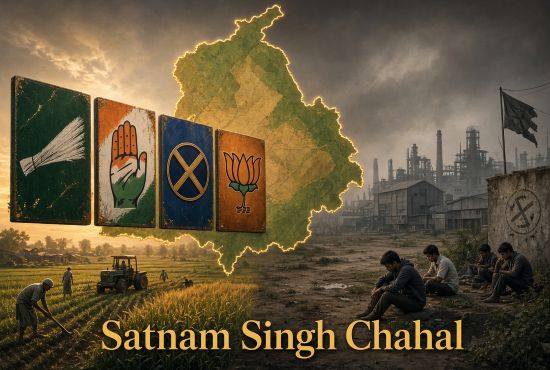
 Punjab’s political landscape is becoming increasingly active as political parties prepare for the next Assembly elections. The Aam Aadmi Party (AAP) is highlighting its organisational activities, government initiatives and public outreach, while the Congress is attempting to strengthen its position as the principal opposition party. However, the political situation cannot be understood simply by accepting the claims made by any individual party or its supporters. Ground-level political activity, public response, organisational strength and the ability to address Punjab’s pressing problems must all be considered.
The Aam Aadmi Party certainly deserves credit for maintaining a visible political presence across Punjab. Its rallies, public meetings, constituency-level programmes and government initiatives have kept it in the political spotlight. Its performance in the May 2026 municipal elections, when it secured 958 of 1,977 wards, also demonstrated its organisational reach in urban and semi-urban areas. These achievements should be acknowledged rather than dismissed merely because the party is in government. At the same time, political visibility and election results should not be confused with the complete assessment of governance. Public expectations concerning employment, drugs, agriculture, industry, law and order and the state’s financial position remain important tests.
The Congress also deserves recognition for retaining a substantial political presence in Punjab. It remains an established political organisation with experienced leaders, elected representatives and a significant support base. Its performance in the 2024 Lok Sabha elections, when it won seven of Punjab’s thirteen parliamentary constituencies, demonstrated that it continued to command considerable electoral support. Its second-place finish in the 2026 municipal elections also confirms that it cannot be treated as an irrelevant opposition force.
However, the Congress must undertake an honest examination of its own weaknesses. Its biggest organisational challenge has been the inability of senior leaders to consistently demonstrate collective leadership. Public disagreements, competing leadership ambitions and factional differences have repeatedly overshadowed issues that should have been at the centre of its political campaign. The differences involving Raja Warring, Charanjit Singh Channi and other senior leaders have raised questions about whether the party can function as one united political organisation.
Another weakness is the absence of a sufficiently sustained grassroots campaign. Political parties cannot build public confidence merely through press conferences, occasional protests, statements on social media or rallies organised around individual leaders. Congress needs a continuous presence in villages, towns and urban neighbourhoods. Its leaders must regularly meet farmers, labourers, traders, unemployed youth, women and other sections of society and listen to their concerns.
The Congress also needs to explain what it would do differently if given the responsibility of governing Punjab. Criticism of the AAP government is not enough. People need specific answers about employment generation, agricultural reforms, drug prevention, industrial investment, public debt, education, healthcare and law and order. A credible alternative requires a detailed policy programme, not simply a collection of political slogans.
The party must also stop allowing the question of who will become the Chief Minister to overshadow the question of how Punjab will be governed. Leadership ambitions are natural in politics, but they should not become a source of organisational instability. The Congress high command and state leadership need to establish clear responsibilities, encourage collective decision-making and ensure that constituency-level workers are not neglected.
At the same time, AAP should not interpret its political visibility or municipal victories as a permanent endorsement of every government decision. Being in power brings greater responsibility and greater public scrutiny. The ruling party must answer questions about its promises, implementation, administrative accountability and the concerns raised by its own elected representatives.
Punjab needs political competition based on performance, transparency and constructive debate. AAP deserves credit for its organisational activities and initiatives, while Congress deserves recognition for its continuing political presence and opposition role. Neither party should be given a free pass. Both must be judged on what they deliver, what they promise and how honestly they respond to the people.
The real question is not which party has the loudest political campaign or the most impressive social media presentation. It is whether political organisations are listening to ordinary Punjabis and presenting credible solutions to the problems affecting their lives. Punjab needs accountability from the ruling party and responsibility from the opposition. Political claims must ultimately be tested against ground realities.
Congress’s organisational weaknesses a major part of the analysis. This gives the article a constructive purpose rather than making it look like an AAP-versus-Congress political argument. The municipal figures and historical election results provide useful evidence, while the assessment of leadership and grassroots activity should be presented as political analysis rather than established fact.
One particularly useful next step would be to incorporate your own constituency-level observations, so the final article distinguishes what you personally observed from what published reports establish.