
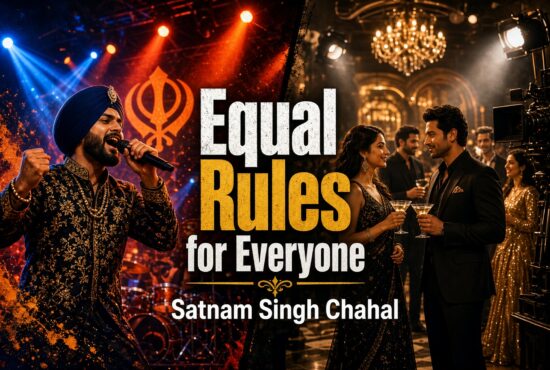
By Satnam Singh Chahal | Punjab Outlook — Entertainment & Social Analysis-The restrictions imposed on Punjabi superstar Diljit Dosanjh during his Indore concert have raised an important question about fairness, consistency and freedom of artistic expression in India’s entertainment industry. The issue is not whether songs referring to alcohol, drugs, weapons or violence should be examined. Protecting children from inappropriate content is a legitimate concern. However, the bigger question is why Diljit Dosanjh’s songs have become such a prominent target of restrictions when hundreds of other singers across India, including Bollywood performers, have also sung songs containing similar themes. Are alcohol, intoxication, weapons and aggressive behaviour not regularly featured in Hindi film songs? Do those songs not reach millions of young listeners?
During the Indore concert, authorities directed Diljit not to perform four songs, including ‘Patiala Peg’, ‘5 Taara’, ‘Case’ and ‘Jatt Uthe Fire Karda’. The restrictions referred to a July 22, 2019, Punjab and Haryana High Court order concerning songs that allegedly glorify alcohol, drugs and violence. Diljit acknowledged the restrictions on stage, saying, “Ye nahi gaana, vo nahi gaana.” He subsequently recited the famous couplet by Rahat Indori: “Sabhi ka khoon shamil hai iss mitti mein, kisi ke baap ka Hindustan thodi hai.” The audience responded enthusiastically, and the incident quickly became a subject of public discussion.
An important question deserves an answer: how many singers in India have actually been banned or prohibited from performing songs because of references to alcohol, drugs and weapons? As of November 17, 2026, there is no publicly available comprehensive national government record establishing the total number. Therefore, it would be inaccurate to claim that a particular number of singers have been banned. However, several reported cases involving Punjabi singers demonstrate that complaints and restrictions concerning such songs are not entirely new.
Diljit Dosanjh, Karan Aujla and Harjit Harman are among the Punjabi singers whose songs have faced complaints, notices or administrative scrutiny at different times. In February 2020, Chandigarh Police reportedly advised Karan Aujla against performing songs associated with drugs, weapons and violence. Harjit Harman’s song ‘Sharab’ also attracted a complaint before the Punjab State Commission for Women in 2021. These incidents should not, however, be described as complete bans on the singers themselves. There is an important distinction between a complaint against a song, an advisory, a restriction on a particular performance and a formal prohibition against an artist.
Now consider Bollywood. Songs such as ‘Chaar Botal Vodka’, ‘Daaru Desi’, ‘Party All Night’, ‘Hookah Bar’ and ‘Nashe Si Chadh Gayi’ have enjoyed enormous popularity. Many other Hindi and regional-language songs have also featured alcohol, intoxication, weapons and aggressive behaviour. These songs have been produced, promoted and distributed through major film production companies, music labels and entertainment platforms, reaching audiences across India and internationally. If such lyrics are considered harmful to children, then singers, lyricists, composers, film producers and music companies should also be examined under the same standards. Why should Punjabi music face particularly intense scrutiny while similar themes in mainstream Bollywood productions do not attract comparable public attention?
Nobody is suggesting that popular singers should be exempt from reasonable regulations. Child protection is a serious social responsibility, and artists and event organisers must recognise their obligations. Concert organisers can establish appropriate age restrictions, provide clear information to parents and ensure that performances intended for mixed-age audiences follow suitable guidelines. However, authorities must also distinguish between mentioning something in a song and actively encouraging people to engage in that behaviour. Lyrics should be assessed in their context, presentation and intended audience rather than automatically treating every reference as an endorsement.
Diljit Dosanjh has established himself as an international representative of Punjabi music, taking Punjabi culture to audiences across the world. His success is also an example of the growing international recognition of Punjabi entertainment. The Indore incident has therefore become bigger than four songs or one concert. It has raised questions about artistic freedom, administrative consistency and equal treatment of performers.
The government and concerned authorities should make their position clear. How many singers have received notices over songs involving alcohol, drugs and weapons? How many concerts have faced restrictions? How many cases have resulted in actual legal action? Is there a national record of such complaints and decisions? Are the same rules being applied to Punjabi, Hindi, Bengali, Haryanvi and other regional-language performers? These questions deserve transparent answers.
The central issue is not whether Diljit Dosanjh should be allowed to perform every song without scrutiny. The issue is whether the same standards are applied to every artist. If authorities believe that songs promoting alcohol, drugs and violence are harmful, they should establish clear and consistent regulations for the entire Indian entertainment industry. Bollywood, Punjabi music and regional entertainment must all be treated equally. Child protection should not become a selective exercise, and one singer should not become the centre of a controversy while similar content elsewhere escapes comparable scrutiny.
The law should have one standard, not different standards for different singers or languages. If there is an objection to such songs, let the same rules apply to everyone.
Punjab Outlook — Independent Journalism. Public Interest. Punjabi Perspective.