
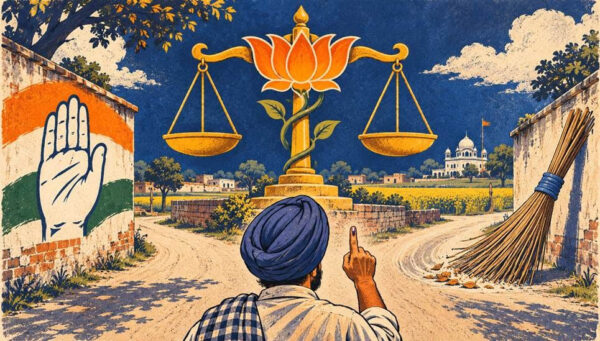
 The Shiromani Akali Dal and the BJP are discussing how to share Punjab’s 117 Assembly seats. PTI reported on 14 November that sources in both parties expected an announcement this month. I regard the reunion as close. The leaders can decide which party gets Amritsar West or a seat in Bathinda. They cannot decide how many Akali voters will back a BJP nominee, or how many BJP voters will return the favour.
Punjab has voted twice since the partners split. I applied the same test to both elections. If three out of four voters of the smaller partner in each constituency had backed the stronger one, the pair would have finished first in 11 seats on the 2022 Assembly vote and 52 segments on the 2024 Lok Sabha vote. Why such a difference? The starting positions changed substantially in those two years.
The votes each party brings to the alliance
¹ The 2024 percentages use all 1,34,76,124 EVM votes across the 117 segments, including votes for other candidates and NOTA. Postal ballots are counted at parliamentary constituency level. The 2022 totals include postal ballots. ² Amritpal Singh and Sarabjeet Singh Khalsa contested as independents. Akali Dal (Waris Punjab De) was formed in January 2025.
In 2022, AAP won 92 seats on 42.01% of the vote. SAD and BJP together polled 24.98% and won five. In 2024, their combined share of segment EVM votes reached 31.98%. BJP led in 23 segments and SAD in nine. In Ludhiana alone, BJP led in five of nine Assembly segments even as Congress won the parliamentary seat. The alliance now has more constituencies where a modest transfer could decide first place.
In my assessment, farm-belt anger against the BJP was at its highest during these two election cycles. The 2022 poll followed the farm-law agitation. In 2024, BJP candidates faced black flags and village boycott calls in parts of Malwa and Majha. That history matters in both directions: an Akali endorsement may make BJP more acceptable to some voters, while others may stay away when their own party gives up the ticket.
Party vote shares in three Punjab surveys (%)
The same transfer test in two elections
In Sujanpur in 2022, Congress polled 46,916 votes, BJP 42,280 and SAD 7,999. A transfer of 4,637 Akali votes, about 58%, would have put BJP ahead. In Amritsar West in 2024, the threshold was lower: Congress led BJP by 4,075 and SAD polled 11,451. Just under 36% of the Akali vote would have reversed the lead. The transfer can work the other way, too. In Maur in 2024, SAD trailed AAP by 252 votes. Just 253 of BJP’s 8,278 votes would have put the Akali candidate first.
How many constituencies would the alliance have led?
In each constituency I kept the stronger partner’s votes and added the stated fraction of the smaller partner’s count. Rival totals stay fixed. In 2022, SAD contested 97 seats and BJP 73. Both had candidates in only 59 seats. I have counted only votes cast for SAD or BJP and assigned none from their then allies. In 2024, both parties contested all 13 parliamentary seats, so each had a recorded vote in every Assembly segment.
Full transfer would have added nine seats to the five the partners won in 2022. On the 2024 votes, it takes their 32 leads to 58, one short of a majority. NDTV reported that BJP sources put the figure at 57 segments. Both calculations look back at 2024. At 75% transfer, my count falls to 52, with eight leads gained from Congress, eleven from AAP and one from an independent.
How all 117 seats could divide in 2027
I use 75% transfer as my working assumption for 2027. For each alternative, I move seats from my central tally by the same party-by-party change seen on the 2024 map. The two independent MPs’ segments stand in for WPD in that calculation. Each row totals 117. These are scenarios, and the transfer rate is a judgment.
There is another question in Maur. SAD needed 253 additional votes to take the lead, provided it kept all 34,959 of its own. As KBS Sidhu argues in The KBS Chronicle, rival Akali groups are contesting Sukhbir Badal’s claim to speak for the Panth. If the pact leads some Akali voters to choose WPD or SAD (Punar Surjit), the first BJP votes that transfer merely replace those who have left. A reunion could therefore help a BJP nominee in Amritsar West more readily than it helps an Akali nominee in rural Malwa.
Congress’s historical base in Punjab includes Hindu voters in the towns and Scheduled Caste voters in the villages. Among Hindu Dalit respondents in the 2024 CSDS post-poll survey, Congress had 32%, AAP 24% and BJP 23%. Among Dalit Sikhs, AAP led Congress 38% to 31%. My reading in Doaba is that Dera Sachkhand Ballan followers themselves are divided between AAP and BJP. An Akali transfer on top of BJP’s urban Hindu support can therefore cost Congress a seat even where it retains much of its rural vote.
Replacing Raja Warring with Pargat Singh gave Congress a new face. I see little excitement on the ground and no Congress wave. What worries me more is the overconfidence, at times bordering on arrogance, with which some Congress leaders treat anger against AAP as a vote already cast for them.
What a reunion changes for 2027
Sikh voters have historically divided their support. SAD traditionally drew the larger share of the Jat Sikh vote, but many Jat Sikhs backed AAP in 2022. Frustrated young voters who had supported Congress or SAD also turned to AAP in the hope of change. My reading is that those restless voters who now leave AAP are more likely to turn to WPD than return to either older party. AAP can lose votes and still retain a seat if the voters who leave it divide among Congress, the alliance and WPD.
AAP keeps devising schemes to retain voters, building on free electricity and cash payments to women. In SCORE’s October round, 51.2% of women backed AAP against 27.4% of men. Vote Vibe’s November tracker put Congress at 27.6%, only 0.4 points ahead of the sum of BJP and SAD. It measured the partners separately. In the October polls, SCORE projected 69–82 AAP seats and Spick Media projected 62. Those majority projections are the strongest challenge to my hung-Assembly assessment.
The two independents who later helped launch Akali Dal (Waris Punjab De) led in 15 segments in 2024. My five-seat estimate for WPD assumes their personal parliamentary vote transfers only partly to Assembly candidates. A shift among disaffected young voters could matter in more constituencies than WPD actually wins.
The four contenders