
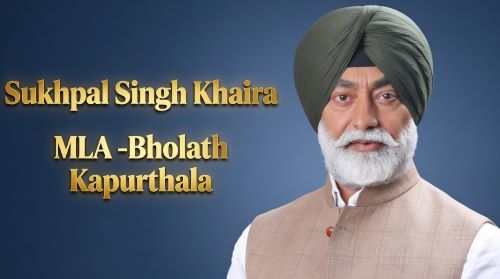
 CHANDIGARH:(By Satnam Singh Chahal | Punjab Outlook — Political Analysis) A fresh political controversy has emerged over the renewed activities of Aam Aadmi Party (AAP) leader Gayatri Bishnoi in Punjab. Congress MLA from Bholath, Sukhpal Singh Khaira, has once again questioned her political role in the state, alleging that she has returned to Punjab at the direction of Manish Sisodia.
In a social media post on November 19, Khaira questioned the circumstances surrounding Bishnoi’s return and referred to the welcome reportedly extended to her by family members of AAP MP from Sangrur, Meet Hayer. He raised a broader question about the growing influence of leaders from outside Punjab in the state’s political affairs and asked whether Punjab’s political decisions should be shaped by its own leadership or by people brought in from outside.
This controversy is not entirely new. In September 2026, Gayatri Bishnoi’s name became part of a political dispute over the use of government ministerial residences in Chandigarh. Khaira had alleged that AAP Punjab in-charge Manish Sisodia and certain other party functionaries were occupying government accommodation allotted to Punjab ministers. He also raised questions about House No. 960 in Sector 39, Chandigarh, and Bishnoi’s stay there. The allegations became part of a wider political debate involving the Congress, BJP and Shiromani Akali Dal over the use of public accommodation and the privileges extended to political functionaries.
Gayatri Bishnoi rejected the allegations at the time. She stated that she had been staying at the residence of Health Minister Dr Balbir Singh along with her parents because her father was undergoing medical treatment. She described Khaira’s remarks as an attack on her dignity and personal life and warned of legal action. The Punjab State Commission for Women also expressed concern over public comments relating to a woman’s personal life and dignity. Therefore, the political questions surrounding government accommodation must be distinguished from personal allegations and attacks.
At the end of September, The Economic Times reported that Bishnoi had vacated a ministerial residence in Chandigarh amid the controversy. Media reports also described her organisational role in the AAP’s Punjab affairs and her involvement in party activities. Her presence at party meetings and organisational programmes had already attracted political attention.
Khaira’s latest post has now brought the issue back into the political spotlight ahead of the next Punjab Assembly elections. His central argument is that the people of Punjab deserve to know how much authority rests with local leaders and how much influence is exercised by political functionaries from Delhi or other states. The photograph accompanying the discussion, showing a welcome being extended to Bishnoi by a family member of Meet Hayer, has also been used by Khaira to raise questions about her political position. However, a photograph of someone welcoming a political functionary does not, by itself, establish political interference, an official appointment or misuse of government authority.
There is also a larger political question that deserves attention. The practice of appointing leaders from outside Punjab to oversee party affairs is not exclusive to the AAP. During previous Congress governments, leaders from other states were also assigned organisational responsibilities in Punjab. Political parties across the country routinely appoint observers and in-charges from outside the states they oversee. Therefore, a leader’s state of origin alone cannot determine whether that person is suitable or unsuitable for a political responsibility.
The real issue is whether such responsibilities remain confined to party organisation or extend to influencing the administrative decisions of the Punjab Government. There is a clear distinction between an outside leader managing party affairs and an outside political functionary exercising influence over government departments, public appointments or the use of state resources.
The people of Punjab have every right to ask under what rules government accommodation is allotted, who is entitled to occupy official residences and whether party functionaries receive government facilities. If individuals associated with a political party are staying in government accommodation allotted to ministers, the government should explain the applicable rules and make the relevant information public. Such questions deserve transparent answers rather than political counterattacks.
The debate over Delhi’s influence, the role of leaders from other states and the position of Punjab’s own political leadership is likely to continue. However, the discussion should remain focused on Punjab’s interests, accountability and democratic rights rather than an individual’s personal life or place of origin.
Punjab Outlook Analysis
Punjab does not belong to any political party, nor is it the personal property of any leader or political group. Every leader who comes to Punjab to work for the state and its people is welcome. But the use of public resources and the exercise of governmental authority must always be subject to transparency and accountability.
The people of Punjab have a legitimate right to know who is making important decisions, under whose authority those decisions are being taken and who will be held responsible for their consequences. The real test of political leadership is not where a leader comes from, but whether that leader respects Punjab’s interests, institutions and democratic mandate.