
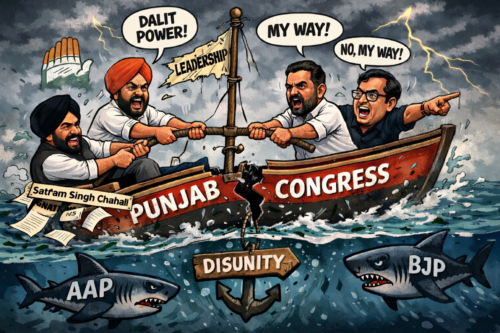
 Jalandhar (By Satnam Singh Chahal | Punjab Outlook — Political Analysis)The Punjab Congress has launched its ‘Punjab Mangda Insaaf’ (Punjab Demands Justice) campaign with an ambitious objective: to reconnect with the people, expose the shortcomings of the Aam Aadmi Party (AAP) government and prepare the political ground for the 2027 Punjab Assembly elections. However, an important question arises: Is this campaign genuinely an effort to seek justice for the people of Punjab, or is it primarily a demonstration of Congress’s organisational strength and an exercise in election preparation?
The campaign, launched under the leadership of Punjab Pradesh Congress Committee president Pargat Singh, Leader of Opposition Partap Singh Bajwa and other senior leaders, aims to take the party’s message to villages, towns and urban neighbourhoods. The Congress has announced cycle rallies, bus campaigns and foot marches to highlight issues such as drug abuse, unemployment, corruption, deteriorating law and order, illegal mining and the economic challenges confronting Punjab. The party has also promised consultations with farmers, industrialists, traders, labourers, women, young people and intellectuals to prepare a development roadmap for the state.
The timing of this campaign is politically significant. With the 2027 Assembly elections approaching, the Congress understands that it cannot depend entirely on criticism of the ruling AAP government. It must rebuild its grassroots organisation, restore confidence among voters and demonstrate that it has a credible alternative government ready to take responsibility for Punjab.
One of the major attractions of the campaign is former Chief Minister and Jalandhar MP Charanjit Singh Channi’s ‘Jawani Sambhal Cycle Yatra’, which began from Chamkaur Sahib on November 12, 2026. Congress general secretary and Punjab in-charge Sachin Pilot flagged off the programme in the presence of Pargat Singh, Partap Singh Bajwa and several senior leaders, including Vijay Inder Singla, Rana Gurjit Singh and Sukhjinder Singh Randhawa.
The first phase is planned as an eight-day, approximately 625-kilometre journey covering 27 Assembly constituencies. Around 2,000 bicycles were distributed among participating youth, and the programme was designed to raise awareness about drugs, gangsterism, unemployment and other challenges facing young people. The gathering undoubtedly provided the Congress with an opportunity to display its organisational strength.
But the real test is not how many bicycles are arranged, how many flags are displayed or how many senior leaders share the stage. The real test is whether the Congress can convert these political activities into a sustained public movement.
The Congress leadership is projecting a united face, but political observers cannot ignore the questions surrounding internal coordination and factionalism. The controversy over Amarinder Singh Raja Warring’s photograph being missing from the original cycle-yatra poster, followed by the release of a revised poster, raised questions about coordination within the state unit.
More importantly, Warring did not attend the November 12 launch of the cycle yatra. Although senior leaders insisted that the party was united, his absence created another opportunity for discussion about the relationship between different groups within Punjab Congress.Congress cannot afford to repeat the mistakes of the past. Punjab voters have witnessed political rivalries, leadership disputes and competing ambitions within the party. A campaign for justice will carry greater credibility when the party demonstrates justice, respect and collective decision-making within its own organisation.
The Congress is raising serious issues, but it must also explain what it would do differently if given another opportunity to govern Punjab. The drug problem cannot be addressed through speeches and bicycle rallies alone. Punjab needs a transparent strategy against drug trafficking networks, accountability within the enforcement system, rehabilitation facilities and employment opportunities for young people.
Similarly, unemployment, industrial decline, agricultural distress, illegal mining and the state’s growing debt require detailed policy proposals. Merely accusing the AAP government of failure will not automatically convince voters that Congress has better solutions.
The party should also be prepared to answer questions about its own previous government. What promises were fulfilled? Which commitments remained incomplete? What lessons has the Congress learned from its previous term in office? Voters will expect honest answers rather than political speeches.
For Pargat Singh, the new responsibility as Punjab Congress president is an important political opportunity as well as a major challenge. His leadership will be judged not simply by the number of rallies organised but by his ability to bring different political groups together, strengthen the district-level organisation and create a common political programme.
Partap Singh Bajwa, Charanjit Singh Channi, Raja Warring, Sukhpal Singh Khaira, Sukhjinder Singh Randhawa and other senior leaders must recognise that individual political ambitions cannot take precedence over the party’s collective interests.
The Congress also needs to give greater importance to its grassroots workers. Election campaigns cannot succeed simply through the presence of MPs, former ministers and senior leaders. Booth-level workers, village representatives and ordinary party supporters are the people who maintain direct contact with voters.The most important question for the Punjab Congress is whether ‘Punjab Mangda Insaaf’ will continue as a public accountability movement or gradually become another election-season exercise.
Punjab needs an opposition that does more than organise demonstrations. It needs an opposition that investigates public grievances, raises people’s voices, follows up on promises made by the government and presents practical alternatives.The Congress has an opportunity to regain political ground before 2027, but it must understand that public gatherings and political optics cannot substitute for public trust. The people of Punjab are looking for answers on drugs, jobs, law and order, agriculture, education, healthcare and the state’s financial future.
Ultimately, the success of the Insaaf Yatra will not be measured by the number of kilometres travelled, bicycles distributed or political leaders attending its programmes. It will be measured by how many ordinary people feel that their voices have finally been heard.
Punjab is certainly demanding justice, but the Congress must first convince the people that it has the political will, organisational unity and a credible roadmap to deliver it.Punjab Outlook — Political Analysis