
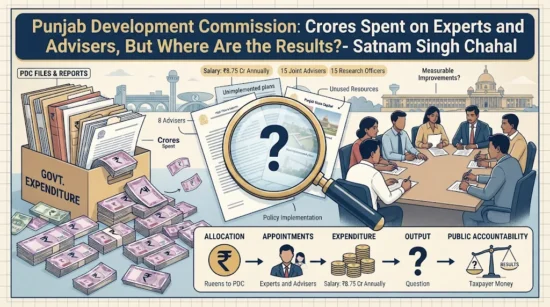
 The Punjab Development Commission (PDC), established by the Aam Aadmi Party government in September 2023 with the promise of bringing professional expertise and accelerating the state’s development, is now facing questions over its expenditure, appointments and actual contribution to Punjab. Nearly three years after its establishment, taxpayers deserve to know how much public money has been spent on maintaining this institution and what tangible improvements it has delivered to the state.The commission was established to advise the government on important sectors such as agriculture, education, healthcare, employment, industrial development and economic planning
The financial questions surrounding the commission became prominent in June 2025 when Leader of Opposition Partap Singh Bajwa raised concerns about its appointments and salary expenditure. According to figures presented by Bajwa, eight advisers were receiving monthly salaries of ₹2.65 lakh each, 15 joint advisers were being paid ₹2.20 lakh each and 15 senior research officers were receiving ₹1.25 lakh each. Based on these reported figures, the combined monthly salary commitment for these 38 positions would be approximately ₹72.95 lakh, or nearly ₹8.75 crore annually, if all positions remained occupied throughout the year.
Bajwa also alleged that the government had spent approximately ₹7.70 crore on the commission during the preceding year. These figures requ…
The controversy gained further attention in October 2026 when former Punjab BJP president Sunil Jakhar questioned the commission’s expenditure and appointments. According to media reports, Jakhar claimed that more than 85 people were associated with the commission and that its monthly salary expenditure was between ₹1.5 crore and ₹1.7 crore. If this claim is accurate, the annual salary bill alone would amount to approximately ₹18 crore to ₹20.40 crore. The government must clarify whether these figures represent salaries alone or include other expenses.
\
The biggest question, however, is not simply how many people are employed or how much they are paid. It is what these highly paid experts have delivered for Punjab. How many major development policies have they prepared? How many recommendations have been accepted by the government? How many have actually been implemented? Can the commission identify measurable improvements in employment, agriculture, industrial investment, education and healthcare resulting from its work?
Punjab is facing serious challenges. Unemployment continues to push young people towards foreign countries. Farmers are struggling with economic uncertainty, industries need investment and expansion, government schools and hospitals require improvements, and the state continues to carry a substantial debt burden. At such a critical time, every rupee spent from the public treasury must produce meaningful results.
Another important issue is the need to clarify how the commission operates alongside the existing Planning and Development Department and other government institutions. Punjab already has an administrative structure responsible for preparing development plans and implementing government policies. The government must explain what additional responsibilities the commission performs and why its work cannot be handled through existing institutions.
The people of Punjab also deserve transparency regarding appointments. How many advisers, consultants and research officers have been recruited? What qualifications do they possess? How many are from Punjab and how many from outside the state? What are their individual salaries, allowances and facilities? These are reasonable public-interest questions because the commission is maintained with taxpayers’ money.
The Punjab Government should publish a complete expenditure statement from September 2023 to November 2026, including monthly and yearly salaries, office expenses, vehicles, travel, accommodation, consultancy payments, meetings and other administrative costs. It should also release the commission’s annual reports, research projects, policy recommendations and implementation records. An independent performance audit would help establish whether the institution is delivering value for public money.
. It should also release the commission’s annual reports, research projects, policy recommendations and implementation records. An independent performance audit would help establish whether the institution is delivering value for public money.The government cannot expect people to accept expenditure figures without asking questions about performance. If the commission has genuinely contributed to Punjab’s development, its achievements should be presented publicly with supporting documents. If it has failed to produce meaningful results, the government must explain why public resources continue to be spent on it.
Punjab does not need institutions merely to provide prestigious designations and attractive salaries. It needs institutions that create employment, strengthen agriculture, attract industries, improve education and healthcare, and give the younger generation a reason to build its future in Punjab rather than abroad.
The fundamental question remains: How many crores have been spent on the Punjab Development Commission, and what has Punjab actually received in return? Public money demands public accountability, and the people of Punjab deserve a clear answer.
Editorial note: Salary and expenditure figures attributed to political leaders are allegations and reported estimates, not independently audited totals. Official financial disclosures are necessary to establish the actual expenditure.