
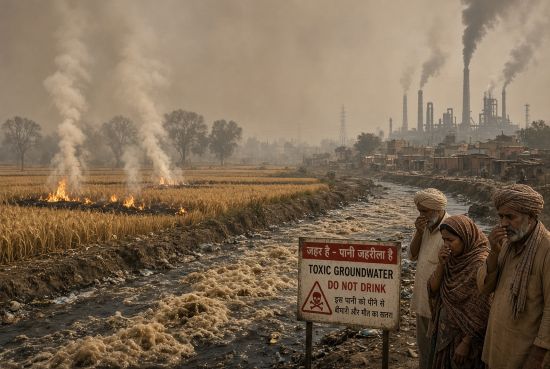
Punjab, once known for its fertile agricultural land, clean villages, rivers and hardworking people, is increasingly facing a serious environmental and public health challenge. Air pollution, contaminated groundwater, polluted rivers, untreated sewage, industrial waste and excessive use of chemical fertilisers and pesticides are creating an alarming situation. The question is no longer limited to environmental protection. It is about the health, survival and future of millions of people living in Punjab.
Unfortunately, environmental pollution has not received the level of public attention and administrative accountability that it deserves. Governments come and go, political parties make promises about development, prosperity and better living standards, but the basic right of people to breathe clean air and drink safe water remains a major concern. Punjab needs to examine whether its environmental regulatory institutions are fulfilling their responsibilities effectively.
The Punjab Pollution Control Board (PPCB), established in 1975, has an important responsibility to implement environmental laws and protect air, water and land from pollution. Its duties include monitoring industrial emissions, checking untreated wastewater, regulating polluting industries, monitoring water quality and taking legal action against those violating environmental standards. However, several official reports have raised serious questions about the effectiveness of pollution control and enforcement in the state.
A status report submitted by the Punjab Pollution Control Board to the National Green Tribunal in December 2025 revealed that out of 1,511 identified pollution sources affecting rivers and other water bodies, action had been completed against only 692. As many as 819 sources, representing approximately 54.2 per cent of the identified total, remained unaddressed. This raises an important question: if pollution sources have already been identified, why has the government failed to ensure that they are eliminated? Identifying pollution is not enough. The real responsibility is to stop it.
Perhaps the most disturbing environmental issue in Punjab is the condition of groundwater. For decades, farmers and rural households have depended on underground water for drinking, agriculture and daily household requirements. However, increasing contamination has raised serious questions about the safety of this essential resource. People in several parts of Punjab are concerned about whether the water supplied to their homes is actually safe for human consumption.
The Comptroller and Auditor General (CAG), in its audit of the Jal Jeevan Mission in Punjab, identified serious shortcomings in the supply of safe drinking water. According to the report published in March 2026, 1,634 rural habitations were affected by water contamination in April 2020. Of these, 815 were affected by arsenic contamination and 319 by fluoride contamination. Even in April 2024, at least 101 habitations were still receiving contaminated piped water through household tap connections. The CAG also questioned why contaminated water sources had been selected for supply and why affected habitations had not received priority for safe drinking water.
Providing a household tap connection cannot be considered a success if the water coming out of that tap is unsafe for human consumption. The government must understand that access to drinking water means access to clean and safe drinking water, not simply the installation of pipes and taps. Every household has the right to know the quality of the water it consumes.
The Central Ground Water Board’s Annual Groundwater Quality Report 2025 has raised further concerns. According to findings reported in December 2025, uranium concentrations exceeded the permissible limit in 53.04 per cent of Punjab’s pre-monsoon samples and 62.5 per cent of post-monsoon samples. Sixteen of Punjab’s 23 districts were identified as affected zones. Sangrur and Bathinda recorded particularly high concentrations, with some samples exceeding 200 parts per billion against the permissible limit of 30 parts per billion. These findings demand immediate attention from the Punjab government and environmental authorities.
Groundwater contamination is not limited to uranium. Arsenic, fluoride, nitrates, iron and other contaminants have also been detected at different locations. Long-term exposure to arsenic is associated with skin lesions and certain cancers. Excessive fluoride can cause dental and skeletal fluorosis, while prolonged uranium exposure raises concerns about kidney health. Unsafe drinking water can also contribute to diarrhoeal diseases, cholera, typhoid, hepatitis A and other waterborne infections. These risks make regular testing and treatment of drinking water essential.
Punjab has also faced public concern about cancer and other chronic illnesses, particularly in some areas of southwestern Punjab. However, it would be scientifically incorrect to attribute every cancer case to water pollution without proper medical and epidemiological evidence. The government must commission independent research to establish the extent of environmental exposure and its possible relationship with disease patterns. People should not have to wait until they become seriously ill before authorities recognise the dangers of contaminated water.
Air pollution is equally serious. Punjab faces multiple sources of air pollution, including industrial emissions, vehicle exhaust, construction dust, burning of solid waste, brick kilns and seasonal agricultural residue burning. During the post-harvest season, stubble burning becomes a major concern. Farmers are often blamed, but the problem also reflects inadequate arrangements for affordable crop-residue management, insufficient machinery access, economic pressures and shortcomings in policy implementation. The government must develop practical solutions instead of treating the issue as a seasonal political controversy.
The Punjab Pollution Control Board must explain how effectively it monitors industrial emissions, whether factories are operating pollution-control equipment and how many violations result in actual penalties or closures. Clean air cannot be achieved through seasonal announcements and temporary campaigns. It requires year-round monitoring, scientific assessment and strict enforcement of environmental standards.
Punjab’s rivers, canals, drains and other water bodies are also under pressure from untreated sewage, industrial effluents, municipal waste and agricultural runoff. The discharge of untreated wastewater damages aquatic ecosystems and creates additional risks for communities that depend on these water sources. The problem becomes more serious when contaminated wastewater reaches agricultural land or enters groundwater systems. The government must ensure that sewage treatment plants and common effluent treatment plants function according to prescribed standards. Their performance should be independently audited, and monitoring information should be made publicly available.
The most important question is whether the Punjab Pollution Control Board is functioning as an effective environmental watchdog or merely as an administrative institution issuing notices, collecting samples and preparing reports. The Board has statutory powers to regulate polluting industries, prosecute violators and order closures in appropriate cases. People have every right to demand information about the number of inspections conducted, violations detected, prosecutions initiated, factories closed and environmental penalties recovered.
The government should also disclose how many polluted water sources have actually been cleaned, how many industrial units continue to discharge untreated waste and how many villages receive independently verified safe drinking water. An independent performance audit of the Board should examine its staffing, laboratory capacity, monitoring infrastructure, enforcement record and coordination with other government departments. Environmental protection cannot be measured by the number of meetings conducted or notices issued. It must be measured by improvements in the quality of air, water and the environment.
Punjab requires an urgent and comprehensive environmental action plan that places public health above administrative convenience and political publicity. Every village, town and city should receive regular drinking-water quality testing. Testing results should be made available to the public, and households receiving contaminated water should be provided with an immediate alternative safe supply. The government should conduct a district-wise survey of groundwater contamination, including uranium, arsenic, fluoride, nitrates and heavy metals, and give priority to areas identified as contaminated.
Air-quality monitoring stations should be expanded beyond major urban centres. Industrial pollution, construction dust, vehicle emissions and agricultural residue burning must be addressed through practical and enforceable measures. The Pollution Control Board should publish monthly public performance reports detailing inspections, violations, penalties, prosecutions and corrective action. The Health Department should work with environmental scientists and medical institutions to conduct independent studies of waterborne diseases, respiratory illnesses and possible long-term exposure to environmental contaminants.
Environmental protection must become a responsibility shared by the Pollution Control Board, local governments, municipal bodies, the Agriculture Department, the Health Department and industrial authorities. No department should be allowed to escape responsibility by blaming another department. The government must establish clear accountability and ensure that officials responsible for environmental enforcement perform their duties effectively.
Political parties frequently speak about making Punjab prosperous, creating employment, improving agriculture and providing better facilities to citizens. But what is the meaning of prosperity if people cannot breathe clean air or confidently drink water from their household taps? Economic development, industrial growth and agricultural productivity cannot be considered genuine progress if they come at the cost of public health and environmental destruction.
Punjab’s people pay taxes and have the right to demand accountability from institutions entrusted with protecting their lives and surroundings. Environmental protection is not a favour to the public; it is a fundamental responsibility of the state. The Punjab Pollution Control Board must demonstrate measurable results rather than simply presenting reports and statistics. The government must explain why identified pollution sources remain active, why contaminated water continues to reach some households and what concrete steps are being taken to protect future generations.
Punjab does not need another publicity campaign about a prosperous state. It needs clean rivers, safe drinking water, breathable air and an accountable environmental administration. The health of the people cannot be sacrificed for administrative negligence, industrial interests or political priorities. If immediate corrective measures are not taken, the environmental crisis will become an even greater burden for future generations. Without clean air, safe water and a healthy environment, the promise of a prosperous Punjab will remain incomplete.