
 PUNJAB OUTLOOK SPECIAL POLITICAL ANALYSIS:Punjab needs accountability for election promises—not another round of political announcements. The Aam Aadmi Party (AAP), Congress, Bharatiya Janata Party (BJP), Shiromani Akali Dal (SAD), SAD (Punar Surjit) and Bahujan Samaj Party (BSP) must be examined against the same standards: what they promised, what they delivered, what remains incomplete and what evidence supports their claims.
Punjab’s voters have repeatedly placed their hopes in different political parties. Some expected employment and economic development; others wanted relief for farmers, affordable electricity, better education and healthcare, social justice, action against drugs and corruption, and protection of Punjab’s interests. Yet the central question remains: how many election promises have translated into measurable improvements in people’s lives?
An unfulfilled promise does not automatically prove deliberate deception. Financial constraints, administrative difficulties and changing circumstances can affect implementation. However, parties must explain their failures and delays rather than repeatedly asking voters to trust fresh assurances without a transparent account of previous commitments.
AAP: The Promise of Change Must Stand the Test of Performance
The Aam Aadmi Party came to power in Punjab in 2022 with a sweeping mandate and a promise to change the traditional style of governance. Its electoral agenda included action against corruption, employment opportunities for young people, monthly financial assistance of ₹1,000 for women, 300 units of free electricity per household, improvements in education and healthcare, and decisive action against drug trafficking .These promises created substantial public expectations. Having secured a strong electoral mandate, AAP must now explain its record through verifiable evidence rather than political publicity alone. The promise of ₹1,000 per month for women deserves particular scrutiny. The government should clearly state the implementation status of this commitment, the steps taken to introduce the benefit and when eligible women can expect to receive assistance. Voters should not have to rely on repeated announcements without a clear and documented implementation plan.Employment is another major test. The government should publish comprehensive figures showing how many jobs have been created, how many government vacancies have been filled, how many appointments are regular and how many posts remain vacant. Appointment ceremonies and publicity campaigns cannot, by themselves, establish the full impact of employment policies. The wider employment situation and the availability of sustainable opportunities for young people also require examination.
The free-electricity scheme should be assessed in terms of benefits to households, government expenditure, subsidy payments and the financial position of the power sector. Free electricity can provide meaningful relief to families, but transparency about its cost and long-term financial sustainability is equally important.AAP also made strong commitments to fight drugs and corruption. The public deserves more than figures showing arrests, seizures or investigations. The government should explain whether drug supply networks have been disrupted, whether treatment and rehabilitation services have improved, and what measurable progress has been made in addressing corruption. Investigations must be distinguished from proven wrongdoing, and arrests must not automatically be treated as convictions.Punjab’s debt, industrial difficulties, agricultural distress and continuing migration of young people also require a transparent assessment. The government should explain what has improved, what remains unresolved and what measurable targets it intends to achieve.AAP asked Punjab to vote for change. It must now demonstrate that change through transparent records, measurable outcomes and an honest explanation of promises that remain unfulfilled.
Congress: The Legacy of Previous Governments Cannot Be Ignored
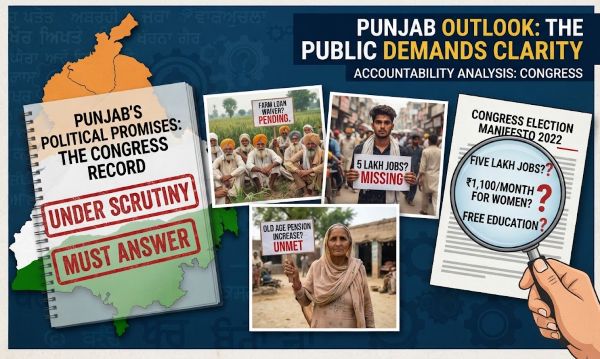
Congress must answer questions about its own record in Punjab rather than concentrating exclusively on criticising the present government.During the 2017 Assembly election campaign, farm-loan relief and welfare commitments were prominent issues. In its 2022 election manifesto, Congress made further promises concerning employment, financial assistance for women, pensions, education and action against corruption.The party should provide a commitment-by-commitment account of what was delivered, what was only partially implemented and what remained incomplete. Where a promise was not fulfilled, Congress should explain the reasons and identify the steps it would take to avoid repeating the same shortcomings.Criticising AAP does not remove the need to answer questions about Congress’s own period in office. Voters deserve evidence of past performance alongside proposals for the future.
BJP: What Has Been Delivered for Punjab?
The BJP must also account for its Punjab-specific commitments. Its 2022 election campaign included proposals concerning infrastructure investment, employment, women’s representation, economic development and relief measures.The party should clarify which commitments have been implemented, which remain pending and what obstacles have prevented delivery. Where implementation depends on coordination between the central and state governments, the respective responsibilities should be explained openly.Holding power at the national level does not, by itself, demonstrate that every promise concerning Punjab has been fulfilled. The relevant questions concern actual investment, completed projects, employment outcomes and benefits reaching the intended population.The BJP should present documented results rather than relying solely on national-level achievements or criticism of rival parties.
Shiromani Akali Dal: Past Governance Must Be Part of the Debate
The Shiromani Akali Dal has governed Punjab in the past, making its earlier policies and administrative record an essential part of any assessment.Its previous electoral commitments and political programmes have addressed farmers, electricity, welfare benefits, education, employment and the needs of economically disadvantaged families. The party should explain which commitments were fulfilled during its periods in government and which remained incomplete.Its record should be assessed through verifiable outcomes, including the impact of policies on farmers, workers, young people, women and low-income households. Previous achievements should receive recognition where supported by evidence, but shortcomings must also be acknowledged.Historical identity and political legacy cannot replace a clear account of governance. If SAD seeks renewed public confidence, it must explain what it has learned from its previous experience and how its future policies would address Punjab’s continuing challenges.
SAD (Punar Surjit): A Distinct Identity Requires a Clear Policy Roadmap
SAD (Punar Surjit) should be assessed on the basis of its own stated leadership, policies, political commitments and organisational identity. It should not automatically be held responsible for every decision taken by another Akali faction. Equally, a distinct political identity should come with clearly defined proposals and measurable commitments.The faction should explain its plans for Punjab’s debt, unemployment, agricultural distress, drug trafficking, migration, industrial development, education, healthcare and the protection of Sikh institutions.If it proposes a different direction for Punjab, it should identify precisely how its policies differ, how they would be financed and how the public could independently assess their results.Voters need specific proposals, realistic timelines and transparent progress reports—not simply new political slogans or a promise to restore an earlier tradition.
BSP: Social Justice Must Produce Measurable Results
The Bahujan Samaj Party has traditionally emphasised social justice, equality and the representation of disadvantaged communities. In Punjab, these principles must be reflected in practical measures involving education, scholarships, employment, housing, healthcare, land rights and protection against caste-based discrimination.The BSP should explain how its proposals would improve access to public services and economic opportunities for disadvantaged communities. It should also clarify which commitments it continues to pursue independently and how it would fund and implement them.Social justice cannot be measured by campaign speeches alone. Its impact must be assessed through access to services, implementation of protective laws, educational opportunities and tangible improvements in the lives of intended beneficiaries.
Punjab’s Larger Crisis: Promises Without Transparent Accountability
Punjab’s difficulties cannot fairly be attributed to one party or one government alone. Debt, agricultural dependence, unemployment, drug abuse, migration, industrial development and the quality of public services require sustained policies and long-term planning.Every political party should answer the same basic questions: What exactly was promised? What has been delivered? How much public money was spent? Who benefited? What remains incomplete? What evidence independently verifies the claims?Parties should publish accessible progress reports covering their major electoral commitments. These reports should distinguish between promises fully implemented, partially implemented, delayed or abandoned. They should include financial details, implementation deadlines, beneficiary information and explanations for significant shortfalls.
AAP must account for its record since taking office in 2022. Congress must explain the record of its previous government. BJP must document its Punjab-specific commitments. SAD must answer for its periods in government. SAD (Punar Surjit) must demonstrate the substance of its separate policy agenda, while BSP must explain how its social-justice commitments would translate into practical outcomes.No party should be exempt from scrutiny simply because it is in power, in opposition, newly organised or presenting itself as an alternative to established political forces.
The People of Punjab Deserve Answers, Not Another Round of Assurances
Punjab’s voters should demand transparent manifestos, realistic financial estimates, measurable targets, implementation deadlines and annual public reviews of major promises. Political parties should also explain openly when a commitment cannot be fulfilled and what alternative measures, if any, are being proposed.The purpose of such scrutiny is not to declare every political promise false or to assume that every party has failed equally. It is to establish a reliable public record against which claims can be tested and citizens can make informed judgments.The central question for Punjab is straightforward: Are political parties prepared to be judged by what they actually deliver rather than by what they promise during elections?
Until every party accepts this standard, Punjab will continue to hear competing claims without always having a complete picture of the results. The people deserve a political culture in which promises are documented, public money is accounted for, failures are explained and achievements are supported by evidence.Punjab needs less political publicity and more verifiable performance, less blame-shifting and more accountability, and fewer unsubstantiated assurances and more measurable results.
Punjab Outlook — Political Analysis
Editorial note: This article examines the need for accountability across political parties. It does not establish that every promise listed was deliberately false or remains unfulfilled. The current implementation status of individual commitments should be verified against official government orders, budgets, audit reports and independently documented outcomes before definitive conclusions are published.
Disclaimer: This article and accompanying images are for informational and illustrative purposes only. Some visuals may be AI-generated or digitally enhanced and may not depict actual events or persons.Views expressed are based on publicly available information and analysis
Referance:The Tribune,The Indian Express