
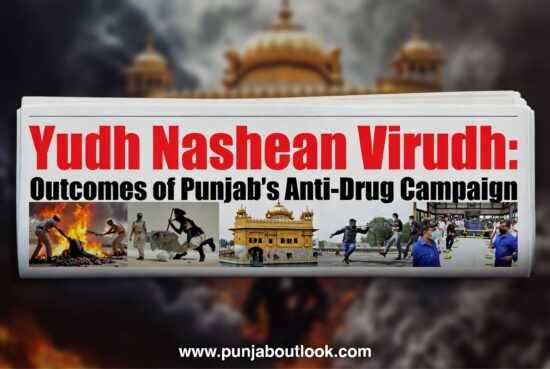
 The Punjab Government’s much-publicised “war on drugs” is facing fresh questions over its effectiveness, with concerns being raised about the state’s growing dependence on medication-assisted de-addiction, the scale of government advertising expenditure and the actual number of people successfully overcoming drug addiction.Critics of the Aam Aadmi Party (AAP) government have accused it of spending heavily on publicity campaigns while failing to demonstrate results proportionate to the resources being committed to the drug crisis. The criticism has intensified following figures cited from a Punjab Vidhan Sabha committee report concerning the use of buprenorphine in government-supported de-addiction centres.
According to the figures cited, more than 43.44 crore buprenorphine tablets have reportedly been purchased during the last four-and-a-half years for use in drug-de-addiction treatment. Buprenorphine is commonly used in medication-assisted treatment for opioid dependence and is intended to reduce withdrawal symptoms and cravings. However, questions have been raised over whether the programme is producing sufficient long-term recovery and reducing dependence on drugs.The central concern is not necessarily the use of buprenorphine itself, but whether patients receiving treatment are ultimately able to move toward sustained recovery. Critics have cited the committee’s observations to argue that the percentage of patients successfully becoming drug-free remains extremely low, with claims that less than one per cent are able to quit drugs completely. Such a figure, if accurately reflected in the committee’s findings and properly defined, would raise serious questions about the effectiveness of the state’s overall rehabilitation strategy.
The issue is particularly significant because Punjab has repeatedly been presented by successive governments as being at the forefront of the battle against drug addiction. The AAP government came to power promising an aggressive campaign against drugs and has repeatedly announced initiatives aimed at eliminating the drug trade and helping addicts recover.
₹15 Crore Poster and Wall-Painting Campaign
Another issue attracting attention is the government’s expenditure on public-awareness campaigns.The Punjab Government reportedly launched a major poster and wall-painting campaign covering more than 13,000 villages across the state. The campaign was designed to spread awareness about the dangers of drugs, with lakhs of posters reportedly displayed throughout rural Punjab.The reported expenditure on the campaign was approximately ₹15 crore.While public awareness is an important component of any anti-drug programme, critics are questioning whether such spending should be accompanied by independently verifiable measurements of its impact. They argue that awareness campaigns cannot substitute for effective policing, dismantling of drug networks, rehabilitation, employment opportunities and long-term social reintegration of recovering addicts.
₹317 Crore Spent on Print Advertising Since 2022
Questions are also being raised over the broader advertising expenditure of the Punjab Government.According to RTI-based figures cited in the controversy, the government has spent approximately ₹317 crore on print-media advertising since March 2022, when the AAP government assumed office.The figure reportedly covers newspaper advertisements and does not include expenditure on television and digital-media advertising. If those additional categories are included, the overall publicity expenditure could be substantially higher.The controversy has therefore shifted the focus from individual advertisements to the larger question of whether public money is being used primarily to communicate measurable government achievements or to create political publicity.
‘Advertisements Cannot Defeat Addiction’
Critics argue that Punjab does not need another publicity campaign as much as it needs a transparent, independently monitored and scientifically evaluated drug-rehabilitation system.The state’s drug crisis is deeply connected with unemployment, organised crime, availability of narcotics, poverty, family distress and the lack of sustained rehabilitation and after-care services. Simply distributing medication to people already trapped in addiction cannot by itself solve the larger crisis.The government’s defenders, however, can argue that buprenorphine is an internationally recognised treatment for opioid dependence and that medication-assisted treatment should not automatically be interpreted as treatment failure. The real measure of success should include retention in treatment, reduction in illicit opioid use, improved health and social functioning, relapse rates and long-term recovery.That distinction makes transparent data particularly important.
NAPA Calls for Independent Audit of Anti-Drug Programme
North American Punjabi Association (NAPA) Executive Director Satnam Singh Chahal said Punjab’s youth and public resources cannot be treated as instruments of political publicity.“Punjab’s youth are being destroyed by addiction, while governments continue to announce campaigns and advertisements. The people of Punjab deserve to know exactly how much money is being spent, how many patients are entering treatment, how many are completing treatment, how many are relapsing and, most importantly, how many are actually rebuilding their lives,” Chahal said.He said the reported purchase of more than 43 crore buprenorphine tablets and the alleged extremely low rate of complete recovery demand a comprehensive public audit.
“Buprenorphine can have a legitimate medical role in treating opioid dependence. The question is whether the government is measuring recovery properly and whether patients are being given a genuine pathway from treatment to rehabilitation and independent living,” Chahal said.Chahal also questioned the justification for large-scale publicity expenditure when Punjab continues to struggle with the consequences of drug addiction.“If ₹15 crore can be spent on posters and hundreds of crores on print publicity, the government must also tell the people how much has been spent on rehabilitation, psychological counselling, vocational training, after-care and reintegration of recovering addicts,” he said.
From ‘War on Drugs’ to a War for Recovery
The debate ultimately raises a larger question: What should constitute success in Punjab’s war on drugs?If success is measured by the number of posters displayed, advertisements published, raids conducted or tablets purchased, the government can produce impressive statistics. But if success is measured by the number of young people permanently freed from addiction, reunited with their families, employed and able to live independent lives, the state must provide much more detailed evidence.Punjab cannot afford a drug policy that becomes an annual cycle of announcements, advertisements, raids and statistics without independently verified outcomes.The state needs a transparent system in which every rupee spent on the drug crisis can be tracked and every treatment programme can be evaluated on measurable outcomes.For Punjab’s families, the real question is not how many posters were put on village walls or how many advertisements appeared in newspapers.The real question is simple: How many lives have actually been saved?
NAPA maintains that Punjab’s youth need recovery, rehabilitation, employment and hope—not merely slogans. The organisation has called for an independent, publicly accessible audit of the state’s anti-drug expenditure and treatment outcomes so that the people of Punjab can judge the government’s performance on evidence rather than advertising.