
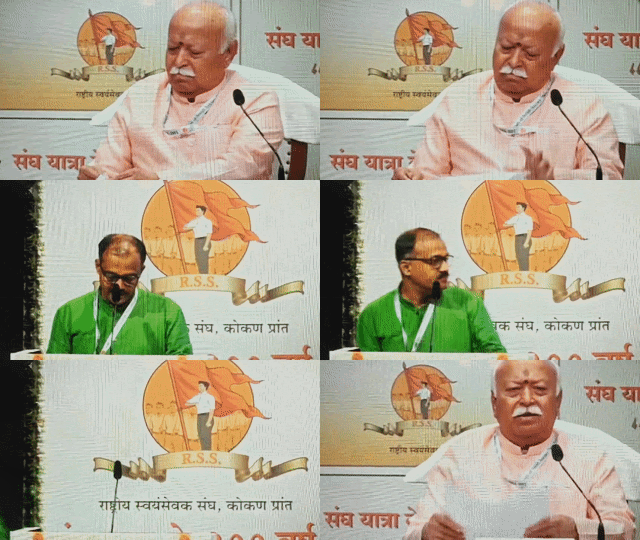
 At the RSS centenary lecture series in Mumbai, Rashtriya Swayamsevak Sangh Sarsanghchalak Mohan Bhagwat made a set of remarks on Sikhs that merit careful and sober attention—particularly in Punjab, where questions of identity are neither abstract nor academic.
Speaking at the “100 Years of Sangh: Journey to New Horizons” lecture series, Bhagwat explicitly acknowledged Sikh religious distinctiveness, even while situating Sikhs within a broader social and civilisational continuum. His words were clear and unambiguous:
“सिखों की अपनी धार्मिक परंपराएं हैं, अपनी मर्यादाएं हैं, अपना पंथ है—इसमें कोई संदेह नहीं।
पूजा एक अलग मानी जा सकती है। रिलिजन के नाते सिख अलग हैं। विशिष्टता को मान्यता देनी चाहिए। सिख समाज से हमारा खून का रिश्ता है, हमारे बीच रोटी-बेटी का रिश्ता है…
हिंदू और सिख एकता का उल्लेख करने से दो अलग हैं, ऐसा लग सकता है। वह गलत है, क्योंकि हम सब एक ही हैं।”
Taken together, these statements leave little room for misrepresentation. Bhagwat did not deny Sikh distinctiveness. On the contrary, he acknowledged that Sikhism has its own religious traditions, its own discipline, and its own identity as a panth, and that this distinctiveness deserves recognition.
Yet for Punjab and the Sikh community, the issue has never been limited to verbal acknowledgment.
The Constitutional Ambiguity That Refuses to Fade
The deeper unease lies in the Indian Constitution itself, specifically Article 25, Explanation II, which groups Sikhs within the definition of Hindus for limited legal purposes. While legally qualified, this provision has had consequences far beyond its textual intent. Over time, it has produced a persistent ambiguity: Sikhs are repeatedly described as a distinct religion in practice, yet remain constitutionally tethered to another category.
This contradiction has shaped Sikh political consciousness for decades. It once led former Punjab Chief Minister Parkash Singh Badal to burn copies of the Constitution in protest—not as a rejection of India, but as a symbolic demand for clear and unqualified recognition of Sikh religious identity. That episode is often dismissed as theatrics, but the grievance it reflected remains unresolved.
Unity, Oneness, and the Sikh Experience
Bhagwat’s larger argument is that repeatedly speaking of “Hindu–Sikh unity” may itself create the misleading impression that two alien communities are being artificially joined. His assertion—
“हिंदू और सिख एकता का उल्लेख करने से दो अलग हैं, ऐसा लग सकता है। वह गलत है, क्योंकि हम सब एक ही हैं”—
flows from a civilisational worldview that emphasises historical continuity, shared social life, and cultural overlap.
But this is precisely where Sikh discomfort arises.
Sikh thought has always affirmed oneness—“na koi Hindu, na Musalman” to “manas ki jaat sabhe eke pehchaanbo”. Yet Sikh history simultaneously stands as a resistance to religious homogenisation. Unity, in the Sikh experience, has never meant merger. Distinctiveness is not ornamental; it is foundational.
When oneness is emphasised without simultaneously resolving constitutional ambiguity, it risks being perceived—not unreasonably—as assimilation by another name.
Recognition Without Resolution Is Not Enough
Bhagwat’s acknowledgment—“रिलिजन के नाते सिख अलग हैं”—is significant. It departs from outright denial and addresses a long-standing Sikh concern at the level of articulation. But articulation alone does not settle constitutional questions.
If Sikh distinctiveness is accepted in principle, it must find reflection in constitutional clarity, political language, and institutional practice. Otherwise, the gap between recognition and reality persists, breeding mistrust rather than cohesion.
Conclusion
Mohan Bhagwat has touched the core of an unresolved national question. By acknowledging that Sikhs are distinct in religion and religious practice, and that this distinctiveness deserves recognition, he has opened a narrow—but important—window for dialogue.