
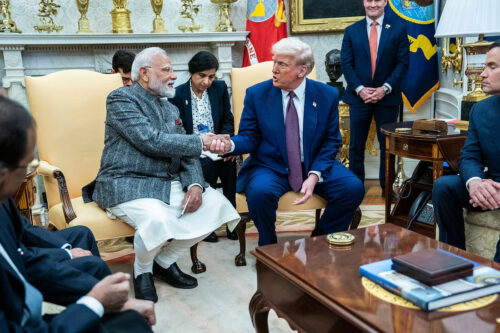
As of 3 February 2026, the public knows precisely two things about the India–US trade understanding announced on 2 February: what President Donald Trump claimed in his Truth Social post, and Prime Minister Modi’s courteous acknowledgement thanking President Trump for reducing US tariffs from 25% to 18%. Everything beyond these two statements is a fog of accolades, speculation, and calculated or unintended ambiguity. The Ministry of External Affairs has issued no substantive clarification. The Ministry of Commerce has offered no authoritative guidance. No official text has been released. No press conference has been held to separate fact from Trump’s characterisation.
This silence is untenable. It must end—today.
President Trump’s post was comprehensive and unambiguous. India, he claimed, has agreed to reduce tariffs and non-tariff barriers to “zero”; purchase $500 billion in American energy, technology, agricultural and coal products; stop buying Russian oil in favour of US and Venezuelan supplies; and commit to a “BUY AMERICAN” policy. Prime Minister Modi’s response—gracious as it was—contained not a single word acknowledging any Indian commitment, explaining any trade arrangement, or clarifying the scope of India’s concessions. The contrast is stark. And the silence is deliberate.
Now it is incumbent upon the Ministry of Commerce—and, where diplomacy is concerned, the MEA—to divulge greater details, clearly and authoritatively. India cannot allow its external narrative to be written by a foreign leader’s social-media post.
What the Ministry of Commerce Must Disclose
The Ministry must immediately publish a detailed clarification addressing questions that go to the livelihoods of millions of Indians and to the strategic interests of the nation.
Agriculture and dairy. India’s agreement with the European Union—concluded only weeks ago—excluded dairy, cereals, pulses, and major agricultural products from market access. Has the US understanding similarly protected these sectors, or has India agreed to open them? If tariff reductions touch agriculture, which products are covered, and at what rates? The dairy economy alone supports 70–80 million small farmers. The Ministry must state, unequivocally: are agriculture and dairy protected, or liberalised?
Genetically modified crops. The overwhelming majority of US corn and soy is genetically modified. India has consistently resisted GM crop imports on health and biosafety grounds. Has this policy been altered? Will India now admit American GM products? This is not a technical footnote—it affects food standards, regulatory integrity, and consumer rights. The Ministry must clarify India’s position.
The “zero tariff” claim. Trump says tariffs and non-tariff barriers will be reduced to “zero”. Which sectors does this cover? Over what timeline? Are there carve-outs for sensitive industries? Is anything reciprocal, and if so, on what terms? The Ministry should publish a sector-by-sector schedule that shows, in plain language, what has been offered and what has not.
The $500 billion figure. This number is of a magnitude that demands immediate explanation. Is it a binding commitment or an aspirational projection? Over what timeframe? Are these government purchases, PSU procurement plans, or private-sector estimates? Which ministries, companies, and public enterprises would absorb purchases on that scale? The Ministry must clarify whether this is a legally enforceable obligation, a negotiated target, or simply Trump’s arithmetic.
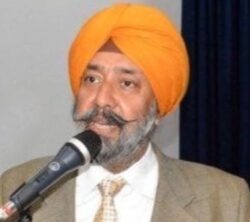
KBS Sidhu, IAS (retd.), served as Special Chief Secretary to the Government of Punjab. He is the Editor-in-Chief of The KBS Chronicle, a daily newsletter offering independent commentary on governance, public policy and strategic affairs.
Russian oil and energy security. Has India agreed to curtail Russian oil imports—and if so, by what percentage and by when? What price assurances, supply guarantees, or contractual terms has the US offered in return? How does any such understanding align with India’s long-standing doctrine of strategic autonomy and its energy security needs? The Ministry must clarify India’s actual position—not Trump’s version of it.
Legal status and ratification. Are Trump’s claims an accurate description of an actual understanding, or an exaggeration of India’s commitments? Is a formal agreement being finalised? What is the timeline for documentation, notification, and parliamentary scrutiny? What is binding, what is aspirational, and what remains under negotiation? On this point, ambiguity is not diplomacy—it is abdication.
Why Clarity Is Essential Now
The Ministry cannot ask stakeholders to wait for a “huge text” that may emerge at an unspecified time. Markets do not pause. Supply chains do not pause. Investment decisions do not pause.
Manufacturers and exporters facing the prospect of zero-tariff competition must plan now. Farmers and dairy producers must know whether protections hold. Importers and distributors must understand what may open, and when. Regulatory agencies must anticipate what standards may be tested. Parliamentary representatives are entitled to be briefed on commitments made in the nation’s name.
Silence creates a vacuum—and Trump is filling it with his interpretation. His version is already circulating internationally as settled fact. American businesses will make decisions on the basis of what he has claimed. Indian stakeholders will make their own competing assumptions. Conflicting expectations will harden. And then, inevitably, we will be told that “misunderstandings” arose—after the damage is done.
In a functioning democracy, this is not acceptable.
The Ministry’s Obligation
The Ministry of Commerce exists to serve India’s economic interests and safeguard those affected by trade policy—farmers, small producers, manufacturers, exporters, workers, and consumers. That obligation includes timely, authoritative public communication on agreements that materially reshape India’s economic relationships.
Publishing a clarification is not an extraordinary demand. It is basic institutional responsibility. The Ministry has the capacity to prepare a factual note within hours, not weeks. The decision to remain silent while a foreign leader’s claims dominate the information space is a choice, not a necessity.
The Way Forward
The Ministry of Commerce should release, immediately, a comprehensive statement that:
Identifies which Trump claims reflect any actual understanding—and which do not.
Provides sector-specific clarity on agriculture, dairy, manufacturing, and energy.
Publishes a tariff and non-tariff roadmap, including protections retained and timelines proposed.
States the legal status of any commitments and the path to formal agreement and parliamentary scrutiny.
Addresses stakeholder concerns directly—farmers, manufacturers, exporters, and workers.
India’s trade engagement with the European Union and the United States can, in principle, deliver real benefits. But benefits are realised only when stakeholders understand the terms, when protections are genuine, and when the executive remains accountable for defending India’s core interests.
The silence of the past 24 hours has been deafening. It must end today. The Ministry of Commerce must speak—clearly, comprehensively, and on the record—so that India’s people know what has been committed in their name.