
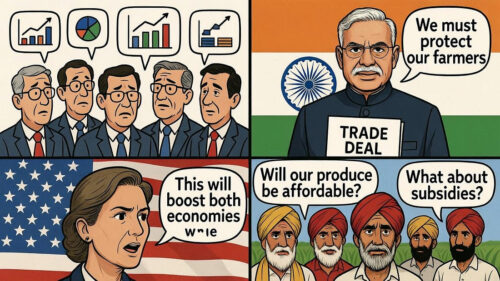
 Farmer organizations have called for Bharat Bandhs, fearing a deluge of cheap US imports that could devastate local livelihoods. Opposition voices paint it as a betrayal, prioritizing foreign interests over our rural backbone.
But as someone who values facts over frenzy, I believe these apprehensions are largely misplaced.
This deal isn’t a zero-sum game—it’s a balanced step toward boosting exports, addressing domestic shortages, and supporting our protein-deficient diets without undermining key sectors. Drawing from expert analyses like Shekhar Gupta’s in-depth breakdowns on ThePrint’s “Cut The Clutter” episodes and Ashok Gulati’s recent interview on The Wire with Karan Thapar, let’s debunk the myths with data and reality.
First, the big picture: India’s agricultural trade with the US already runs a healthy surplus. As Gupta highlights, we export about $5.9-6.2 billion worth of farm goods to the US annually—think basmati rice ($1.8 billion), spices ($900 million), tree nuts like cashews ($750 million), and marine products ($650 million)—while importing around $2.7 billion, yielding a $3-4.1 billion surplus. Projections show this gap widening as zero-tariff access opens US markets to Indian spices, tea, coffee, fruits like mangoes and papayas, and marine products—sectors where our farmers excel. The total US import market for these categories is $82 billion globally, with India holding just a 3.5% share; this deal could double that, directly benefiting smallholders through higher prices and demand. Far from harming us, it amplifies our strengths while protecting vulnerabilities—staples like rice, wheat, corn, dairy, and poultry remain shielded from imports, ensuring no threat to our food grains.

One persistent myth is that the deal floods our
markets with subsidized US goods, crashing prices.
Truth: It allows limited, targeted imports to fill gaps we can’t meet domestically. Take edible oils, a critical component of our diets. India produces only 9.6 million tonnes annually in 2025-26, covering just 40% of demand—we import 16.7 million tonnes (worth $18-20 billion, half our total ag imports) to bridge the shortfall. Our country, largely vegetarian (nearly 30% strictly so), can’t sustain on wheat and rice alone—these provide carbs but lack essential proteins and fats. Protein deficiency affects 73-80% of Indians, with 84% of vegetarian diets and 65% of non-vegetarian ones falling short. Edible oils like soybean oil (94% of US soybeans are GM, but India already imports GM-derived oils from Argentina, Brazil, and others) are vital for cooking and indirectly for protein via animal feed. As Gupta explains, these oils are safe—”they lack proteins or genetic elements”—and without imports, prices would soar, hitting the poor hardest. India’s overall ag imports are $38.5 billion against $52 billion in exports, a $13.5 billion surplus, positioning us as a “food power.” Gulati echoes this, noting we’ve imported GM soybean oil from Argentina and Brazil for ~20 years, with FSSAI clearance despite debates on trace GM elements: “There is some difference of opinion depending upon the process… the traces can remain.” He argues such imports aren’t new risks but essential, given our shortages.
This ties into another key aspect: animal feed.
The deal permits imports of dried distillers’ grains with solubles (DDGS) and
de-oiled cake (DOC)—byproducts used in poultry, dairy, and aquaculture—but only
in limited quantities. India has capped DDGS at 0.5 million tonnes in the first
phase, a mere 1% of our 50 million tonne annual feed consumption. We already
import these (about $1 billion worth) to meet shortages, as domestic production
falls short amid rising demand from our booming livestock sector. DDGS, cheaper
than soy DOC (Rs 24-25/kg vs. Rs 43/kg for high-protein soy meal), lowers feed
costs by 15-20%, making milk, eggs, and meat more affordable. Dairy and
poultry, crucial protein sources for our vegetarian-leaning population, are
fully protected—no direct imports allowed. This isn’t dumping; it’s smart supplementation
that supports rural incomes in these sectors, which employ millions. As Gupta
debunks, “No country is fully food self-sufficient this day and age… oil
seeds and pulses is a concern,” but these imports enhance quality amid
rising demand. Gulati adds nuance, confirming GM traces in DDGS are
“almost certain” and enter the food chain via feed: “Through the
feed to the food chain, it will enter. Poultry will be eating it. Cattle will
be eating it. Milk comes from cattle.” However, he points out we’re
already exposed through domestic GM cottonseed oil and feed, often illegally
per FSSAI, so the deal doesn’t introduce novel threats but highlights policy
gaps.
The pulses panic is another myth amplified by
the initial US factsheet mentioning “certain pulses,” which was
quickly removed. Gupta calls this a “triple paradox”: India is the
world’s largest producer (27-28% of global output, 26-27 million tons
annually), consumer, and importer, facing a 20-25% shortfall. In FY 2024-25, we
imported 7.256 million tons worth $5.48 billion—yellow peas (2.2 million tons
from Canada/Russia), chana (1.66 million from Australia), arhar/tur (1.2
million from Myanmar/Africa), masur (1.2 million from Canada/Australia/US), and
urad (1 million from Myanmar/Brazil). Imports peak during droughts (e.g., 6.7
million tons in 2016-17) but drop with good monsoons (2.4 million in 2021-22).
The Modi government’s “Mission for Aatmanirbhar in Pulses 2025-2031”
(₹11,440 crore outlay) is distributing 8.8 lakh free seed kits for short-duration
varieties, aiming for 35 million tons output. Pulses aren’t threatened by the
deal; as Gupta says, “India will not buy some dal from some place just to
dump it somewhere. It will buy what is needed.” We’re 75-80%
self-sufficient here, far better than edible oils (40%).
Then there’s the apple controversy. Yes, US
apples will enter at lower tariffs, but will they “destroy” Indian
farmers? Hardly. India’s apple production hit 2.55 million tonnes in 2025, with
imports at 600,000 tonnes filling year-round demand. Our horticulture is
seasonal: Kashmir and Himachal harvests peak July-October, while US varieties
(with advanced storage) arrive off-season, complementing rather than competing.
Regions outside the north rely on imports for consistent supply, and US apples
target premium urban markets, not local mandis. Past trade spats (e.g., 2018
tariffs) showed US exports rebound without decimating us—India’s market share
in apples remains dominant at home. Gupta extends this to other fruits and
nuts: We import 98% of our almonds (192,000 tons vs. 4,100 domestic) and 70,000
tons of walnuts (against 30-35,000 produced), but this fills gaps, not harms
growers. This isn’t harm; it’s choice for consumers and stability for growers.
Critics hype GM risks from DDGS (derived from
US corn), but traces in feed are already common via existing imports, and the
government assures no direct GM crops enter. Gupta reinforces this: Science
supports tested GM seeds, and India’s blocks (e.g., on advanced GM cotton) are
“self-inflicted” wounds from underinvestment in research—our ag
research budget is just $1.1 billion vs. Europe’s $2.5 billion for one entity.
Gulati sharply criticizes policy inconsistency: We allow GM cotton (95% of
cultivation) but not corn or soybean, despite U.S. yields being “three
times higher.” “Farmers are losing out… their productivity is
one-third of the productivity that could happen,” he says, adding that
without science-based policies, “your future will remain bleak.” He
faults Commerce Minister Piyush Goyal’s claim of no GM items entering as
inaccurate for DDGS (”he’s definitely wrong”) and possibly soybean
oil, urging respect for scientific agencies like GEAC: “When scientific
tests have been done and GEAC has approved… Rest is all politics or ideology.
It’s not science.” Our $500 billion purchase “intention” isn’t
binding—it’s aspirational, focused on energy and tech, not ag overload.
Protests are understandable amid rural distress (over 10,000 farmer suicides
yearly), but blaming this deal ignores real fixes: legal MSP guarantees, better
irrigation, and tech adoption to match US yields (our corn at 3.4 tonnes/ha vs.
their 11). As Gupta urges, “You can’t spend so little on agricultural
research and then feel sorry for your farmer… Be like the Chinese.” Gulati
agrees, noting “the Indian people are the ones who are losing out”
from such inconsistencies.
In truth, this framework aligns with
Aatmanirbhar Bharat by exporting more while importing only essentials we lack,
potentially adding billions to farmer incomes and easing protein accessibility
while safeguarding the dairy and poultry —both fully protected under the deal.
It stabilizes diets in a nation where calorie intake masks nutrient gaps,
especially for our largely vegetarian population whose protein needs must primarily
come from pulses.
Yet, contrarian voices, like those from Samyukt Kisan Morcha (SKM) and opposition figures, decry it as a “doomsday” for agriculture, predicting a flood of subsidized US goods that will “kill Indian farmers,” crush smallholders in soybeans and maize, lead to mass job losses, rural migration, and even higher suicides by creating dependency on GM-laden imports from US agribusiness giants. These ill-informed alarms overlook the deal’s exclusions for staples, phased tariff cuts over 10 years for adjustment, our existing $3-4 billion ag surplus, and ongoing self-sufficiency drives like the pulses mission. Pro-deal perspectives, including from RSS affiliates like Bharatiya Kisan Sangh and government officials, emphasize export wins for spices and fruits, protected sectors, and no compromise on dairy or grains, while economists like Gulati stress that real threats stem from our own policy flip-flops on GM and low R&D, not this balanced pact.
The core point is to look at the domestic policies which are limiting the agriculture growth. CACP terms, food subsidy at the cost of farmers welfare, priority of the governments to keep prices under check, Essential commodities act, erratic import export restrictions, all add to the misery of farmers. That is where the error lies, and we are looking elsewhere for the fault.
Another myth that needs to be broken is that Indian farmers are beneficiaries of subsidies. All data tells that Indian farmers are implicitly taxed. For reference you can read OECD’s report.