
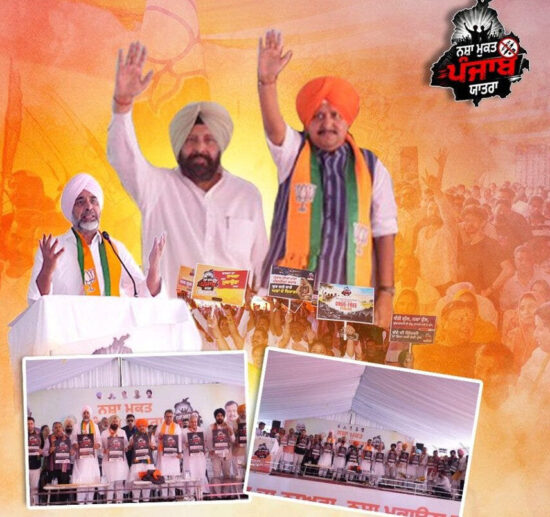
 Punjab politics has a habit of waiting for the Akalis. The Bharatiya Janata Party (BJP) has, for once, declined to, and has set out on the road without its old hamsafar (the Urdu word for a companion on a journey, and just as often for a spouse). In late August, sources were telling news agencies that seat-sharing talks with the Shiromani Akali Dal (SAD) were in their “final stages”, with the BJP cast as the big brother; three weeks on, nothing has been signed. On 11 September the state president, Kewal Singh Dhillon, announced in Chandigarh a thirteen-day programme of four Nasha Mukt Punjab Yatras (tagline: Bhajpa Da Naara, Nasha Mukauna Saara) to cover all 117 Assembly segments, built on three themes: drugs, law and order, and corruption. A party that starts marching before a single seat is shared is telling its prospective ally what it thinks the gradation list should look like.
National president Nitin Nabin flagged off the first yatra on 18 September from Ekta Sthal, the Dr. Syama Prasad Mookerjee memorial at Madhopur on the Ravi, in Sujanpur (the segment the Election Commission numbers 1). The second is scheduled from Sri Fatehgarh Sahib on the 19th, the third from Fazilka on the 20th and the fourth from Talwandi Sabo on the 21st. All four converge on Jalandhar on 30 September, with Union Home Minister Amit Shah as the closing speaker. On day one, AAP and BJP workers clashed at Pangoli Chowk in Sujanpur before the yatra had even cleared its home district.
The issue chimes, and nowhere more than in the border belt. Drive the first yatra’s route (Pathankot, Dina Nagar, Gurdaspur, Batala, Dera Baba Nanak, Ajnala, Attari) and village after village has a family that has paid for it.
II. A Saw with Two Handles
The BJP may not have fully priced in who else gets to hold the issue. At the 11 September press conference, national vice-president Manpreet Badal called the drug menace a question of national security as well as a human tragedy. He is right. He has also, perhaps without meaning to, placed the problem squarely in New Delhi’s own jurisdiction.
In the Shivalik forests the old crosscut saw needed two men, one at each handle, pulling in turn. The drugs-and-gangsters question has put both handles in the Congress’s hands.
The first handle is the Centre. By a notification of 11 October 2021, the Ministry of Home Affairs extended the jurisdiction of the Border Security Force (BSF) in Punjab from 15 to 50 kilometres inside the international border, a belt that takes in most of all six border districts. The Narcotics Control Bureau (NCB), the National Investigation Agency (NIA) and the Intelligence Bureau (IB) all answer to New Delhi, and none of them is marching.
The second handle is the State. Law and order is a State subject, the Punjab Police answers to the Aam Aadmi Party (AAP) government, and the AAP’s Yudh Nashian Virudh campaign, running since 1 March 2025, has produced arrests by the thousand and a steady drumbeat of seizure figures. Convictions make a thinner file.
One case shows both handles at once. In July, an indictment unsealed in Los Angeles described Jaggu Bhagwanpuria’s syndicate and alleged that the Station House Officer at Tanda had done its bidding, while Bhagwanpuria himself sat in Silchar Central Jail in Assam, where the NCB had lodged him under the PIT-NDPS Act (the preventive-detention law for narcotics). The indictment puts a State officer and a Central detention in the same document, and the Congress did not have to invent either.
III. Chapter, Verse and Date
The Congress is working the saw in three ways.On the street, State Congress president Amarinder Singh Raja Warring led workers towards the Chief Minister’s residence over law and order and drugs, and was met with water cannons.At Lok Bhawan, Charanjit Singh Channi and Sukhjinder Singh Randhawa led a delegation to Governor Gulab Chand Kataria on 10 September over the suicide of Gulzar Singh, a Dalit daily-wager from Sangrur.
On paper, the most sustained work has been Randhawa’s. As MP for Gurdaspur, which the first yatra crosses end to end, he has written to the Prime Minister and the Home Minister on killings and extortion in the border belt. On 11 August he wrote to the Finance Minister asking the Enforcement Directorate and the Income Tax Department (both within her ministry) to examine the money being spent on mass marriages and shagun in Dera Baba Nanak by Rajwinder Kaur, Bhagwanpuria’s maternal aunt and chairperson of the block samiti. The method is the old administrative one: a date, a place, a name, and an addressee who holds the lever. A letter built that way is harder to answer with a slogan.
His opponents keep a ledger of their own. Randhawa was Punjab’s Jails Minister, and later its Home Minister. Bikram Singh Majithia once accused him on the floor of the House of patronising Bhagwanpuria’s extortion from jail, a charge Randhawa met by accusing Majithia in turn, and the AAP has lately revived the Mukhtar Ansari episode at Ropar. Randhawa, for his part, has said that Bhagwanpuria threatened his son last year. All of it is on the public record.
IV. Faction, Friction and a Pilot
None of this depends on the Congress being united, which is as well, because it is not. On 5 September the high command replaced Bhupesh Baghel with Sachin Pilot as general secretary in charge of Punjab. Days later Channi, Randhawa, Pargat Singh and others stayed away from Warring’s march. Yet Channi and Randhawa stood together at Lok Bhawan. For a divided party the drug issue has a practical advantage, since each faction can pick up a handle without asking the other’s permission.
V. Whose Waris?
The Congress is not the only claimant. The Akali Dal (Waris Punjab De) has named its jailed president, Khadoor Sahib MP Amritpal Singh, as its chief ministerial face and is fielding candidates from the families of Sikh ‘martyrs’. Its parent movement’s 2022 tours under Amritpal paired amrit sanchar with a campaign against drugs, and its bet now is that the drug issue, with Amritpal offered as the answer, will carry it. Sukhbir Badal’s Punjab Bachao rallies lead on drugs too, and he has called the new outfit a “virus”. The AAP will say, with its seizure figures, that it alone is fighting.
Punjab’s two most talked-about prisoners are both in Assam: Amritpal under the National Security Act in Dibrugarh, Bhagwanpuria under the PIT-NDPS Act in Silchar. Both are held on preventive-detention orders, not on any conviction, and both are campaign issues.
As for whom Punjab will trust, the border voter has heard deadlines before; the AAP’s own was a drug-free Punjab by 31 May 2025. That voter is likely to back whichever party can show a conviction, a dismantled network or a gangster brought to trial before the polls. On 30 September at Jalandhar, the Home Minister speaks for the party that holds the first handle, and the border belt will be listening for what he says about the BSF, the NCB and Silchar.