
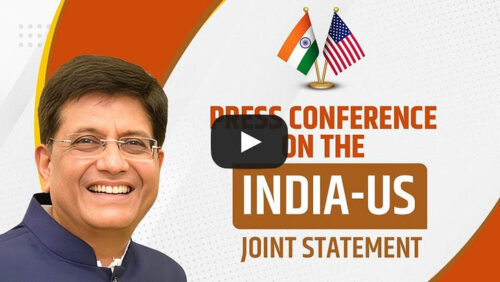
 The Government of India has issued an official press note on the India–US interim trade framework, and Piyush Goyal, Union Minister for Commerce and Industry, has followed it up with a detailed public statement and media briefing. The government’s position has been placed on record through an official PIB release
https://www.pib.gov.in/PressReleasePage.aspx?PRID=2224783®=3&lang=2
and reinforced through the minister’s interaction with the media, available on the government’s official YouTube channel and on social media platforms @ani_trending
Asian News International on Instagram: ““डंके की चोट पे कह सकता…
.
The message from the government is clear and categorical: Indian agriculture is “fully protected” and none of India’s long-standing agricultural red lines have been crossed. As the minister stated, there has been no compromise whatsoever on sensitive farm sectors.
The safeguards outlined are both unambiguous and comprehensive. No tariff concessions or market access have been granted to the United States for India’s sensitive agricultural products. Core food staples—rice, wheat, maize, other cereals, pulses and millets—remain completely outside the scope of tariff liberalisation. Equally important is the complete protection of the dairy sector, including milk and milk products, which supports millions of small and marginal farmers. Poultry, meat products, ethanol, tobacco, oilseeds and key vegetables have also been expressly excluded from any duty concessions, a fact reiterated by the minister while rejecting allegations of the deal being anti-farmer
https://www.firstpost.com/world/piyush-goyal-rejects-anti-farmer-charge-defends-india-us-interim-trade-deal-13977287.html.
The government has further clarified that there is no dilution of India’s regulatory framework, including firm restrictions on genetically modified food products. While India has secured improved—and in some cases zero-duty—access for select agricultural and non-agricultural exports to the US
https://www.indiatoday.in/business/story/diamonds-pharma-items-smartphone-parts-to-face-zero-tariffs-piyush-goyal-on-india-us-trade-deal-2864608-2026-02-07,
there is no reciprocal opening of the Indian market that could destabilise domestic prices or undermine farmer incomes.
Taken together, these official clarifications should decisively end the unnecessary debate and alarmist rumours that Indian farmers will be “killed” by the trade framework. What emerges instead is a policy marked by continuity, caution and calibrated openness—one that expands export opportunities while firmly safeguarding food security and farmer livelihoods.