
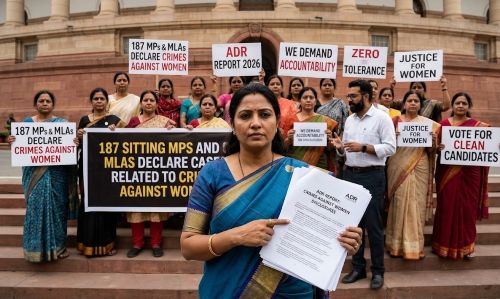
NEW DELHI, October 23, 2026: A new report by the Association for Democratic Reforms (ADR) and National Election Watch (NEW) has raised serious questions about the criminal backgrounds disclosed by elected representatives in India. According to the report, 187 sitting Members of Parliament (MPs) and Members of Legislative Assemblies (MLAs) have declared criminal cases related to crimes against women in their election affidavits.
The findings are particularly significant because they concern individuals who currently hold elected public office and are expected to represent citizens, participate in lawmaking and uphold public accountability. The report identifies 19 sitting MPs and 168 sitting MLAs who have declared cases related to crimes against women. The findings are based on election affidavits submitted to the Election Commission of India (ECI) between 2022 and 2026. <Cite refs={[“turn627416view0”]}/>
The report does not establish that these elected representatives have been convicted of the offences concerned. Rather, it examines cases declared in their sworn election affidavits. The legal status of individual cases may have changed since the affidavits were submitted, and the report states that their current status is not known and may vary from case to case. Nevertheless, the disclosures raise important questions about candidate selection, the scrutiny of political parties and the public’s right to make informed electoral choices.
Nearly 4,900 election affidavits examined
ADR and NEW analysed 4,881 out of 4,899 election affidavits of sitting MPs and MLAs across India’s states and union territories. The analysis covered 772 out of 776 sitting MPs and 4,109 out of 4,123 sitting MLAs.
The study also included affidavits submitted during by-elections held over the five-year period when seats became vacant because of resignation, death or other reasons.
The information was extracted from Form 26 affidavits submitted to the ECI by candidates when they contested elections between 2022 and 2026. These affidavits provide voters with information about candidates’ declared criminal cases and other relevant background details. <Cite refs={[“turn627416view0”]}/>
Of the 4,881 elected representatives whose affidavits were analysed, 187, or approximately 3.8 per cent, declared cases related to crimes against women. This includes approximately 2.5 per cent of the 772 MPs analysed and 4.1 per cent of the 4,109 MLAs analysed.
These percentages describe the proportion of elected representatives who disclosed such cases in their affidavits. They should not be interpreted as a measure of guilt or as evidence that every individual case has been proved in court.
BJP, Congress and TDP figures in the report
The party-wise analysis identifies the Bharatiya Janata Party (BJP) as having the highest number of sitting MPs and MLAs who declared cases related to crimes against women, with 106 representatives. The Indian National Congress (INC) follows with 20, while the Telugu Desam Party (TDP) has 18.
These figures are counts of elected representatives identified in the report, not conviction figures. They also do not, by themselves, establish which party has the highest proportion of representatives with such disclosures, because the total number of MPs and MLAs belonging to each party differs. <Cite refs={[“turn627416view0”]}/>
The findings place responsibility on political parties across the political spectrum to explain how they assess candidates before giving them tickets. Parties have a legitimate responsibility to examine candidates’ backgrounds carefully, disclose relevant information and explain their decisions to voters.
The issue should not be reduced to a political contest in which one party uses the figures to attack another. The broader question is whether political organisations consistently apply transparent standards when selecting candidates, especially when declared cases concern offences against women.
Fourteen representatives declare rape-related cases
One of the most concerning findings concerns rape-related cases. According to ADR, 14 of the 187 sitting MPs and MLAs who declared cases related to crimes against women also declared cases related to rape under Section 376 of the Indian Penal Code or repeated rape of the same woman under Section 376(2)(n).
Of these 14 representatives, two are sitting Lok Sabha MPs and 12 are sitting MLAs.
The party-wise figures show that the BJP and Congress have four representatives each who declared rape-related cases. The BJP figure comprises two sitting MPs and two sitting MLAs, while the four Congress representatives are sitting MLAs. The report also identifies one sitting MLA each from the TDP, Democratic Trinamool Congress, Biju Janata Dal (BJD), National People’s Party (NPP), Bharat Adivasi Party and All India Secular Front. <Cite refs={[“turn627416view0”]}/>
These are disclosures of cases, not findings of guilt. Every case must be assessed according to its individual facts, procedural status and the outcome of judicial proceedings. At the same time, the seriousness of the alleged offences makes timely investigations and transparent public information particularly important.
The report brings the candidate-selection process into focus. Political parties should be able to explain what due diligence they undertake when candidates disclose serious allegations in their affidavits, and what safeguards they use to ensure that voters have accurate information.
West Bengal records the highest number
The state-wise analysis identifies West Bengal as having the highest number of sitting MPs and MLAs who declared cases related to crimes against women, with 69 representatives. Andhra Pradesh follows with 22, while Odisha has 17.
These are state-wise counts rather than rates adjusted for the number of elected representatives in each state. Consequently, the figures should not automatically be interpreted as showing which state has the highest proportion of legislators with such disclosures. <Cite refs={[“turn627416view0”]}/>
The state-level findings nevertheless provide an important starting point for examining candidate selection and electoral accountability. Political parties, election authorities, civil society organisations and voters can use such information to demand greater transparency and more consistent scrutiny of candidates.
Crimes against women remain a major national concern
The ADR findings come against the backdrop of a continuing national challenge involving violence against women.
According to the National Crime Records Bureau (NCRB), India registered 4,41,534 cases of crimes against women in 2024, equivalent to approximately 1,210 registered cases per day. The national crime rate was 64.6 cases per lakh women. Delhi and Telangana recorded rates of approximately twice the national average. <Cite refs={[“turn627416view0″,”turn627416search2″,”turn627416search8”]}/>
These figures represent cases registered by the police, not necessarily the total number of offences that occurred. Reporting practices, access to law enforcement and the willingness of victims to come forward can influence recorded crime figures.
The national data and the ADR report measure different things. NCRB figures concern police-registered cases involving crimes against women, while ADR examines declared criminal cases associated with elected representatives. The two sets of figures should therefore not be treated as directly equivalent. Together, however, they underline the importance of effective law enforcement, fair investigations and accountability in public life.
Should political parties face greater scrutiny over candidate selection?
India’s electoral system requires candidates to disclose specified criminal-case information in their affidavits. This disclosure helps voters assess candidates using information that might otherwise be difficult to obtain.
But disclosure alone cannot answer every question. Voters also need information that is accurate, accessible and up to date. Political parties should be transparent about their candidate-selection procedures and explain how they consider serious criminal allegations while respecting the legal rights of the individuals concerned.
Election authorities and other relevant institutions should ensure that affidavit information is accessible and that applicable disclosure requirements are enforced. Cases involving serious allegations should proceed through the justice system without unnecessary delay, while every accused person retains the right to a fair trial and the presumption of innocence.
It is equally important not to confuse an allegation with a conviction. A pending case does not establish that an accused person committed an offence. Equally, the existence of legal proceedings should not prevent voters from asking legitimate questions about the information disclosed by candidates and the standards applied by political parties.
The need for transparency and public accountability
The ADR report highlights an issue that extends beyond party politics. Elected representatives exercise public authority and help shape laws, policies and institutions. Citizens therefore have a legitimate interest in understanding the information candidates disclose about their backgrounds.
Political parties should adopt clear, transparent procedures for reviewing candidates’ affidavits, including disclosures involving serious offences against women. They should also provide meaningful explanations when questions arise about candidate selection, rather than treating scrutiny as merely a partisan attack.
The public, meanwhile, should examine the complete evidence, distinguish allegations from judicial findings and avoid drawing conclusions about individual guilt from aggregate statistics alone.
The central issue is not simply how many elected representatives have declared such cases. It is whether India’s political and judicial institutions provide a transparent process in which voters receive reliable information, allegations are investigated fairly and justice is delivered without unnecessary delay.
The ADR report is a reminder that electoral accountability requires more than the publication of affidavits. It requires informed voters, responsible candidate selection, accurate disclosure and a justice system capable of dealing with cases fairly and efficiently.
Source: Association for Democratic Reforms (ADR) and National Election Watch (NEW), “Analysis of Sitting MPs/MLAs with Declared Cases Related to Crimes Against Women,” published October 23, 2026.
Read the official report in English and Hindi: https://adrindia.org/content/Analysis-of-Sitting-MPs-and-MLAs-with-Declared-Cases-Related-to-Crimes-against-Women-2026
Editorial note: All figures in this article refer to declared cases in election affidavits. They should not be interpreted as convictions. The current status of individual cases requires separate verification.