
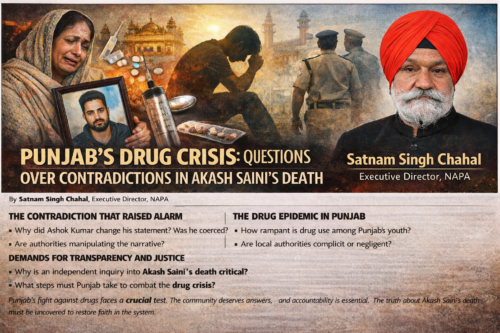
 Punjab’s longstanding battle with drug abuse has once again captured attention following the tragic death of 26-year-old Akash Saini. His passing has stirred widespread concern, not only because of the continuing epidemic of narcotics in the state but also due to contradictory statements made by his father, Ashok Kumar, which have sparked public debate about transparency, accountability, and systemic failures in law enforcement.
The controversy arose when the Amritsar Police Commissionerate released a video on social media, described as a “fact-check” of Ashok Kumar’s earlier statements. Initially, the father had openly said that his son’s death was caused by drug addiction and had urged authorities to take stronger action against local drug suppliers. In the video, however, he appeared to retract these claims, leaving many observers puzzled about whether the father had spoken under pressure or emotional distress.
Residents of the Guru Nanakpura locality, where Akash’s body was found, say that the area has long been known for open drug activity and a lack of safety. “We have repeatedly complained about drug dealers operating openly near our homes,” said a resident. “It is heartbreaking to see a young life lost, and then hear conflicting reports about what really happened. It adds to the fear and frustration in our community.”
Experts suggest that the retraction of Ashok Kumar’s statements may indicate a broader pattern in Punjab, where families of drug victims sometimes feel intimidated or coerced into modifying their narratives. “This is a systemic problem,” said a human rights lawyer familiar with drug-related cases in the state. “When families feel unable to speak freely, it undermines enforcement and allows traffickers to operate with little risk of accountability.”
The death of Akash Saini is not an isolated incident. Punjab has seen a rising number of deaths among young men in residential neighborhoods, public spaces, and even near police-monitored areas known for drug activity. Synthetic drugs and chemical intoxicants continue to spread rapidly across districts and even international borders. Despite repeated political promises to tackle the problem, the availability of drugs remains alarmingly high, and public confidence in enforcement agencies has eroded significantly.
Many families have reported delays in police response, conflicting information from authorities, and opaque forensic procedures, leaving relatives frustrated and fearful. Observers note that cases like Akash Saini’s highlight the urgent need for transparent investigations, better communication, and stronger policing. “When law enforcement controls the narrative instead of providing clarity, it damages public trust and prevents meaningful action,” said a former law enforcement official in Amritsar.
Social organisations and diaspora groups have called for an independent and impartial inquiry into the circumstances of Akash’s death, including any pressures that may have influenced his father’s statements. Transparency and accountability, they stress, are not just necessary for this case but essential to restore public faith in the fight against the drug menace across Punjab.
The tragedy also sends a personal message to Punjab’s youth and families. Experts and community leaders emphasize that young people should seek help if struggling with addiction, support peers who may be silently suffering, and maintain awareness of the dangers surrounding synthetic drugs. Parents are urged to remain vigilant, compassionate, and proactive in engaging with their children’s emotional and physical well-being.
The death of Akash Saini is a stark reminder of the human cost of Punjab’s drug epidemic.Without urgent, honest measures to tackle trafficking, strengthen enforcement, and ensure transparent investigations, similar tragedies are likely to continue. For the thousands of families affected by this crisis, accountability and clarity are no longer optional — they are a matter of life and death.