
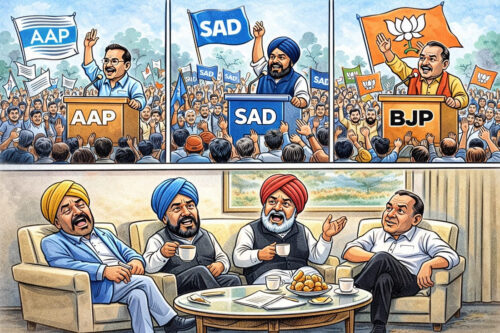
 Senior leaders who, until recently, were locked in visible factional rivalries now appear together at polished dinner gatherings and tightly scripted strategy meetings. The optics are deliberate. The messaging is disciplined. The intent is unmistakable: to convey stability ahead of the 2027 Assembly elections.
While rival parties have already begun structured campaigns and articulated preliminary agendas, Congress observers and in-charges appear to be working overtime as firefighters—dousing flames of internal discord largely of their own making. When AAP, SAD and BJP are in the field, organising rallies, Congress is in drawing rooms.
Yet beneath this carefully curated façade lies a restless and unresolved organisational churn.
Recent internal meetings, convened in preparation for high-profile rallies, have reportedly witnessed sharp exchanges over leadership, candidate selection and generational transition. One senior leader has even levelled serious allegations of a deliberate attempt to tarnish his image. While public statements speak of cohesion and collective resolve, private deliberations reveal lingering distrust and competitive positioning. What is being described as “unity” resembles more a tactical ceasefire than a principled convergence.
Politics is fundamentally a game of perception, and in this arena, Congress is steadily losing ground. The public perception of deep and chronic infighting is not easily erased by staged unity. Second, is the discipline. Look at the discipline in AAP, BJP and SAD. Now compare.

Youth Congress Elections: Renewal or Repetition of a Fractured Past?
The most telling indicator of the party’s fragility is not at the top, it is at the grassroots.
The ongoing Youth Congress elections, instead of energising the organisation, are intensifying polarisation across Vidhan Sabha constituencies. During internal deliberations, several leaders sought clarity on the proposal to allocate 60–70 Assembly tickets to youth candidates. This announcement, rather than calming aspirations, has compounded them—fueling sharper competition amid already divisive youth polls. This is a readymade team of 60-70 rebels.
In constituency after constituency, rival camps have crystallised. Ambitious youth aspirants are aligning themselves with competing senior leaders. Patronage and allegiance networks are hardening. Loyalty chains are being drawn vertically rather than collectively. What should have been a democratic exercise in rejuvenation has evolved into a microcosm of the same factionalism the senior leadership claims to be extinguishing. The interference in other constituencies is immense and causing deep politically painful cuts.
In fact, the Youth Congress polls have created multiple sub-factions operating under the patronage of different senior leaders. Listen carefully at the grassroots, and one hears the rumbling undercurrents—restless, competitive, and combustible.
The situation carries an unmistakable sense of déjà vu.
In 2011, Youth Congress elections were conducted just ahead of the 2012 Assembly polls. The atmosphere then too was charged with confidence and anticipation. Yet intense internal competition and factional calculations diluted organisational coherence. Congress entered the 2012 election buoyant but internally fractured. The Shiromani Akali Dal repeated in power. The lesson was unmistakable: unmanaged ambition can sabotage electoral arithmetic.
Today’s internal environment bears uncomfortable similarities.
Firefighting Instead of Forward Thinking
More fundamentally, Punjab Congress appears so consumed with extinguishing its own factional fires that it has failed to articulate a compelling, state-specific vision. And one cannot escape the uneasy suspicion that some of these fires are not accidental—only the matchbox remains unidentified.
Punjab faces structural and deeply entrenched crises:
Agriculture trapped in an ecologically unsustainable paddy-wheat cycle.
Rapidly depleting groundwater reserves.
Youth unemployment driving migration and frustration.
A corrosive drug menace eroding social stability.
Organised gangster networks generating fear and insecurity.
Fiscal strain constraining public investment.
Industrial stagnation limiting economic diversification.
On each of these existential issues, the party’s articulation remains fragmented, cautious, or reactive.
Where is the comprehensive agricultural restructuring blueprint?
Where is the time-bound anti-drug enforcement architecture?
Where is the industrial revival strategy tailored to Punjab?
Where is the sincere fiscal rehabilitation roadmap?
Most important: Where is the sincerity?
Instead, the state unit often appears to echo the themes and campaigns crafted by the national high command, be it institutional disputes, centrally framed welfare narratives, or national slogans. While such themes may mobilise a few committed party workers, they do not automatically resonate with a farmer in Sangrur, a small industrialist in Ludhiana, or an unemployed graduate in Moga.
Punjab’s electorate looks at local issues, domestic crises; not the forced or borrowed narratives form Delhi
Rivals Project Direction; Congress Projects Adjustment
In a fiercely competitive political environment, perception is power.
The Aam Aadmi Party, despite facing sustained governance scrutiny, projects centralised command and narrative discipline. The Shiromani Akali Dal is rebuilding its agrarian and panthic outreach with methodical preparation. The Bharatiya Janata Party is attempting to expand independently by foregrounding law-and-order and development themes.
Whether one agrees with their politics or not, these parties are projecting a direction.
Punjab Congress, by contrast, risks appearing internally preoccupied and ideologically tentative. Tactical unity may prevent public embarrassment. It may buy time. But it cannot generate electoral enthusiasm or restore strategic credibility.
Unity Without Vision Is Hollow
There is nothing inherently objectionable about reconciliation among senior leaders. Organisational discipline is indispensable. However, unity that lacks intellectual clarity and programmatic depth is hollow.
A party does not revive merely by reducing quarrels. It revives by presenting a bold, credible and coherent agenda.
Without a defined economic vision, a structured agricultural diversification strategy, a robust anti-drug enforcement plan, and a transparent candidate selection process insulated from factional patronage, Congress risks repeating its historical miscalculations.
A dinner table can stage harmony. It cannot build conviction.
Survival Politics or Structural Renewal?
Punjab Congress stands at a consequential inflection point. It can continue navigating internal adjustments, managing rival egos and postponing difficult reforms. Or it can transform this fragile truce into a serious exercise in policy articulation and organisational renewal. If it evolves into disciplined clarity backed by state-specific solutions, it may regain credibility.
Punjab does not need choreographed unity. It needs courageous leadership and a clear roadmap. Until Congress moves beyond factional management and articulates a persuasive vision for agriculture, youth, industry and social stability, its tactical unity will remain procedural—not transformative.