
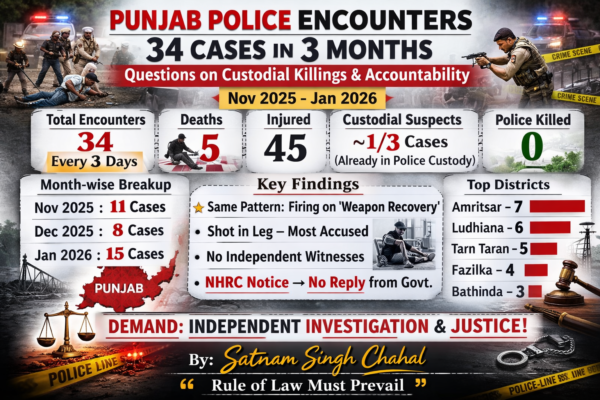
 Punjab is witnessing a disturbing rise in police encounters, raising sharp concerns about legality, transparency, and human rights. In November 2025, DGP Gaurav Yadav publicly revealed that since April 2022, Punjab Police had carried out 324 encounters, resulting in 24 deaths and 515 arrests. While this announcement was framed as a show of strength against gangsters, it quickly triggered debate and scrutiny. A new investigation by The Indian Express shows that between November 2025 and January 2026 alone, 34 encounters took place—an average of one every three days—leading to 5 deaths and 45 injuries. Not a single police official was killed. Most troubling is the fact that nearly one-third of these encounters involved suspects who were already in police custody.
The National Human Rights Commission (NHRC) issued a notice to the Punjab Government in December 2025, seeking a detailed report on what it termed possible “state-sanctioned extrajudicial killings.” However, even after two months, the state has not responded. Human rights groups argue that a repeated pattern is visible: detainees are taken at night or early morning to remote areas—forests, canals, deserted roads—for weapon recovery, without independent witnesses, and are then shot, usually in the legs, with police citing “self-defence.”
Case-by-case examination from November 2025 to January 2026 reveals striking similarities in the official narrative. According to police, suspects either arrived on motorcycles and opened fire, or custodial detainees suddenly snatched hidden pistols and shot at officers during recovery operations. Many of the injured were shot in their legs, and in most cases, there were no independent witnesses. Human rights activist Sarabjit Singh Verka and lawyer Nikhil Sidhu argue that these encounters demand rigorous scrutiny. They cite the Supreme Court’s PUCL guidelines, which mandate independent investigation for every encounter—guidelines they say are being routinely ignored in Punjab.
December 2025 and January 2026 saw several custodial encounters, with December recording eight and January witnessing the highest number—fifteen encounters in a single month. From the Hamur village shootout to the killing of Sukhraj Singh (Gunga) in the Balachaur stadium case, from NDPS operations in Ludhiana to gang-related shootings in Tarn Taran and Fazilka, Punjab Police intensified its operations while maintaining that suspects fired first.
Families of those killed or injured rarely speak publicly, but lawyers and civil society groups in Amritsar, Ludhiana, and Chandigarh argue that these encounters appear politically driven. They claim the current pattern aligns with the state government’s attempt to project a strong law-and-order image through aggressive policing. Critics highlight that out of 515 arrested gangsters mentioned in DGP Yadav’s statement, 319 had gunshot injuries—about 62 percent—raising serious legal questions.
Indian law is clear: an FIR must be registered after every encounter, magistrate inquiry is mandatory, and investigation must be conducted by an officer senior to those involved in the shootout. The Supreme Court’s 2014 PUCL judgment also lays down strict procedures for encounter cases. Critics allege that these procedures are being violated systematically in Punjab.
As Punjab continues to grapple with organized crime and rising gang activity, questions about transparency, legality, and human rights are growing louder. With the state government yet to respond to NHRC’s notice, the debate around encounter policing is far from over, and demands for accountability are intensifying.