
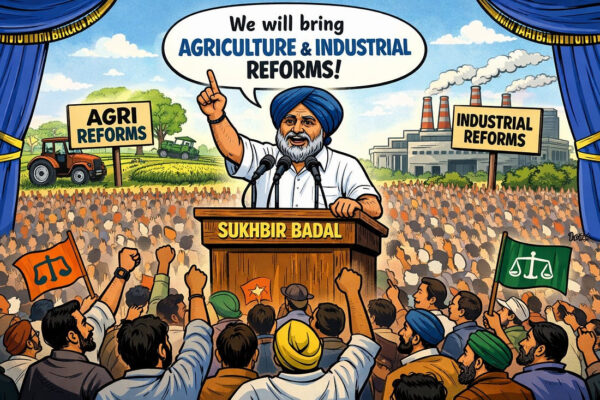
 A Chronicle of Punjab’s Most Turbulent Political Legacy Few political careers in contemporary Punjab have been as dramatic, consequential, and ultimately embattled as that of Sukhbir Singh Badal. As president of the Shiromani Akali Dal (SAD) one of India’s oldest regional parties, founded in 1920 Sukhbir’s tenure from 2008 to 2025 encapsulates the full arc of a dynasty’s glory and gradual unravelling. His story is inseparable from the story of the Akali Dal itself.The Early Ascent: A Dynastic Coronation (2008)Sukhbir Singh Badal, born in 1962, is the son of Parkash Singh Badal a towering figure who served as Punjab’s Chief Minister five times and dominated Sikh politics for over five decades. When Sukhbir was elected SAD president in December 2008, his father was serving as Chief Minister. It was widely seen as a dynastic handover, positioning the son as the heir apparent to one of India’s most powerful political families. Yet Sukhbir was not merely a beneficiary of nepotism. He brought with him a modernising energy.
Known for his corporate-style political management, he revamped the party’s organisational machinery, made it more data-driven, and projected himself as a young, dynamic face of Akali politics. Critics and admirers alike acknowledged that he injected new vigour into a party that risked becoming a relic of the Parkash Singh Badal era.The Highs: Power, Governance, and the 2012 Triumph. Sukhbir’s greatest political triumph came in the 2012 Punjab Assembly elections. Under his leadership of the SAD-BJP alliance, the party secured a rare consecutive term in government a feat virtually unheard of in Punjab’s political history, where voters traditionally alternate between parties. The 2012 victory was credited in large part to Sukhbir’s organisational acumen and aggressive campaigning. During his tenure as Deputy Chief Minister from 2007 to 2017, Sukhbir oversaw several infrastructure and governance initiatives in Punjab.
He was seen as the de facto executive power behind the Badal government, managing key departments including Home and Urban Development. His supporters credit him with administrative efficiency and development work in this period. On the national stage, Sukhbir aligned the SAD with the NDA under Narendra Modi, a partnership that initially brought electoral dividends. His wife, Harsimrat Kaur Badal, served as Union Cabinet Minister for Food Processing Industries from 2014 to 2020, giving the Badal family a prominent voice in Delhi.The Turning Point: Seeds of Decline (2015–2017)The seeds of Sukhbir’s eventual downfall were sown during the second SAD-BJP government (2012–2017), when a series of controversies began to erode public trust. The most damaging of these was the 2015 Guru Granth Sahib sacrilege incidents, in which pages of the Sikh holy scripture were found desecrated in Punjab.
The Badal government’s handling of the protests, including police firing on protesters at Behbal Kalan and Kotkapura, drew fierce condemnation from the Sikh community. Equally controversial was the 2007 pardon extended to Dera Sacha Sauda chief Gurmeet Ram Rahim Singh for a blasphemy case a decision that outraged orthodox Sikh sentiments. These two issues , the sacrilege case and the pardon, would later become the formal grounds on which Sukhbir and other SAD leaders were declared ‘tankhaiya’ (guilty of religious misconduct) by the Akal Takht, Sikhism’s highest temporal authority. The 2017 Punjab Assembly elections delivered a crushing verdict. The SAD was reduced to a mere 15 seats out of 117 a dramatic fall from the heights of 2012. Punjab’s voters punished the Badals for the drug crisis that had ravaged the state’s youth, the sacrilege incidents, and widespread anti-incumbency.The Downward Spiral: 2022 and BeyondDespite the 2017 rout, Sukhbir retained his grip on the party presidency. But the worst was yet to come.
In the 2022 Punjab Assembly elections, the SAD suffered a catastrophic defeat winning only 3 seats out of 117. With its vote share decimated and its cadre demoralised, the party’s 103-year-old legacy seemed imperilled.The rout triggered an unprecedented internal revolt. Senior leaders, including former MP Prem Singh Chandumajra and former SGPC president Bibi Jagir Kaur, publicly demanded Sukhbir’s resignation. An internal inquiry panel the Iqbal Singh Jhundan committee was set up to analyse the reasons for the 2022 debacle. Its recommendations, widely understood to call for leadership change, were reportedly ignored by Sukhbir.The 2024 Lok Sabha elections compounded the disaster. The SAD, which once commanded Punjab’s political landscape, managed to win only one of the 13 parliamentary seats it contested , Bathinda, held by Harsimrat Kaur Badal. The rumour result hardened demands from rebel leaders for Sukhbir to step down.By mid-2024, a formal rebel grouping called the ‘Akali Dal Sudhar Lehar’ (Akali Dal Reform Movement) had coalesced under leaders like Gurpartap Singh Wadala.
They dragged the controversy over the sacrilege case and the Ram Rahim pardon directly to the Akal Takht, appearing before the Sikh religious court in July 2024 and seeking collective forgiveness thereby escalating pressure on the Badal leadership.The Akal Takht Reckoning: Tankhaiya and Tankhah (2024)In a move that shook Punjabi politics to its foundation, the Akal Takht formally declared Sukhbir Singh Badal ‘tankhaiya’ guilty of religious misconduct. On December 2, 2024, the Sikh clergy delivered a historic verdict, awarding punishment (tankhah) to Sukhbir and several other SAD leaders for their role in the sacrilege incidents, the Ram Rahim pardon, and failures of governance that had brought disrepute to the Sikh community.The punishment was both symbolic and deeply humiliating. Sukhbir a former Deputy Chief Minister, once the most powerful man in Punjab after his father was photographed seated in a wheelchair at the entrance of the Golden Temple in Amritsar, dressed as a sevadar (religious volunteer), serving langar (community meals) and cleaning shoes as penance.
It was an extraordinary moment of public atonement for one of India’s most powerful political dynasties.The reckoning almost turned fatal. While undergoing his religious punishment at the Golden Temple premises, Sukhbir narrowly survived an assassination attempt when a gunman opened fire at point-blank range, but the weapon misfired. The dramatic incident only deepened the turbulence surrounding his leadership.The Akal Takht also issued a broader directive: the SAD was to reconstitute itself under a new committee overseen by SGPC president Harjinder Singh Dhami, conduct a fresh membership drive, and elect a new party president under Akal Takht supervision. This effectively called for the removal of Sukhbir from the party’s helm.Resignation, Defiance, and Comeback (2024–2025)Sukhbir had offered his resignation as SAD president on November 16, 2024, submitting it to the party’s Working Committee. Initially, the resignation was not accepted.
After months of internal and external pressure, his resignation was formally accepted on January 10, 2025 ending a 16-year reign as SAD president and marking the first time in 30 years that a member of the Badal family was not at the helm of Punjab’s oldest political party.Yet the political story did not end there. The party remained deeply divided between the Badal loyalists and the rebel faction aligned with Akal Takht directives. In a move that drew fierce criticism from the Akal Takht and opposition parties, Sukhbir was re-elected as SAD president on April 12, 2025, by party delegates loyal to the Badal camp a decision his rivals called a direct affront to the Akal Takht edict.The rival faction, backed by the Akal Takht committee, subsequently elected a breakaway SAD president of their own Harpreet Singh, a Dalit leader and the first of his community to hold such a position in the party’s history.
By August 2025, Punjab had effectively two claimants to the SAD’s presidentship, with both factions disputing ownership of the party’s name, symbol, and institutional legacy.Assessment: Legacy in the BalanceSukhbir Singh Badal’s tenure as SAD president is a tale of extraordinary highs and shattering lows. He took charge of a party at the peak of its power and, over 17 years, presided over its steepest electoral decline. Yet his story also speaks to the resilience or, critics would say, the stubbornness of dynastic politics in India.His supporters argue that the party’s decline was not solely his doing that factors such as the AAP wave, agrarian distress, the drug crisis, and broader anti-incumbency were beyond any single leader’s control.
They credit him with modernising the party’s organisational culture and point to the 2012 election as proof of his capabilities.His critics counter that his autocratic leadership style his unwillingness to heed internal voices, his dominance of Panthic institutions, and his family’s alleged capture of the SAD as a private enterprise accelerated the party’s decay. The sacrilege controversy and the Ram Rahim pardon, they argue, were not just political miscalculations but moral failures that cost the SAD its Panthic credibility.What is beyond dispute is that Sukhbir Singh Badal has navigated the most turbulent chapter in his party’s century-old history. Whether the SAD emerges from its current schism as a unified, revitalised force or fractures irrevocably, Sukhbir’s journey will stand as one of the defining political stories of modern Punjab a story of power, hubris, penance, and an unyielding will to survive.