
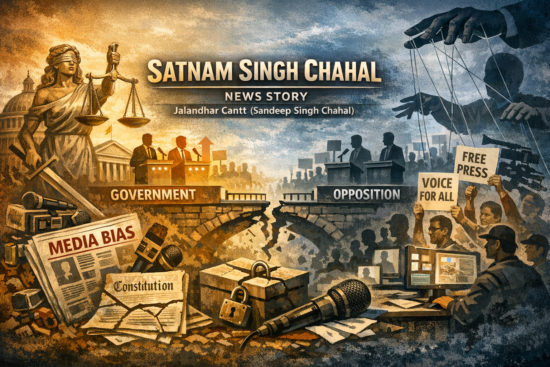
 Jalandhar Cantt( Sandeep Singh Chahal)A growing debate around media accountability has come to the forefront after former minister and MLA Pargat Singh raised concerns over what he described as the “systematic sidelining” of opposition voices in mainstream coverage.
In a strongly worded statement, Singh questioned the role of media in a democratic system, emphasizing that journalism must serve as a bridge between the government and the opposition not a platform for one-sided narratives. He remarked that when media institutions fail to present dissenting voices, they risk undermining the very spirit of democracy.
Political analysts argue that a लोकतांत्रिक system depends heavily on informed citizens who have access to diverse perspectives. When coverage disproportionately favors those in power, it weakens public discourse and limits accountability. Experts warn that such trends could lead to a narrowing of debate, ultimately affecting policy scrutiny and governance.
Media watchdogs and civil society groups have echoed similar concerns, calling for a renewed commitment to editorial independence and ethical journalism. They stress that balanced reporting is not just a professional standard but a democratic necessity.
Support for Singh’s remarks has also gained traction online, where many users have voiced frustration over perceived bias in news reporting. The conversation has sparked a broader reflection on whether media outlets are fulfilling their responsibility as the “fourth pillar” of democracy.As this issue continues to gain momentum, it raises an important question: can democracy truly thrive if all its voices are not given equal space in the public narrative?