
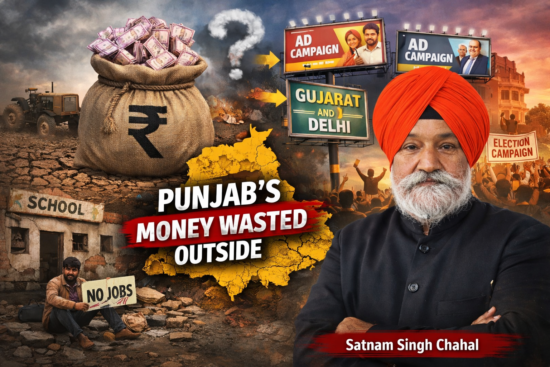
 Punjab today stands at a critical crossroads, facing mounting financial stress, rising unemployment, pressure on agriculture, and visible gaps in public infrastructure. In such a situation, every rupee of public money carries immense value and responsibility. Yet, the growing expenditure of crores of rupees by the Punjab government on advertisements, especially in other states, has sparked a serious debate. The core issue is not merely about spending, but about whether this spending serves the people of Punjab or political interests beyond its borders.
Government advertisements are meant to inform citizens about welfare schemes, policies, and public services. They are supposed to bridge the gap between governance and the public. However, when such advertisements are published or broadcast in states far from Punjab, the immediate question arises: who benefits? Farmers in Punjab do not gain from advertisements placed in Gujarat or Delhi. Youth struggling for employment in Ludhiana or Amritsar do not benefit from campaigns aired in other regions. This disconnect suggests that the purpose of such spending may not be public awareness, but something else entirely.
A growing perception is that these advertisements are aimed at political expansion rather than public service. When ads appear prominently in states heading into elections, it raises suspicion that Punjab’s taxpayers’ money is being used to build political narratives outside the state. This blurs the line between governance and party promotion. A state government is constitutionally bound to serve its own people first, not to fund political visibility elsewhere. If public money is used for indirect political campaigning, it becomes not just an ethical issue but a serious question of accountability.
The financial condition of Punjab makes this issue even more concerning. The state is already burdened with heavy debt, and many essential sectors continue to struggle for adequate funding. Government hospitals often lack modern equipment, schools need urgent upgrades, and infrastructure projects face delays due to limited resources. In such a scenario, allocating hundreds of crores to advertisements appears to be a misplaced priority. The contrast is stark on one hand, departments face financial shortages; on the other, publicity budgets continue to grow.
There is also a significant opportunity cost involved. The money spent on advertisements could have been invested in transformative development. It could have strengthened healthcare systems, improved education, supported farmers, or created employment opportunities for the youth. Instead, it is being used for campaigns that often have no measurable impact on improving the lives of Punjab’s citizens. This raises a fundamental governance question: are these expenditures truly necessary, or are they avoidable luxuries at a time of economic strain?
Transparency further complicates the matter. There is a growing demand for clear and detailed disclosure of advertisement spending. Without transparency, it becomes difficult for the public to understand how much is being spent, where it is being spent, and for what purpose. Public money demands public accountability. When such large sums are involved, silence or incomplete disclosure only deepens public distrust.
The government may argue that advertising outside the state helps build a broader image and attract investment. However, this argument struggles to hold ground when basic issues within the state remain unresolved. Development speaks louder than advertisements. If governance is effective, it naturally becomes visible without the need for excessive promotion.
In the end, the debate over advertisement spending is not just about numbers—it is about priorities, intent, and responsibility. Punjab’s resources are meant for Punjab’s progress. When crores are spent outside the state without clear benefits to its people, it risks being seen as a misuse of public funds. The people of Punjab deserve governance that is focused, transparent, and committed to their welfare not distracted by publicity beyond its borders.
The question remains simple but powerful: should Punjab’s hard-earned money be used to solve Punjab’s problems, or to build an image elsewhere?