
 This article grew out of a routine conversation with my engineering college batchmate, Nirlep Singh, who retired as Chairman and Managing Director of National Fertilizers Limited. It was he who drew my attention to the concrete progress on the TAPI gas pipeline and the fact that it is designed to make landfall at Fazilka in Punjab. I am grateful to him for this valuable insight, which prompted me to explore the wider strategic implications set out in the following pages.
–
In the last few weeks, India has had a brutal preview of what it means to live at the mercy of West Asian sea‑lanes. Rising tensions around Iran and Israel, coupled with threats to shipping near the Strait of Hormuz, have not remained abstractions on foreign pages; they have shown up as abrupt LPG price spikes, erratic supplies and what is, in effect, a quiet rationing of gas cylinders. In city after city, restaurateurs complain of half‑empty dining rooms because they cannot be sure of full cylinders; small dhabas shut early or trim their menus, and households are advised to “use gas judiciously” as if this were wartime, not a normal working month. That sense of creeping scarcity and helpless dependence is the real context in which India must rediscover an old, half‑forgotten idea: the Turkmenistan–Afghanistan–Pakistan–India (TAPI) gas pipeline as a land‑based lifeline that can, over time, help us move beyond the tyranny of cylinders and the chokepoint of Hormuz.
Hormuz as chokepoint, not corridor
The Strait of Hormuz has always been a strategic vulnerability for India, but recent events have turned that vulnerability into a day‑to‑day risk. A large share of our crude and imported LNG flows through this narrow channel between Iran and Oman; when tensions flare, insurers raise premiums, freight rates spike and spot LNG prices start behaving like a roulette wheel. Each new round of brinkmanship—missiles in the region, naval escorts for tankers, threats of closure—translates into anxiety for Indian importers and, ultimately, into higher costs and insecure supplies for Indian consumers.
Energy strategists have long warned that a serious disruption or temporary closure of Hormuz would be a major supply shock for Asia, with India particularly exposed because of its heavy reliance on Gulf producers. The recent scramble for cylinders, and the effective “rationing by regulation” of LPG that has followed, is simply a mild foretaste of what a more sustained crisis could look like. If we continue to treat Middle Eastern sea‑lanes as an unshakeable given, we will also continue to live with recurring episodes of scarcity, price spikes and forced austerity in our kitchens, factories and restaurants.
The forgotten land bridge: what TAPI really is
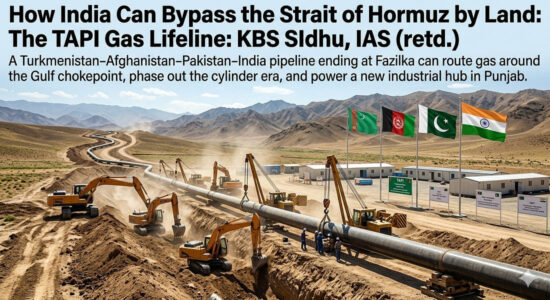
Against this backdrop, TAPI deserves to be seen not as a stalled relic of 1990s energy diplomacy, but as a serious, long‑term hedge. Technically, it is a roughly 1,800‑kilometre, 56‑inch‑diameter, high‑pressure pipeline designed to bring gas from Turkmenistan’s giant Galkynysh field to consumers in Afghanistan, Pakistan and India. It runs a little over 200 kilometres in Turkmenistan from the Mary region to the Afghan border, roughly 770 kilometres across western and southern Afghanistan, and more than 800 kilometres through Pakistan via Quetta and Multan before reaching the Indian border near Fazilka in Punjab.

The design foresees an initial “free‑flow” phase, delivering around 11 billion cubic metres (bcm) per year using wellhead pressure and compressor stations in Turkmenistan, followed by a second phase in which compressor stations in Afghanistan and Pakistan raise throughput to roughly 30‑plus bcm annually. At full capacity, Afghanistan would receive a modest 5 bcm, while Pakistan and India each contract for about 14 bcm a year, over a 30‑year period. In Indian terms, that is in the range of 40 million cubic metres per day: not enough to meet all our needs, but enough to matter significantly for power, industry and city‑gas distribution.
Institutionally, the project is anchored in a special‑purpose company in which Turkmenistan’s state gas firm holds the dominant stake, while the national gas entities of Afghanistan, Pakistan and India (GAIL) hold minority equity. The financing model combines equity from these entities and debt from international lenders and export credit agencies, with a multilateral development bank acting as transaction adviser and partial de‑risking anchor. India is thus woven into TAPI not just as a buyer at the tail‑end, but as a shareholder and political sponsor of a project meant from the outset to deliver non‑maritime gas to our system.
A pipeline through Taliban‑land: risk or opportunity?
For years, the Achilles’ heel of TAPI was Afghanistan. Even during the NATO presence, a steel tube running 770 kilometres through Herat, Farah, Helmand and Kandahar seemed perilously exposed to insurgent attacks. The assumption in Delhi’s corridors was simple: until Afghanistan stabilises, TAPI is a diplomatic talking point, not a real option.
Paradoxically, it is the Taliban regime that has, over the past few years, spoken most openly about TAPI’s importance. Well before they took Kabul, Taliban spokesmen described TAPI as a national project and pledged to protect it in areas under their control, arguing that the transit revenues and jobs would benefit ordinary Afghans. At the ceremonial launch in Herat in 2018, they issued statements promising to safeguard construction and operation rather than to sabotage it. After 2021, as they consolidated power, Taliban leaders have repeatedly assured Turkmenistan of their commitment, casting TAPI as a flagship of Afghanistan’s hoped‑for economic normalisation and even announcing a special force to protect the line.
None of this removes the real risks: an unrecognised regime under sanctions has limited access to finance, rival militant groups may target infrastructure, and political volatility could return. But it does create an unusual alignment of interests in which Turkmenistan, the Taliban authorities, Pakistan and India all stand to gain from a functioning gas corridor. For New Delhi, the question is not whether the Taliban have suddenly become ideal partners. It is whether we can, with our eyes open, use this alignment to build a land‑based hedge against a maritime chokepoint that we know will remain unstable.
Pakistan’s stretch: formal support, hesitant execution
In Pakistan, the TAPI story is more complex than a simple, unified “yes”. On paper, Islamabad has been a committed party: its state company, Inter State Gas Systems, holds equity in the project vehicle, and successive civilian governments have signed on to the inter‑governmental framework, transit arrangements and pricing formulas. Over the years, senior figures in the military establishment have also signalled interest in regional energy corridors, seeing them as a way both to monetise Pakistan’s geography and to alleviate its own chronic gas shortages.
Yet independent assessments point to uneven progress on the Pakistani section. Foreign investors remain wary of security risks along parts of the route, particularly in Balochistan and segments of Khyber‑Pakhtunkhwa, where attacks on energy infrastructure have a long history. Domestic business groups and provincial actors have at times pulled in different directions over questions of right‑of‑way, local employment and benefit‑sharing, complicating land acquisition and project implementation. Layered onto this is Pakistan’s recurring macro‑economic distress, which constrains Islamabad’s ability to offer strong sovereign comfort and long‑term payment security to financiers and suppliers.
The net result is a paradoxical picture. TAPI enjoys formal endorsement from Pakistan’s civilian leadership and at least conditional backing from the army, which has its own interest in additional gas supplies and transit revenue. But on the ground, execution has been slow and risk‑averse, with the Pakistani corridor—like the Afghan one—still facing serious questions of security, governance and economic stability that India cannot ignore as it weighs its own stakes in the project.
Fazilka: landfall of the TAPI lifeline
On current plans, the story of this land route on Indian soil is deceptively simple. The TAPI pipeline crosses into India near Fazilka in Punjab and plugs into the existing high‑pressure gas grid operated by GAIL. On the ground, this means a border receiving and metering station—complete with pressure regulation, quality monitoring and remote control systems—and a short stretch of pipe, roughly ten kilometres long, linking the border to the trunk network.
If we think of Fazilka only in those narrow engineering terms, we are guaranteed to under‑utilise the opportunity. The district will host some technical installations, the gas will disappear into the national grid, and a few city‑gas and CNG networks will spring up over time. Punjab’s energy landscape, however, will remain dominated by the familiar trio of cylinders, diesel and coal, and Fazilka will remain a border outpost rather than an energy hub.
Fazilka: A Potential Gas Hub
A more ambitious approach would treat Fazilka as the landfall of India’s bypass around Hormuz—and as the anchor of a “gas city” vision. On the retail side, that means planning and licensing dense city‑gas distribution networks in Fazilka and neighbouring towns right now, so that households and small businesses can move from bottled LPG to piped natural gas soon after TAPI becomes operational. It also means building a robust CNG—and, eventually, LNG—ecosystem for transport, converting bus fleets, municipal vehicles and freight corridors along the Fazilka–Abohar–Bathinda belt from diesel to gas.
On the industrial side, Fazilka should be conceived explicitly as a gas‑anchored hub rather than a mere landing station. That implies:
A dedicated gas‑based industrial park or special economic zone in the district’s hinterland, where anchor units—fertiliser, petrochemicals, glass, ceramics, textiles, light engineering—are guaranteed long‑term gas supply at the gate.
Integrated food‑processing and cold‑chain complexes, using reliable gas‑fired power and heat to support horticulture, dairy and meat processing, helping southern Punjab diversify away from water‑intensive cropping while adding value locally.
A network of small and medium industrial clusters that can convert from furnace oil and coal to piped gas, reducing pollution while improving reliability and cost predictability.
Fazilka’s location on the Indo‑Pak border, plugged into both the national highway and rail systems, makes it a natural candidate for such a cluster once reliable gas is at the gate. With deliberate planning, the district can become not just an entry point for TAPI but the nucleus of a new gas economy in North‑West India.
From cylinders to strategic autonomy
At present, millions of Indian households, eateries and enterprises are locked into an energy model defined by LPG cylinders and diesel gensets. Cylinders are logistically cumbersome, subject to leakage and diversion, and politically explosive whenever prices rise; diesel is dirty, noisy and volatile in cost. The recent scramble for cylinders in the wake of Hormuz‑linked disruptions has shown just how fragile this model is when global conditions turn hostile.
If India uses the TAPI land route well, this can change over the medium term. On our side of the border, we must be ready with the last‑mile network so that TAPI gas does not merely trickle into an anonymous grid, but actually allows Punjab to dispense with the cylinder era—replacing bottled LPG and scattered diesel sets with efficient, piped gas for households, transport and industry. One pipeline will not erase all our vulnerabilities, but a fully realised TAPI, anchored in a serious Fazilka hub, would have three strategic effects.
First, it would diversify our routes and sources by adding up to 14 bcm per year of pipeline gas from Central Asia, reducing marginal dependence on Gulf LNG that must brave the Hormuz gauntlet. Second, it would strengthen our bargaining power with Gulf suppliers, who would know that India has a credible non‑maritime alternative for a meaningful slice of its gas demand. Third, it would rebalance our regional role: from being a passive victim of Middle Eastern politics, we could become an active participant in a Central Asia–South Asia energy corridor, with Punjab as one of the principal beneficiaries.
To make that happen, New Delhi will need to move beyond polite communiqués about TAPI and invest real political capital: in hard‑nosed risk assessment of Taliban‑ruled Afghanistan; in realistic engagement with Pakistan’s civilian and military establishments on security and transit; in detailed internal planning for gas evacuation and industrial use centred on Fazilka; and in creative financial and diplomatic arrangements that keep all four TAPI parties invested in timely execution. Punjab, for its part, will need to show that it has a concrete “gas city” vision ready to plug into the pipeline the moment it crosses the border.
If the last few weeks have taught us anything, it is that we cannot base our energy security on the hope that West Asian sea‑lanes will always remain calm. A land route that brings gas to Fazilka will not solve all our problems—but it could mark the beginning of the end of India’s cylinder era, and the start of a more autonomous, pipeline‑powered future that finally bypasses the Strait of Hormuz by land.