
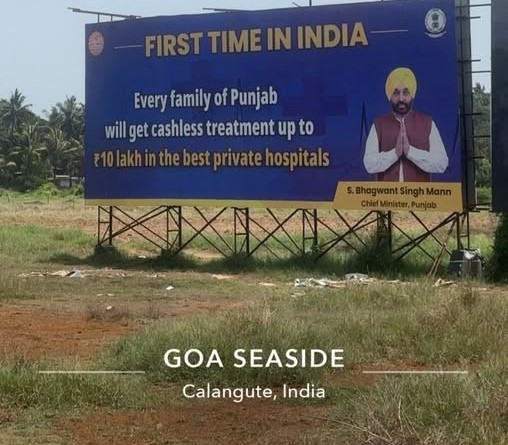
 A striking image from Goa’s Calangute seaside has once again raised uncomfortable questions about governance priorities in Punjab. The large hoarding, featuring Chief Minister Bhagwant Singh Mann, boldly claims “First Time in India” while promising cashless treatment of up to ₹10 lakh for every Punjabi family in the best private hospitals. Yet, the irony of such a grand promise being advertised hundreds of kilometres away from Punjab, on a tourist beach in Goa, has not gone unnoticed.
At a time when Punjab itself is grappling with serious healthcare challenges, the presence of such promotional boards outside the state appears disconnected from ground realities. Critics argue that instead of investing heavily in publicity campaigns across tourist destinations, the government should be focusing on strengthening its own healthcare infrastructure. Reports and concerns have repeatedly surfaced about delayed payments to hospitals, shortages of essential equipment, and even instances where ventilators in government hospitals risk being shut down due to unpaid bills., Instead of investing heavily in publicity campaigns across tourist destinations, the government should focus on strengthening its
This contrast has sparked public frustration. On one hand, citizens hear assurances of world-class healthcare access through large, polished advertisements; on the other, they face practical hurdles when seeking treatment. Doctors and healthcare providers, bound by financial constraints, often demand pending dues to continue services, while patients are left caught between promises and reality. The situation creates a troubling paradox where official messaging suggests abundance, but the system on the ground struggles to deliver even basic continuity of care.
The symbolism of placing such a hoarding on a beach is also being questioned. Goa’s coastline attracts tourists from across the country and abroad, but what purpose does a Punjab-specific welfare announcement serve there? For many observers, it reflects a shift in governance style—where visibility and perception management are prioritized over tangible improvements within the state. The message may reach more eyes, but does it translate into relief for the people it is meant to serve?
There is also a deeper concern about the culture of governance becoming overly dependent on advertising. Public funds, critics argue, should first address pressing needs—healthcare systems, employment generation, agricultural stability, and infrastructure development. Punjab, once considered one of India’s most prosperous states, now faces economic and social challenges that demand urgent attention. In such a scenario, excessive spending on promotional campaigns risks appearing insensitive to the struggles of ordinary citizens.
The question that emerges is simple yet powerful: where should a patient go for treatment? To a hospital struggling with resources, or to a roadside hoarding promising relief? The disconnect between policy announcement and implementation can erode public trust, especially when life-saving services are involved.
Ultimately, governance is not judged by the size or location of hoardings, but by the lived experiences of people. If ventilators stop working, if hospitals hesitate to admit patients, and if essential services are disrupted, no amount of advertising can fill that gap. Punjab’s people need functioning systems, not distant promises. Until then, such images—from beaches or highways—will continue to serve as reminders of a widening gap between projection and reality.