
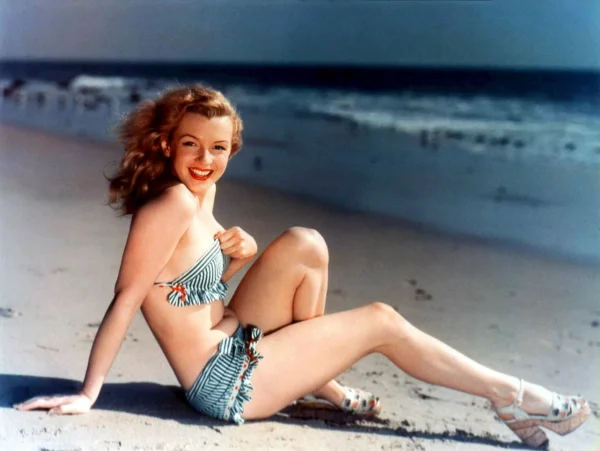
Does the name Norma Jeane Baker ring a bell? Probably not — and that, in itself, is the point. The world knows her by the name the studio gave her: Marilyn Monroe. But it was Norma Jeane Baker — baptised in a Los Angeles church, shuttled between foster homes and an orphanage, her mother institutionalised, her father a rumour — who did all the suffering. Marilyn Monroe merely inherited the glow. This division, between the frightened girl from Hawthorne, California, and the incandescent woman on the silver screen, is the prism through which the entire Monroe story must be read. As the world prepares to mark the centennial of her birth — June 1, 1926 — it is Norma Jeane, not Marilyn, who deserves to be remembered.
I. The Invention of Marilyn
The transformation of Norma Jeane Mortenson into Marilyn Monroe was one of Hollywood’s most deliberate acts of alchemy. A name was chosen — Monroe, after her maternal grandmother Della Monroe — a voice was lowered to a breathy whisper, a walk was cultivated, a persona was engineered. The studio system of the 1940s and 1950s operated as a machine for the manufacture of dreams, and Marilyn was its most spectacular product. She was blonde, luminous, and devastatingly present on screen. She was also deeply, privately uncertain about all of it.
Those who knew Monroe in the years before stardom describe a young woman of surprising intellectual curiosity, warm generosity, and fragile self-regard. She read seriously — Dostoyevsky, Joyce, Whitman — and kept a shelf of poetry beside her bed. She was funny in ways the studio never quite knew what to do with, a natural comic whose timing was impeccable and whose instincts were those of a serious actress, not a pin-up. When she enrolled at the Actors Studio under Lee Strasberg, she was not pretending to depth. She was excavating it, brick by brick, from the ruins of a childhood that had given her precious little to build on.
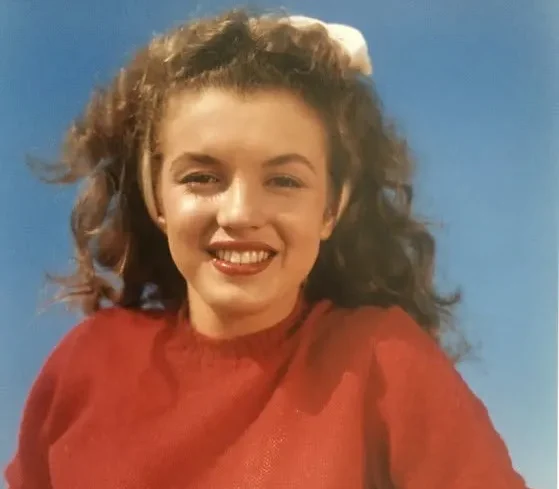
Norma Jean Baker before she morphed into Mrilyn Monroe
II. The Prison of Beauty
Beauty, for Marilyn Monroe, was simultaneously her ticket and her cage. It opened every door and closed every conversation. Studio executives, directors, journalists, and lovers all saw the same thing first — the platinum hair, the half-parted lips, the figure that redefined the contours of postwar desire — and most of them never looked further. She was cast, again and again, as the dumb blonde, the showgirl, the decoration. That she was anything more was considered, at best, an amusing detail.
The cruelty of this is apparent in retrospect. When Monroe lobbied for serious roles, she was humoured or dismissed. When she married Arthur Miller, one of America’s greatest playwrights, and began to move in intellectual circles, she was mocked in the press as a trophy wife playing dress-up. When she co-founded Marilyn Monroe Productions in 1954 — becoming, as the BFI has noted, the first woman since the silent era to establish her own production company — it was treated more as eccentricity than enterprise. She was not supposed to have agency. She was supposed to stand still and be looked at.
No single image captures this paradox more completely than the celebrated skirt scene from The Seven Year Itch (1955), filmed on the streets of New York before a crowd of thousands. Standing over a subway grate on Lexington Avenue, her white halter dress billowing around her, she paused mid-shoot to acknowledge the press corps that had turned out to watch — turning toward the cameras, as she always did, with that instinctive, practised grace. It was the most photographed moment of her career, and one of the most paradoxical: a woman who had fought, quietly and persistently, to be taken seriously as an actress, most remembered for a gust of wind and a flash of leg. Her then-husband Joe DiMaggio, watching from the crowd, was said to be incandescent with rage. She smiled for the cameras anyway.
Marilyn Monroe, New York City, 1954. A pause during the filming of the famous skirt scene from The Seven Year Itch — the star turning, instinctively, toward the cameras that would never stop following her.
She refused, repeatedly and at great personal cost. She walked away from a Fox contract worth a fortune. She negotiated for script approval and director approval. She chose roles that frightened and challenged her. Bus Stop (1956) and The Prince and the Showgirl (1957) demonstrated a range the industry had spent a decade refusing to acknowledge. Some Like It Hot (1959), directed by Billy Wilder — who was famously impatient with her — contains one of the great comic performances in American cinema. Even Wilder, grudgingly, admitted it.
III. The Architecture of Tragedy
The tragedies in Monroe’s life were not dramatic in the Hollywood sense — not sudden reversals, not single catastrophic moments. They accumulated. Three marriages, each failing for different reasons. Two miscarriages that devastated her. A dependency on barbiturates and alcohol that her psychiatrists fed rather than treated. The Kennedy entanglement — never fully explained — that left her isolated at the precise moment her fame was at its most overwhelming. And, underlying everything, the original wound: the child who was never wanted, passed from hand to hand, who had learned to make herself irresistible because invisibility felt like death.

By 1962, the architecture of her life was visibly crumbling. Fox fired her from Something’s Gotta Give after excessive absences. The photographs from her last session — taken by Bert Stern just weeks before her death — show a woman of extraordinary beauty and equally extraordinary sadness. She is luminous and she is lost. Both, simultaneously, without contradiction. On August 4, 1962, she was found dead at her Brentwood home. She was thirty-six years old. The cause — barbiturate overdose — was ruled probable suicide, though questions have never entirely ceased.
IV. The Afterlife
What happened after Monroe’s death is itself a kind of tragedy. She became an industry: a face on a thousand posters, a lyric in an Elton John song, a subject for Norman Mailer’s overreaching biography, a muse for Andy Warhol’s silkscreens that drained her of colour and humanity in equal measure. The centenary year of 2026 brings another wave — exhibitions at the Academy Museum in Los Angeles and the National Portrait Gallery in London, a BFI retrospective season, auction houses selling her handwritten notes and poetry. All of it is sincere. None of it is sufficient.
The most honest thing one can say about Marilyn Monroe at one hundred is this: she was more than the world allowed her to be, and the world has been profiting from her ever since. She remains the supreme example of a woman who was consumed by the very gaze she could not escape. Her intelligence, her ambition, her humour, her capacity for love — these are the footnotes. The image is the headline. She deserved better. Norma Jeane Baker always did.
V. A Mirror Across the World: Marilyn and Madhubala
Half a world away, in the Bollywood of the same era, another woman was living a strikingly parallel story. Madhubala — born Mumtaz Jehan Begum Dehlavi in Delhi in 1933, the daughter of a factory worker who staked everything on his daughter’s beauty — became, by the mid-1950s, the undisputed queen of Hindi cinema. Like Monroe, she was born into poverty and made into a goddess. Like Monroe, she possessed a comic genius — Chalti Ka Naam Gaadi (1958) is irresistible evidence — that was perpetually overshadowed by her physical perfection. Like Monroe, she fell into a love that damaged her: her relationship with Dilip Kumar was intense, public, and ultimately destroyed by familial interference, leaving wounds she never fully healed. And like Monroe, she carried her tragedy inside her body itself — a congenital heart defect diagnosed in 1954, which she concealed from the industry for years while continuing to work, until she could work no more. Madhubala died in February 1969, aged thirty-six — the same age as Monroe at her death — having spent her final nine years largely bedridden, her face still luminous in the photographs taken at her bedside, the camera still in love with a woman the world had not finished looking at. Two women. Two continents. Two different industries built on the same ruthless economy of beauty. Both consumed before forty. Both immortal after.
VI. The Helen of Troy
And therein lies the final, bittersweet truth about both women. Christopher Marlowe asked of Helen of Troy whether this was truly “the face that launch’d a thousand ships.” Marilyn Monroe and Madhubala launched no ships — but they launched entire civilisations of longing. Shakespeare wrote of Cleopatra that age could not wither her, nor custom stale her infinite variety. He meant it as tribute to a woman who had lived and loved across decades. For Monroe and Madhubala, the line carries a darker irony — age was never permitted even the attempt. They remain, instead, ageless and unageing: fixed forever in the amber of their youth, immune to time precisely because time was denied them. The world was denied the sight of what the years would have done, and we may say, with quiet confidence, that they would have done so with great grace. For women of such inner fire, such wit, such hard-won dignity, do not diminish with age; they deepen. But that deepening was never permitted. Instead, Marilyn at thirty-six and Madhubala at thirty-six became permanent — sealed into a moment of impossible beauty, perpetually young on a million screens and posters and pages, eternally the women the camera adored. It is a kind of immortality. It is also a kind of cruelty. They deserved the wrinkles. They deserved the years. Above all, they deserved to grow old.