
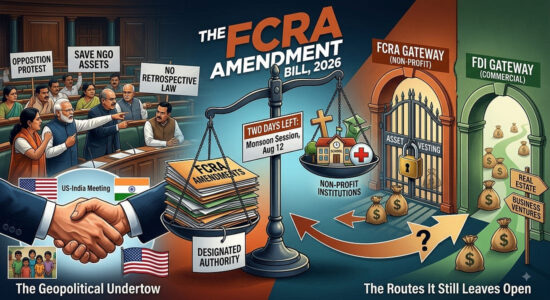
 With the Monsoon Session down to its final two sitting days, the Foreign Contribution (Regulation) Amendment Bill, 2026, remains officially slated for discussion and passage on 12 August — the date the government itself set after weeks of outreach to Opposition parties and an explicit assurance from the Home Minister that the amendments will not apply retrospectively. That official slotting has not been withdrawn or revised on paper.
Yet running against that official position is a distinct and, as of 11 August, strengthening signal that the government is inclined to step back from passage and refer the Bill to a Joint Parliamentary Committee instead. Multiple outlets, citing government and Opposition sources, are reporting this shift: News18 reports the government is “weighing” the JPC route amid growing Opposition numbers; the New Indian Express, citing Opposition sources, reports the government has itself floated the JPC option ahead of taking the Bill up; India TV carries a similar “likely to refer” line. Set against a session with barely two days left to run, a JPC reference would necessarily mean the Bill lapses into a later session for further consideration — an outcome very different from the government’s original intent to close the matter within the Monsoon Session itself.
It is worth being precise about what this is and is not. These are sourced reports of an emerging government inclination, not confirmation that a formal motion has been moved and adopted on the floor of the House. The PIB’s own factsheet, as of 10 August, still described the Bill as simply “under consideration of Parliament,” with no JPC reference announced. So two things are true simultaneously, and the tension between them is the story as this piece goes to press: officially, the Bill is still on the 12 August agenda for passage; unofficially, with the session’s clock nearly run out, the smarter reading of the government’s own signals is that it may prefer the political cover of a JPC reference — mirroring the precedent of the Waqf Amendment Bill in 2024 — over forcing a contested vote in the session’s dying hours.
II. What the Bill Actually Does, and Why the Opposition Wants It Stopped
At its legislative core, the Bill does one specific thing: it creates a statutory “Designated Authority” empowered to take over, manage and eventually dispose of the foreign-funded assets of any organisation whose FCRA registration is cancelled, surrendered, or simply allowed to lapse — including through the routine failure to renew a certificate before its five-year validity expires. As of mid-July 2026, roughly 14,400 FCRA certificates remain active against nearly 38,000 that have been cancelled or have expired since the Act came into force — a base large enough that the asset-vesting mechanism is not a marginal provision but the Bill’s central architecture.
The Opposition — led publicly by the DMK, with Congress issuing a formal whip to its Lok Sabha members ahead of the debate — wants either withdrawal or referral to a JPC, a course also pressed by the Chief Ministers of Mizoram and Nagaland and by a delegation of Christian institutional heads who met the Home Minister directly. Their specific objection is to Section 14B and the new Chapter IIIA: as drafted, a bureaucratic delay on the FCRA online portal, or a minor technical lapse in renewal, can trigger automatic cessation of the certificate and immediate provisional vesting of assets in the Designated Authority — without the organisation first being given a hearing. The Act already provides such a hearing before an outright cancellation; the amendment, on the delegation’s reading, removes that safeguard for the much larger and more routine category of lapse-by-non-renewal. Institutions built substantially from domestic and CSR funds, they argue, could see their entire asset base absorbed even where only a fraction ever originated abroad.
III. The Geopolitical Undertow
The domestic debate has not unfolded in isolation. US Secretary of State Marco Rubio’s maiden visit to India in May 2026 opened, deliberately, not in Delhi but in Kolkata — his first stop was the Mother House of the Missionaries of Charity, where he prayed at Mother Teresa’s tomb and visited the Nirmala Shishu Bhavan orphanage before any government-to-government engagement had taken place.