
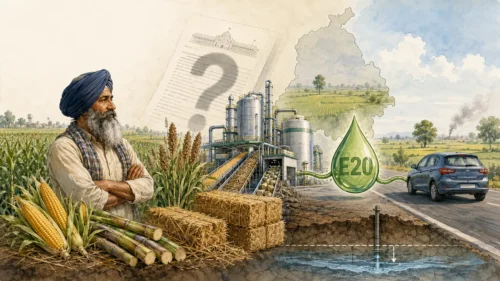
 The Punjab Assembly’s resolution asking the Union Government to suspend compulsory E20 petrol for vehicles not certified for it is surprising. Punjab is battling falling groundwater, paddy-straw burning and the absence of assured markets for alternative crops. Yet its Assembly has opposed a policy that can help address all three.
A Phased Transition, Not a Sudden Experiment
Finance Minister Harpal Singh Cheema has questioned why the E20 target was advanced from 2030. But ethanol blending did not appear overnight. Pilot projects began in 2001 and the national programme followed in 2003. India reached E10 in June 2022, while E20 was introduced at outlets in February 2023. The decision to advance the E20 target to 2025-26 was announced years ago.
Why, then, has an alarming narrative suddenly appeared? Once E20 became widely available, owners of older vehicles began asking legitimate questions about mileage, compatibility and warranties. Social media converted individual complaints into sweeping claims of engines being destroyed.
Mileage Loss Is Not Engine Destruction
Ethanol contains less energy per litre than petrol, so some reduction in mileage is expected. The NITI Aayog roadmap estimated a loss of 6-7 per cent in older four-wheelers designed for unblended petrol, 3-4 per cent in older two-wheelers and 1-2 per cent in four-wheelers designed and calibrated for E20. This concern should not be dismissed, but lower efficiency is not evidence of widespread engine failure.
The Automotive Research Association of India (ARAI) and oil companies have tested vehicles over tens of thousands of kilometres without finding significant abnormal damage. Automakers have not reported systemic corrosion or unusual component failure attributable to standard-quality E20. Mechanics interviewed by The Indian Express said complaints were mainly about mileage. A viral Toyota Hycross malfunction blamed on E20 was traced by the company to contaminated fuel. Contamination is a quality-control failure, not proof that ethanol destroys vehicles.
The government must publish complete test data, issue model-wise guidance, enforce quality checks at every outlet and protect owners of legacy vehicles. If feasible, an alternative grade should be available for genuinely incompatible vehicles at its actual market price. These safeguards do not justify abandoning ethanol.
Crop Diversification Needs a Market
The farmer movement recognised ethanol’s potential long before it became fashionable. During the 1981 sugarcane agitation led by my father, S Bhupinder Singh Mann, his organisation argued that sugar mills must diversify into ethanol. Sharad Joshi and the Shetkari Sanghatana advanced the same broad principle: agriculture must be allowed to supply energy and industrial markets, not remain trapped within the traditional mandi.
Crop pattern change is the necessity of the moment, especially in Punjab where the subsoil water is over exploited. But the change requires a market.
Punjab’s farmers have been told for decades to leave the wheat-paddy cycle. But no farmer will diversify on speeches alone. An alternative crop needs an assured buyer, a competitive price and regular demand. Ethanol can provide that market.
Maize uses far less water than paddy and does not create the same stubble problem. Punjab offers ₹17,500 per hectare for shifting to maize. It cannot subsidise maize with one hand while weakening its strongest emerging market with the other. This is a clear policy contradiction.
Ethanol gives sugar mills another revenue stream, enabling timely cane payments and improving the viability of cooperative mills. Sorghum and other lower-water crops offer further choices. Damaged grain unfit for human consumption can be converted instead of occupying storage space and deteriorating further. Second-generation ethanol can turn paddy straw from a pollution problem into industrial raw material and additional farm income.
Make Ethanol Farmer-Owned
Ethanol is not automatically farmer-friendly merely because it uses agricultural material. AIKCC has objected to heavily discounted FCI rice being supplied to distilleries at prices that undercut maize. If distilleries receive cheap government rice, why would they pay maize growers a remunerative price? Policy should use only genuinely surplus or damaged grain while prioritising maize, sorghum and crop residue.
Ethanol production is not rocket science. Fermentation and distillation are centuries-old processes. Fuel-grade ethanol, however, must meet strict purity and safety standards. Licensing, finance and procurement should be reformed so farmer groups, FPOs and cooperatives can establish compliant units, hold equity in distilleries and secure long-term agreements with oil companies. Farmers should not remain mere suppliers of raw material; they should become owners in the energy value chain.
The National Dividend Is Measurable
A Petroleum Ministry projection indicates that every additional litre of ethanol can save about ₹48.75 in foreign exchange, channel around ₹40 to farmers, displace approximately 0.7 kg of crude oil and avoid about 2.15 kg of carbon dioxide. These are gross impacts and cannot simply be added as a net benefit, but their scale is undeniable.
Official figures say blending since 2014-15 has saved over ₹1.97 lakh crore in foreign exchange, transferred more than ₹1.66 lakh crore to farmers, substituted nearly 316 lakh tonnes of crude oil and avoided around 952 lakh tonnes of CO₂.
A 2025 input-output study found that maize-based ethanol produced the strongest gains among major feedstocks in GDP, output and employment, with a lower water and greenhouse-gas footprint than rice or sugarcane ethanol. It also warned against excessive dependence on maize. The answer is a diversified feedstock mix.
A world renowned consulting company KPMG’s Beyond E20 report strengthens the case for second-generation ethanol made from agricultural residue. It notes that India’s limited commercial 2G capacity includes a 100-KLPD paddy-straw plant at Bathinda. This matters deeply to Punjab. Its farmers are repeatedly blamed whenever stubble smoke coincides with Delhi’s winter smog, although no single source explains that crisis. Converting straw into ethanol would provide a paid alternative to burning, reduce pressure on food crops and create rural employment.
KPMG also warns that 2G ethanol is presently costlier and depends on assured offtake and policy support. Bathinda cannot remain an isolated demonstration. Punjab needs reliable systems for collecting, baling, transporting, pricing and purchasing straw.
Farmers Need a United Voice
On August 4, an AIKCC delegation led by S Bhupinder Singh Mann Ex MP, and Gunvant Patil General Secretary AIKCC, met Agriculture Minister Shivraj Singh Chouhan. It met Road Transport Minister Nitin Gadkari the following day and urged the government not to retreat under political or commercial pressure or the pressure of the lobbies.
Farmers remain divided by organisational rivalry and political allegiance. The influence of Left-wing groups becomes worrying when ideological hostility to markets overrides farm economics. But no farmers’ organisation should become an extension of the Left, the Right or any political party or toe a particular hidden agenda. The core agenda should remain farmers welfare.
Farmers have no coherent lobby and too few MPs consistently speaking for them. A hundred competing voices create noise that governments can ignore. Agitations may draw attention, but lasting solutions emerge through legislation, negotiation and the negotiating table.
Educate the Consumer
Consumer interests must be protected through facts, not slogans. The government should publish test results, label fuel clearly, provide model-wise compatibility information and counter rumours with scientific evidence. Where feasible, owners of legacy vehicles should be able to buy E10 or unblended petrol at transparent, unsubsidised market prices. Any future blending in diesel must follow independent trials and full technical validation.
Punjab should demand better implementation, not suspension: scientific testing, strict fuel-quality monitoring, a stable five-year feedstock policy, assured markets for low-water crops and faster investment in straw-based ethanol. Protect motorists and punish every quality failure. But do not sacrifice farmers’ long-term interests to rumours, political competition or ideological rigidity. Science must drive technology; politics must not overrule evidence.