
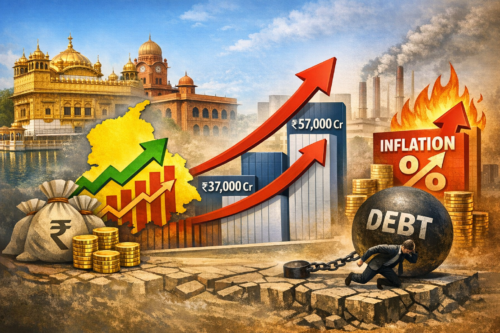
 Punjab, one of India’s most agriculturally prosperous states, is today paradoxically one of its most financially distressed. With an outstanding debt burden projected to hit ₹4.17 lakh crore by the close of the 2025–26 financial year, the state finds itself in a deepening spiral of borrowing to service earlier borrowings — a textbook case of a debt trap.
What makes Punjab’s crisis distinct from other fiscally strained Indian states is its structural nature. The problem is not rooted in a sudden economic shock or a natural disaster. It has been decades in the making, shaped by successive governments’ reliance on subsidies, an oversized public payroll, and a systematic underinvestment in productive economic infrastructure.
The numbers tell a grim story. Punjab’s debt-to-GSDP ratio hovers around 46%, placing it among the most indebted states in the country. While the national norm considered sustainable is roughly 25–30%, Punjab has been operating well beyond these thresholds for years, with debt growing faster than economic output.
1.1 Borrowing to Pay Salaries
Perhaps the most alarming signal of fiscal distress is that Punjab has been borrowing not to invest in infrastructure, education, or industry but simply to pay salaries, pensions, and power subsidies. Between January and March 2026, the state government planned to raise over ₹12,000 crore through the Reserve Bank of India’s Ways and Means Advances and market borrowings to meet day-to-day operational expenses. This is not an occasional emergency measure. Multiple quarters in recent years have seen the state rely on short-term credit lines to meet its current expenditure obligations, a pattern that signals a fundamental mismatch between revenue and spending.
1.2 Interest Eating Into Revenue
A growing share of Punjab’s annual budget goes directly toward servicing its existing debt. Interest payments alone now consume an estimated 20–25% of the state’s own revenue meaning that nearly one-fourth of every rupee earned by the state goes to lenders before a single rupee is spent on public services, roads, or schools.
This creates a vicious cycle: to meet interest obligations, the state borrows more, which increases future interest payments, which forces further borrowing. Breaking this cycle requires either a dramatic increase in revenue or a sharp reduction in expenditure both of which are politically difficult.
2. The Disaster Fund Controversasy
Among the more politically charged aspects of the crisis is the allegation surrounding Punjab’s State Disaster Relief Fund (SDRF). Opposition politicians and central government officials have raised serious concerns that nearly ₹12,000 crore in SDRF funds — specifically earmarked for flood mitigation and disaster relief — were either left unutilised or redirected to meet other budgetary pressures.
Punjab is highly vulnerable to floods, particularly in the districts bordering rivers like the Beas, Sutlej, and Ghaggar. The failure to deploy these funds for embankment repairs, drainage improvements, and flood warning systems has drawn criticism not only from political rivals but also from civil society groups and affected communities.
The state government has disputed the framing of these allegations, arguing that fund utilisation follows its own timeline and that relief operations were conducted. However, independent audits and central inspection reports have continued to raise questions about whether disaster preparedness received adequate priority.
3. The Power Sector Crisis
Alongside the headline debt figures, Punjab is grappling with a severe power sector crisis that further strains its finances. The Punjab State Power Corporation Limited (PSPCL), the state-owned utility, is owed thousands of crores in unpaid dues largely from government departments themselves. State government offices, public sector undertakings, municipal bodies, and even some welfare departments have accumulated massive electricity arrears. This internal payment failure weakens PSPCL’s ability to maintain infrastructure, procure adequate power, and repay its own loans creating a financial black hole within the state’s own ecosystem.
3.1 Free Electricity: Popular Promise, Fiscal Burden
The AAP government’s flagship promise of 300 units of free electricity per month to households has been both politically successful and financially costly. While the scheme has benefited millions of families, its fiscal impact on PSPCL’s revenue model has been significant. The state compensates PSPCL through subsidies, but delays and underpayments have led to chronic shortfalls.
ritics argue that the promise was made without a credible revenue model to sustain it long-term, and that the subsidy burden has grown beyond the state’s capacity to absorb. Supporters counter that free power was a social welfare necessity in a state where agricultural electricity costs had long burdened small farmers.
4. The Governance Debate
The fiscal crisis has become the central battlefield of Punjab’s political discourse. The question being asked across party lines is a stark one: Is Punjab’s financial ruin the product of deliberate misgovernance, structural inheritance, or a combination of both?
4.1 The Case for Governance Failure
Critics of the current Aam Aadmi Party government point to several indicators of mismanagement:
• Subsidy expenditure nearly doubled between 2019–20 and 2023–24, consuming fiscal space that could have been directed toward capital investment.
• Revenue promises, including increased income from sand mining, liquor policy rationalisation, and industrial attraction, have largely not materialised at the projected scale.
• Policy paralysis has affected large infrastructure and industrial projects, with slow decision-making and regulatory uncertainty discouraging private investment.
• The state’s agriculture-dominated economy, representing over 30% of GSDP, has seen limited structural diversification, making it vulnerable to monsoon variability and commodity price cycles.
• Unemployment remains high, particularly among youth, despite promises of new job creation. The dependence on government employment has grown rather than shrunk.
4.2 The Legacy Debt Argument
The AAP government has consistently pushed back against accusations of mismanagement by pointing to what it calls ‘legacy debt’ the accumulated borrowings of Congress and Akali Dal governments over two decades.This argument has some basis in fact. A significant portion of Punjab’s current debt was indeed inherited, and the interest payments on pre-2022 borrowings form a large part of the current fiscal burden. The government has also noted that it has renegotiated interest rates on some older loans, generating modest savings.ocThe Chief Minister’s office has argued that debt growth must be seen relative to GSDP growth, and that as long as the economy expands, a rising absolute debt figure is not inherently unsustainable. Independent economists, however, note that Punjab’s GSDP growth has not been fast enough to outpace debt accumulation at its current rate.
5. Inter Governmental Dimensions
5.1 Centre-State Financial Relations
Punjab’s fiscal crisis is not playing out in isolation from central government dynamics. The state’s relationship with the Union government has been periodically strained over issues ranging from the farm protest movement to allegations that central grants and transfers to Punjab have been lower than warranted under devolution formulas.Finance Commission transfers and grants-in-aid from the centre form a critical part of Punjab’s revenue. Any reduction or delay in these flows directly worsens the state’s cash position. Critics of the central government argue that fiscal federalism in India remains biased toward penalising states that pursue social spending, while rewarding those that prioritise ease-of-doing-business rankings a framework they argue is structurally disadvantageous to agrarian states like Punjab.
5.2 GST Compensation and Its End
The end of the GST compensation regime in 2022 dealt a significant blow to Punjab’s finances. Under the original GST framework, states were guaranteed compensation for revenue losses for five years. When that protection ended, Punjab which had been receiving thousands of crores annually in GST compensation was forced to absorb the shortfall, further widening its fiscal deficit.
The state government has argued that GST compensation should have been extended, particularly for states with lower industrial bases and higher agricultural dependencies. This remains a point of contention between New Delhi and several non-BJP state governments.Behind the macro numbers lies a human story. Punjab’s fiscal crisis has real consequences for ordinary citizens, government employees, and public service delivery:
6.1 Government Employees and Pensioners
Reports of delayed salary and pension payments have surfaced in several districts, particularly at the level of district-level departments and panchayati raj institutions. Teachers, health workers, and clerical staff have reported disruptions in timely disbursement affecting household budgets and consumer confidence in local economies.
6.2 Infrastructure and Public Services
Capital expenditure the spending on roads, hospitals, schools, and water supply has been squeezed to near-minimum levels to protect current expenditure. This means that while salaries continue to be paid (however delayed), physical infrastructure is deteriorating. Rural roads, irrigation canals, and public health facilities in interior Punjab have seen neglected maintenance over several budget cycles.
6.3 Agriculture and the Rural Economy
Punjab’s famous Green Revolution legacy has become a double-edged sword. The state’s intensive agricultural economy, once a model for the nation, now faces serious groundwater depletion, soil degradation, and commodity price volatility. Farmers, already stressed by input costs and debt, find state support systems including procurement infrastructure and crop insurance mechanisms — weakening as government finances deteriorate.The combination of agrarian stress and fiscal crisis is fueling outmigration, particularly among the youth, with Canada, the UK, and Australia seeing a sustained surge in Punjabi emigrants. The brain drain and labour drain further reduce the state’s long-term economic potential.
7. Comparative Context : How does Punjab Compare ?
Punjab is not alone in facing a debt crisis several Indian states are in fiscal distress. However, its position is notable for combining a high debt-to-GSDP ratio with low economic diversification, making recovery harder than for states like Andhra Pradesh or Rajasthan, which have larger industrial and services sectors to generate revenue.
State Debt/GSDP Ratio Key Stress Factor Recovery Potential
Punjab ~46% Subsidies + Low diversification Moderate-Low
Rajasthan ~39% Large welfare spend Moderate
Andhra Pradesh ~35% Infrastructure debt + welfare Moderate-High
Kerala ~34% Pension liabilities + slow growth Moderate
8. The Path forward : What would recovery require ?
Economists and policy analysts broadly agree that Punjab’s fiscal stabilization — let alone recovery — requires a multi-pronged approach. There is no single lever that can resolve a crisis this structural in nature.
8.1 Revenue Generation
• Rationalisation of the mining sector to maximise legal revenue from sand and gravel extraction, estimated to have multi-thousand crore potential if governance is improved.
• Expansion of Punjab’s Goods and Services Tax base through better compliance enforcement, particularly in the informal trade and services sectors.
• Property tax reform and urban local body strengthening to unlock municipal revenue streams that are currently significantly underperforming.
• Incentivizing industrial investment in sectors like food processing, textiles, and renewable energy industries where Punjab has natural advantages but has failed to attract capital at scale.
8.2 Expenditure Reform
• Pension reforms, potentially through a shift toward defined-contribution models for new government employees, could reduce long-term pension liabilities.
• Rightsizing the state bureaucracy through attrition rather than forced retrenchment not filling vacancies as existing staff retire could gradually reduce the salary burden.
• Subsidy rationalization: directing subsidies more narrowly toward the genuinely poor rather than broad universal entitlements would reduce fiscal outflow without abandoning the welfare agenda entirely.
8.3 Political Consensus
Perhaps the most important and most difficult requirement for fiscal stabilization is political consensus. Calls for an all-party meeting on Punjab’s financial crisis have grown louder, with opposition leaders arguing that resolving a crisis of this magnitude requires decisions that no single party can take alone without electoral penalty. Historical precedents from states like Bihar — which undertook significant fiscal correction under the Nitish Kumar government in the mid-2000s suggest that turnaround is possible, but requires sustained political will over multiply budget cycles, something that has been conspicuously absent in Punjab’s recent history.
Punjab’s debt crisis is not a sudden emergency. It is the accumulated result of decades of fiscal choices across governments of different colours and ideological persuasions that prioritised short-term political calculations over long-term fiscal sustainability. The current AAP government inherited a difficult situation, but its own choices have not always made that situation easier.What distinguishes the current moment is the sheer scale of the numbers and the narrowing of options. With a debt-to-GSDP ratio of 46%, interest payments consuming a quarter of revenues, and borrowing now required to meet current expenses, the state has very little fiscal room to manoeuvre without external support or internal structural reform. The coming years will test whether Punjab’s political class can rise to the occasion placing the state’s long-term financial health above short-term electoral calculations. The alternative a continuing spiral of debt, declining services, and economic stagnation is a future that neither Punjab’s 30 million citizens nor India’s federal structure can afford to ignore.
This report is based on publicly available fiscal data, state budget documents, and media reports as of April 2026. It does not represent the official position of any government body.