
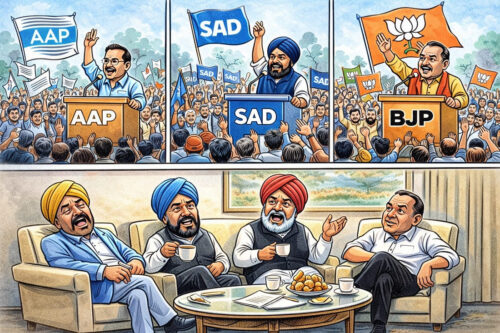
 There is no state in India quite like Punjab. It is the land of five rivers and ten Gurus. It is the land whose farmers fed a hungry nation during the Green Revolution. It is the land whose soldiers have laid down their lives in every war India has ever fought. It is a land of extraordinary resilience, extraordinary courage, and extraordinary love for its faith, its language, and its people. And yet, for decades, this magnificent land has been held hostage by a political class that has used it, looted it, broken it, and then asked it to vote for them again. This is not a political manifesto. This is a human cry , a cry for a land and a people who deserved so much more than what their leaders ever gave them.
The story of corruption in Punjab does not begin in recent times. It began at the very birth of modern Punjab’s political life, when those who were trusted to rebuild a shattered land after the horrors of partition chose instead to enrich themselves. Partap Singh Kairon was Chief Minister of Punjab from 1956 to 1964. While he is credited for much of the development the state achieved, the controversy about his corrupt actions in promoting the economic interests of his sons, relatives and cohorts transcended the epoch. He had been charged by senior members of the Congress Assembly Party with a dictatorial attitude and with charges of corruption, nepotism and favouritism. Allmultidisciplinaryjournal The people of Punjab, still carrying the trauma of partition on their shoulders, still rebuilding their homes and their lives from nothing, deserved a leader who would serve them. What they got was a leader who served himself. That wound of being betrayed by the very person entrusted with your future has never fully healed in Punjab. It simply changed faces with every election.
No date in Punjab’s political history carries more pain than June 1984. After years of political mismanagement by both the Congress government in Delhi and factions within Punjab itself, a crisis had been allowed to grow until it became uncontrollable. The Golden Temple the holiest shrine of the Sikh faith, a place of prayer and peace — had become a battlefield. What followed was one of the most controversial military operations in Indian history. In 1982 the main militant leader, Jarnail Singh Bhindranwale, and his armed followers occupied the Harmandir Sahib in Amritsar. They were forcefully evicted in June 1984 by the Indian military, and Bhindranwale was killed during the operation. There followed a period of violence in Punjab and elsewhere in India that included the assassination of Prime Minister Indira Gandhi by her Sikh bodyguards at the end of October. Wikipedia What came next was perhaps the darkest political crime of independent India.
Anti-Sikh riots erupted across the country. Thousands of innocent Sikhs men, women, and children who had nothing to do with any militancy were massacred in the streets of Delhi and other cities. Anti-Sikh rioting paralyzed New Delhi, ultimately claiming at least 3,000 lives; unofficial estimates placed the number far higher. Al Jazeera These were not random acts of public anger. Evidence gathered over decades points to the organized, political direction of the mobs. Congress leaders were accused of leading the rioters. The state machinery looked away. The police did not protect. Every Sikh family in this country carries that memory in their bones. And for the next thirty years, case after case was filed, investigated, shelved, reopened, and shelved again. The families who lost fathers, sons, and brothers in those three days of fire and madness are still waiting for justice. That is what dirty politics looks like at its most brutal when the machinery of democracy is turned into a weapon against the very people it was created to protect.
For ten long years, from 2007 to 2017, the Shiromani Akali Dal and the BJP governed Punjab as partners. It was a decade of infrastructure projects and ribbon-cutting ceremonies and beneath the shining surface, a decade of deepening rot that would take years for the full truth to emerge. The Akali Dal’s rule from 2007 to 2017 is described as a dark chapter in Punjab’s history, with charges that the regime was responsible for pushing Punjab into an era of drugs, corruption, and sacrilege. Encyclopedia Britannica The most devastating and heartbreaking crisis was the drug epidemic that consumed Punjab’s youth during those years. Drug trafficking and massive drug abuse were wreaking havoc in Punjab. The epidemic of substance abuse in the young generation assumed alarming dimensions in the state. Experts warned that the state may lose an entire generation to rampant abuse of smack, heroin and synthetic drugs.
These were the children of farmers and labourers. These were boys who should have been in colleges, on cricket fields, working alongside their fathers in the wheat fields of Ludhiana and Amritsar. According to police sources, heroin, popularly known as chitta in Punjab, costs an addict not less than Rs. 2,000 per day. After begging, borrowing and stealing, when an addict can no longer buy his fix, the dealer has a deal for him sell ten and get one. Human Rights Watch And some of the politicians who should have been fighting this menace were themselves linked to the very networks that were destroying Punjab’s children. There is no more evil form of political betrayal than this to poison the youth of a land for profit and then mount a stage to talk about their future.
Then came 2015, and a wound that cut to the very soul of Punjab. The sacred saroop of the Guru Granth Sahib was stolen and desecrated at Bargari in Faridkot. For Sikhs, the Guru Granth Sahib is not merely a holy text it is considered a living Guru. What happened was not vandalism. It was a spiritual assassination. The people of Punjab took to the streets in peaceful protest, demanding that those responsible be punished. The response of the Akali-BJP government was to order police to fire on the protesters. When Sikhs protested against the sacrilege and demanded action against those guilty, they were fired upon by the police at Behbal Kalan and Kotkapura. Two protesters were killed in police firing. Sikh Siyasat News Two innocent people, who had come out to defend their faith peacefully and with dignity, were shot dead by the state.
The theft and desecration of Sri Guru Granth Sahib at Bargari, followed by the police firing at Behbal Kalan and Kotkapura, were not isolated incidents. They came to symbolise, in the minds of many Punjabis, institutional collapse, political complicity, and the inability of the State to protect what Sikhs hold most sacred. Nearly a decade later, the wound remains open. Suraiya Shaikh News Three governments have come and gone since that October in 2015. Congress, Akali Dal, and AAP have all held power. According to official data, the state has witnessed 597 sacrilege incidents since 2015, with conviction in only 44 cases. Business Standard The families of those killed at Kotkapura and Behbal Kalan still sit and wait. There is no more crushing form of political indifference than watching a government collect votes on the promise of justice and then quietly let the case files gather dust.
In 2017, the anger against the sacrilege and the deaths caused by police firing was one of the major reasons why the Shiromani Akali Dal-BJP alliance was routed in the assembly elections. Captain Amarinder Singh swept into power on a massive wave of public fury, promising justice for the beadbi victims, a war on the drug mafia, and a new era of honest governance. Punjab believed him. Punjab voted for him with hope burning in its chest. And then Punjab watched, year after year, as those promises dissolved quietly into inaction. The beadbi cases moved nowhere. The drug lords continued their trade. The sand mining mafia whose illegal excavation of Punjab’s riverbeds was destroying the state’s ecology and filling political coffers continued operating with impunity. By 2021, Captain’s own party had turned against him, replaced him, and Punjab had been robbed of yet another five years of its precious future. The people had voted for change. They received only a change of faces at the top, while the system beneath remained untouched.
In 2022, Punjab made history of a different kind. The Aam Aadmi Party swept the assembly elections in a historic landslide, winning 92 of 117 seats. The Aam Aadmi Party lured voters with promises that were impossible eliminating corruption from government in the first 20 days and uneconomical freebies and social security payments despite Punjab’s perilous finances. But not having any historical baggage in the state, it enjoyed a distinct advantage over traditional political parties. Thelawwaywithlawyers The people of Punjab, exhausted and repeatedly betrayed by Congress and Akali Dal alike, reached for something entirely new. They believed in the moral promise of a party born from a grassroots anti-corruption movement. But after taking charge, the party was attacked for its apparently selective approach in weeding out corrupt party officials, and social activists shared the concern that the current government, like its predecessors, was holding back information on pending corruption cases against its own party and government officials. The pattern was repeating itself, wearing a new face.
And then in April 2026, came the latest chapter of betrayal. Seven Rajya Sabha MPs all elected under AAP’s banner, six of them from Punjab crossed the floor to join the BJP in a single coordinated move. They were sent to Delhi by the people of Punjab to represent Punjab in Parliament. Within a short time, they had switched to the very party against whose farm laws the farmers of Punjab had staged one of the most powerful protest movements in democratic history. The Shiromani Akali Dal had snapped its 24-year-old alliance with the BJP in September 2020 over the now-scrapped three farm laws, which had triggered the massive farmers’ protest movement that galvanized millions of Punjabis. India TV News The farmers who had sat at Delhi’s borders through bitter winter nights hundreds of whom had died during those months of dignified, peaceful resistance had fought precisely against the party these seven MPs now chose to join. Punjab’s political betrayals have a long and painful history. But this one stung with a particular sharpness, because it came from those who had loudly promised to be different.
Behind every political scandal in Punjab, behind every broken promise and every calculated act of betrayal, there are real human beings paying the price in silence. There is the mother in Amritsar who lost her 22-year-old son to chitta a boy who started using drugs because there were no jobs, because the field he used to work with his father had been sold to pay debt, because the politicians who should have built factories and colleges were too busy building their own empires. There is the old farmer in Sangrur who has voted in every election since 1967, who has believed every promise made from every decorated stage, and who is still waiting for the Sutlej-Yamuna Link waters that have been promised and denied for fifty years in a deliberate political game played between states while his crops fail. There is the widow in Patiala whose husband was a police constable killed in the line of duty, whose pension case has been stuck in government files for a decade because nobody with power has bothered to sign a paper. There is the young girl in Faridkot whose father wept openly at Kotkapura in 2015, demanding justice for his sacred faith, and was shot at for it. These are not statistics in a crime report.
These are Punjab. These are the real people behind every election result, every broken promise, every headline that disappears after a news cycle.The most heartbreaking question in all of this is not why the politicians keep betraying Punjab the answer to that is simple and ugly: because power corrupts, and Punjab’s resources its land, its rivers, its sand, its border corridors are deeply attractive to those who wish to exploit them. The real question is: why does Punjab keep believing? Why, after Congress, after Akali Dal, after BJP, after AAP why does this bruised, brilliant, generous, suffering people keep reaching out to the next hand that promises salvation? The answer, perhaps, is that Punjab cannot afford not to believe. To stop believing would be to surrender — to accept that this land cannot be governed with honesty, that the next generation must flee to Canada or the Gulf to find the dignity they deserve, that a farmer’s son must bribe someone just to get what is rightfully his.
The faith of Punjab’s people is not naivety. It is courage a stubborn, undefeated, heartbreaking courage that keeps showing up at polling booths and protest grounds and candlelight vigils, even when hope has been betrayed so many times it should logically have died long ago.Punjab deserves leaders who have actually lived the life of a Punjabi. Who know what it means to stand in a field at four in the morning in January fog, or to watch a son sink into addiction while politicians throw election rallies. It deserves a government that fights the drug mafia instead of taking money from it. It deserves justice for the families of Behbal Kalan and Kotkapura not ten years after the crime, but now. It deserves an economy that gives its young people a reason to stay on this soil instead of leaving it. Most of all, Punjab deserves the truth not the truth of election manifestos and stage speeches, but the truth of who really controls the drug trade, who really benefits from sand mining, who really profits when a poor farmer’s ancestral land is acquired for a new project. Punjab has given enough. It has given soldiers, grain, sacrifice, rivers, and faith. It is long past time that those who seek to govern it give something real in return not promises, but justice. Not slogans, but service. Not betrayal, but belonging.
“Ik din aauga jado Punjab da aam insaan jaag jayega te us din koi vi siyasatdan uss nu bewakoof nahi bana sakda.”
(One day the common man of Punjab will wake up and on that day, no politician will ever be able to fool him again.)
Published April 27, 2026 | A tribute to the resilient, undefeated people of Punjab 🙏