
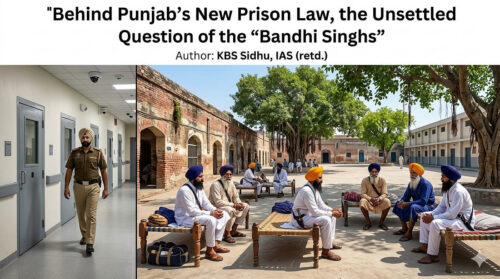
 Punjab’s new Prisons and Correctional Services law deserves a fair, even mildly appreciative, reading. It marks a serious effort to move beyond the colonial Prisons Act, 1894, and to acknowledge that a modern prison system cannot be built on custody and discipline alone. It must also address security, rehabilitation, technology, accountability and the dignity of inmates.
That is no small shift. A State that has wrestled with militancy, organised crime, gang violence, brazen prison-security failures such as the November 2016 Nabha jailbreak, and a deep public distrust in institutions can scarcely afford an archaic prison law that still speaks the language of Empire.
Yet the true significance of this statute lies not merely in what it says about prison administration. It also lies in what it reveals, by contrast, about Punjab’s larger political evasions. For no discussion of prison reform in Punjab can remain clinically administrative for very long. Sooner or later, one arrives at the unresolved moral, legal and political question of the “Bandhi Singhs”—especially those who have spent decades behind bars, including those originally sentenced to death, those whose sentences were later commuted, and those whose cases sit at the intersection of constitutional clemency, Union authority and State-level political posturing.
Part I: What the New Act Does—and Does Not Do
From Colonial Custody to Correctional Purpose
The new law does several things right. It recognises that prisons cannot remain mere holding facilities. Public accounts of the legislation make clear that it aims to reorganise prisons as correctional institutions, with stronger provision for education, counselling, legal aid, vocational activity and reintegration, even while also tightening control over dangerous and high-risk inmates.
It also reflects a realistic reading of Punjab’s prison problem. Gangsters and organised criminals have allegedly continued to exercise influence from inside prison walls, and any serious reform law had to respond to that challenge through classification, high-security arrangements, surveillance, digital systems and tighter internal regulation.
Security Without Executive Excess
This is where the law deserves support. A prison system that cannot prevent its enclosures from becoming command centres of criminal enterprise is not humane; it is simply incompetent. If the new Act helps prevent prisons from serving as operational hubs for extortion, narcotics and political intimidation, that is a genuine public good.
But a prison law must be judged not only by the threats it addresses, but also by the restraints it respects. High security must not become a euphemism for opacity, arbitrariness or executive excess.
Ministerial Visits Are Not Personal Privileges
That distinction becomes especially important in relation to ministerial power. The new statute does not create a private privilege that permits the Jail Minister to walk into prisons at will, as though the prison estate were a personal or political preserve. A Minister may visit in an official capacity, certainly; but those visits remain visits within law, procedure and security protocol, not incursions by personal discretion. The authority of the Superintendent over internal custody, order and discipline cannot be casually diluted by political theatre. In a prison system vulnerable to influence and patronage, that line matters.
Oversight, Inspection and Judicial Scrutiny
The same is true of oversight. No modern prison law is worthy of confidence unless it remains answerable to external inspection and judicial scrutiny. The new framework does not displace the larger constitutional position in which executive inspection, judicial oversight and High Court supervision remain essential. Nor should it. A closed prison system quickly becomes an abusive one.
Custodial Deaths and the Test of Accountability
Equally, the law should be tested by how it handles the gravest event that can occur in custody: death. Under the older framework, any death in prison—natural, violent, suicidal, accidental or suspicious—was required to be medically examined, properly recorded and reported through the chain of authority. That discipline remains non-negotiable. A modern correctional system is judged not merely by infrastructure and technology, but by whether it ensures timely medical attention, proper documentation and lawful accountability when custody ends in death.
The Limits of Prison Reform
And yet, even when one gives the law its due, one must also say what it does not do. It does not solve overcrowding, undertrial delay, inadequate mental-health and medical care, or the wider pathologies of the criminal justice system. It does not automatically create a constitutional culture inside prisons. And it does not answer the politically charged question that hangs over Punjab’s prison discourse more heavily than any other: what, in real legal terms, is to be done about the Bandhi Singhs?
Part II: Bandhi Singhs—Law, Sentiment and the Evasion of Responsibility
A Question of Conscience, Not Merely Administration
It is here that Punjab’s debate turns from administration to conscience. The phrase “Bandhi Singh” is not merely a legal category; it is also a term of memory, sacrifice, grievance and collective Sikh emotion. But precisely because of that, the issue is too important to be left at the level of slogans. If one is to speak honestly, one must separate sentiment from legal structure—without dishonouring either.
What Life Imprisonment Legally Means
The first legal clarification is basic but vital: life imprisonment means imprisonment for the remainder of the convict’s natural life, unless the sentence is remitted, commuted or otherwise shortened by lawfully exercised executive or constitutional power. It is not a sentence that automatically ends after fourteen years, twenty years, or any other popularly invoked number. When courts use the expression “imprisonment for life”, that is the legal meaning. In some cases, the courts go further and expressly indicate imprisonment for the remainder of natural life without the ordinary play of remission policy, leaving only constitutional clemency as a practical route.
One Emotional Phrase, Many Legal Categories
This distinction matters because the Bandhi Singh issue is often discussed as though all such prisoners stand on the same legal footing. They do not. Some are straight life convicts. Some were sentenced to death and later had that sentence commuted to life imprisonment. Others are linked to offences tried outside Punjab, or under special laws, or investigated by the CBI, or arising in the Union Territory of Chandigarh. The phrase is emotionally unifying; the legal categories are not.
The Rajoana Case and a Persistent Misunderstanding
Take the case of Bhai Balwant Singh Rajoana, because public misunderstanding here has been especially persistent. The record, as widely reported, is that Rajoana was convicted in the assassination of former Chief Minister Beant Singh and sentenced to death by a special CBI court in 2007. He has long maintained an unambiguous and defiant stance with respect to his role. Public commentary and reporting indicate that he did not personally file any mercy petition, did not seek to soften his own legal position by pleading for clemency, and had in fact repeatedly objected to that course. The mercy petition presently hanging fire was filed by the SGPC in 2012 on his behalf, not by him, and not by the Punjab Government of the day under Parkash Singh Badal.
That is not a small factual correction. It goes to the heart of the moral and political posture of the case. Bhai Rajoana’s position, whatever one’s view of the underlying offence, was one of proud confession and refusal to supplicate. The formal clemency route was pursued by the SGPC. The Badal government, despite its public rhetoric and despite the emotional power of the issue in Sikh politics, did not own the matter through a decisive and transparent legal strategy of its own.
Articles 72 and 161: The Constitutional Route
The constitutional position, moreover, is more intricate than most political speeches suggest. Under Article 72, the President can grant pardons, reprieves, respites or remissions, and can suspend, remit or commute sentences in cases involving Union executive power, in court-martial cases, and in all cases of death sentence. Under Article 161, the Governor has similar powers in relation to offences to which the executive power of the State extends. But neither power is a free-floating personal discretion; both are exercised on the aid and advice of the relevant Council of Ministers. That position is now settled enough that no serious political actor can pretend otherwise.
Why Punjab Cannot Simply ‘Release’ Everyone
This has major consequences for the Bandhi Singh question. Where the offence arose outside Punjab, where trial and conviction were in another State, where the case was investigated by the CBI, or where the trial was before a special court in Chandigarh as a Union Territory, Punjab is often not the “appropriate government” for statutory remission under the CrPC in the first place. In such cases, Union concurrence may be necessary, or the effective route may run through the Centre and ultimately the President rather than through the Governor of Punjab.
This is precisely why lazy slogans about “Punjab should just release them” are legally hollow. But it is also why the repeated inaction of Punjab governments is politically revealing: even where Punjab was not the final authority, it could have chosen to become the most persistent advocate.
The Failure of Successive Punjab Governments
That, in truth, is the real indictment of successive governments. The Akali leadership under Parkash Singh Badal spoke the language of Sikh sentiment, but did not convert that sentiment into a sustained, transparent, case-wise constitutional strategy. Captain Amarinder Singh, for all his cultivated image of firmness and realism, also did not meaningfully move the issue through formal constitutional channels. One heard statements, one saw gestures, one encountered calibrated ambiguity—but not the disciplined use of Cabinet advice, legal recommendation, or sustained confrontation with the Centre on behalf of identified prisoners whose cases had ripened for consideration.
Clemency Is Not Automatic, But Delay Cannot Be Endless
It is also necessary, however, to speak with legal precision even when emotion presses hard. Not every Bandhi Singh case is equally situated. Some involve heinous crimes, mass-casualty events, or assassinations that continue to carry a major security and political valence. Some involve death sentences later commuted. In such cases, the existence of a constitutional power does not mean that clemency is automatic, or that a government must exercise it. But the opposite is equally true: the gravity of the offence does not extinguish the constitutional power, and it does not justify governments hiding behind endless deferral while still harvesting the emotional symbolism of Sikh pain.
From Emotional Dividend to Constitutional Duty
This is where the gap between legal possibility and political sincerity becomes almost painful. Punjab’s governments have repeatedly wanted the emotional dividend of solidarity without assuming the legal burden of recommendation. They have wished to sound sympathetic without becoming accountable. They have invoked Bandhi Singhs in speeches, resolutions and atmospherics, but too rarely in the sober language that matters most in constitutional democracies: a formal recommendation, a case-wise legal brief, a Cabinet-backed insistence, and a demand placed before the proper constitutional authority.
The Present Opportunity for the Centre and Punjab
The current moment therefore presents two different but connected opportunities. For the BJP-led Union Government, the question is whether it will continue to hold these matters in suspension indefinitely, especially in cases where the President’s clemency jurisdiction under Article 72 is directly engaged or where Union concurrence is indispensable. For the AAP Government in Punjab, the opportunity is narrower but still real: to make categorical, official and reasoned recommendations in deserving cases, identify the correct constitutional route in each matter, and place itself on the record not through slogan, but through law.
Such action may not solve every case. But it would at least show that the government understands the difference between emotive signalling and constitutional responsibility.
In conclusion, and looking ahead
Punjab’s new prison law deserves support to the extent that it modernises administration, tightens security against criminal networks, and acknowledges that prisons must also be institutions of correction and accountability. That is the objective and analytical part of the story. But Punjab cannot speak honestly of prison reform while remaining evasive on the deeper moral and political question of those Sikh prisoners whose continued incarceration has become, for many, a living wound.
The harsher verdict falls not on the law, but on the older political class. The Shiromani Akali Dal under Parkash Singh Badal and the Congress under Captain Amarinder Singh both found ways to speak to Sikh feeling without carrying its constitutional demand to its logical conclusion. They were rich in rhetoric, poor in record. They wanted the credit of sympathy without the risk of decision. That hypocrisy is now too old to be forgiven as mere caution.
The test now, even as Punjab heads towards elections early next year, is whether today’s governments can do better: whether the Centre will stop allowing delay itself to become punishment, and whether Punjab Government now will press the cases it can with clarity, courage and constitutional seriousness. That would not erase history. But it would at least honour it.