
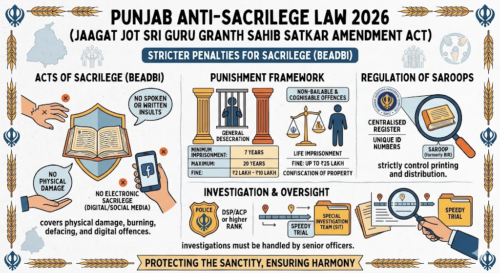
 Amritsar / Chandigarh-There is a cruel and recurring irony in the history of laws made in the name of religion. They are born in the heat of genuine moral outrage, shaped by the tears of communities that have been wounded by sacrilege or disrespect, and passed unanimously in legislatures where no politician dares to stand against the emotional tide. And then, once enacted, they are handed to the same political system that failed the community in the first place the same system of selective policing, partisan investigation, and motivated prosecution that allowed every previous injustice to go unpunished. The Jaagat Jot Sri Guru Granth Sahib Satkar (Amendment) Act, 2026, enacted by the Bhagwant Mann government in Punjab on April 13, 2026, is no exception to this pattern. It was passed with the best intentions. It may yet be used for the worst purposes.
The Architecture of the Law: What It Actually SaysBefore understanding the dangers embedded in this legislation, it is essential to understand its provisions in their full weight. The Jaagat Jot Sri Guru Granth Sahib Satkar (Amendment) Act, 2026 amends the parent legislation of 2008 and prescribes serious penalties: for a basic sacrilege offence, the law mandates a minimum of seven years’ imprisonment extendable to twenty years, along with a fine between Rs 2 lakh and Rs 10 lakh. Where the offence involves criminal conspiracy to commit sacrilege with the intention to disrupt peace or communal harmony, the minimum sentence is ten years, extendable to life imprisonment.
The Act defines sacrilege as any wilful and deliberate act committed with the intent of desecration including physical damaging, defacing, burning, tearing, or theft of any Saroop, as well as acts conveyed through spoken or written words, signs, visible representations, or electronic means, where such acts are of a nature as to hurt the religious feelings of persons professing the Sikh faith. Beyond punishment, the Act assigns the SGPC the duty of maintaining a Central Register recording the printing, storage, distribution, and supply of each Saroop, including a unique identification number for each copy. Custodians of Saroops are required to ensure safe custody, prevent damage or misuse, observe Sikh Rehat Maryada, and immediately report any incident of damage, disappearance, or suspected sacrilege. On paper, this is a formidable legal framework. But as every student of Indian legal history knows, the distance between what a law says and what it does in practice is often a chasm wide enough to swallow justice whole.
The Sword That Cuts Both Ways: The Danger of Misuse
Critics argue that the broad definition of sacrilege — especially its inclusion of speech and digital expression could create ambiguity and enormous potential for misuse. This is not a peripheral concern or an abstract legal worry. It is the single most dangerous feature of this law, and it deserves to be examined with the seriousness it demands. The definition’s reach over “words spoken or written, or by signs or through electronic means” has been legally challenged as vague, with critics arguing it invites misuse against dissent, social media posts, or even legitimate criticism. This creates what constitutional scholars call a “chilling effect” on Article 19(1)(a) the fundamental right to free speech by making every critical voice potentially liable under a law whose outer boundaries are unclear. Consider the implications in concrete human terms. A Sikh scholar who writes a peer-reviewed article questioning the authenticity of a particular textual interpretation could find his work described as an act that “hurt the religious feelings of Sikhs.” A journalist who investigates corruption in Gurdwara management and reports inconvenient facts might face a complaint under this law. A social media user who criticises the SGPC itself a deeply political institution could wake up to an FIR under a provision that carries a minimum sentence of seven years. The law does not distinguish between genuine desecration and passionate criticism. That distinction is left entirely to the police, the prosecution, and ultimately the courts all of whom operate within a political environment.
The Political Weapon Hidden Inside a Religious Law
The most chilling scenario and one that has historical precedent both within India and globally is the deliberate weaponisation of the beadbi law against political opponents. The unanimity with which the Bill was passed in the Assembly is itself cause for unease. Even those harbouring reservations chose silence, wary of being branded as sympathetic to sacrilege. Such a climate of fear reveals the deeper peril embedded in laws of this nature.This fear is not hypothetical. The pattern of using blasphemy and sacrilege laws to settle political scores is well documented across South Asia. In Pakistan, the blasphemy law has been used overwhelmingly not against genuine religious offenders but against minorities, dissidents, journalists, and personal enemies. In India itself, sedition law another broadly worded statute meant to protect national integrity became for decades a tool to silence journalists, activists, and opposition politicians. There is no structural reason why the beadbi law would behave differently, especially in the turbulent political environment of Punjab.
The proof is already visible in how the law’s passage is being narrated politically. Chief Minister Bhagwant Mann, addressing public gatherings, alleged that previous governments lacked the intent to bring such a law, saying, “If the opposition had honest intentions, they would have enacted a strict law long ago.” And more revealingly, Mann himself stated openly that ever since strict laws against beadbi were passed, there is visible unease within the BJP, and they are unable to tolerate it — framing the anti-sacrilege law directly as a political weapon against his opponents. This is the ruling government’s own Chief Minister declaring in public that the sacrilege law has made the opposition “uneasy.” If the law is being used as a political cudgel even in public statements, one shudders to consider how it may function in practice when administered by a police force that answers to that same government. CM Mann also remarked that opposition leaders had politically misused religious issues and failed to act against sacrilege cases in the past a statement that, while containing some historical truth, is also a transparent signal that the ruling party intends to use the history of beadbi as a political hammer against its rivals. When the law designed to protect Sri Guru Granth Sahib Ji is simultaneously being wielded as a narrative weapon against political opponents, something has gone profoundly wrong.
The Proportionality Catastrophe: Life Imprisonment for a Non-Violent Offence
One of the most alarming aspects of this law and one that has already attracted constitutional litigation — is the sheer disproportionality of its punishments. Section 5(3)’s life term for conspiracy to commit sacrilege has drawn sharp rebuke from constitutional experts, who argue that equating a non-violent offence against religious sentiments with the punishment for murder is disproportionate and manifestly arbitrary under Article 14 of the Constitution. Post-Manish Sisodia (2024), courts have increasingly applied the “manifest arbitrariness” test to strike down unbalanced laws. This is not a minor technical objection. It goes to the heart of how a democratic legal system should function. Life imprisonment is the most severe sentence the Indian state can impose short of death. Reserving it for the most extreme acts premeditated murder, rape, terrorist offences — reflects the principle that punishment must be proportionate to harm. When life imprisonment is prescribed for an act of religious offence however deeply felt and genuinely painful to the community — the law has crossed into territory that a High Court or the Supreme Court may well find constitutionally unsustainable. And if the law is struck down on proportionality grounds, the entire legislative exercise collapses, leaving the Sangat worse off than before.
The History of Failed Implementation: Why a Tough Law Is Not Enough
From 1978 to the traumatic Bargari incidents of 2015, cases of sacrilege have seen delays, acquittals and police firing, casting long shadows of doubt over the justice system’s capacity to protect what Sikhs regard as their living Guru. A common explanation from authorities was that the accused were mentally unstable, drug-dependent, or acting alone without a broader conspiracy — explanations whose repetition has created scepticism and widened the gap between official narratives and public belief. Amarjit Singh, former director of the Centre for Studies in Sri Guru Granth Sahib at Guru Nanak Dev University, said that already there are plenty of laws available with the government and its law-enforcing agencies, and the need of the hour is to ensure their compliance, since offenders have rarely been punished. This observation cuts to the core of the problem. Punjab did not lack laws against sacrilege before 2026. It lacked will, accountability, and political independence in its investigative and judicial machinery. None of those things are provided by the new amendment. The law adds severity of punishment but does nothing to address the culture of impunity that allowed previous offenders to walk free.
There is little empirical evidence to suggest a surge in sacrilege cases warranting such draconian measures. Moreover, existing provisions under the Bharatiya Nyaya Samhita already address acts that disturb public order or incite communal tensions. The new law adds no new investigative powers, no new accountability mechanism for police, no independent oversight body, and no guarantee of time-bound trials. It simply raises the punishment which, in a system where cases are routinely delayed, acquitted, and buried, changes very little in practice.
The Dhami Question: A Lawyer Who Blessed a Legally Dangerous Law
Perhaps no aspect of this entire controversy has generated more intense and justified criticism within Panthic circles than the conduct of SGPC President Advocate Harjinder Singh Dhami. Dhami is not a layperson or a purely religious figure. He is a practising advocate, a man who has trained in law and understands its implications. And yet when the Punjab Governor gave his assent to the beadbi amendment, Dhami publicly welcomed it.
Shiromani Gurdwara Parbandhak Committee President Advocate Harjinder Singh Dhami welcomed the approval granted by the Punjab Governor to the bill, expressing his support by saying that protecting the religious sentiments of the Sikh community and ensuring respect for the Guru Granth Sahib Ji is of utmost importance, and that the law is a positive step — while adding that it is equally necessary to expose the forces behind such acts.
The criticism directed at Dhami from within the Sikh community is both sharp and substantive. As a lawyer, he is presumed to know exactly what the constitutional vulnerabilities of this law are the vagueness of the definition of sacrilege, the life imprisonment provision that legal scholars have already called manifestly arbitrary, the chilling effect on free speech, and the absence of procedural safeguards that could prevent misuse against innocent individuals or legitimate religious critics. He is presumed to understand that a law which makes “electronic means” of expression punishable by seven years in prison with no bail is a law that could silence any Sikh journalist, scholar, or political opponent of the ruling party. And yet, despite knowing all of this, he stepped forward and blessed the law publicly.
Before the law was passed, Dhami had expressed the right concerns calling the matter extremely sensitive, emphasising the need for collective Panthic opinion, warning that any law framed by the state government would be applicable only within Punjab raising questions about implementation in other states, and pointing out that the Punjab government had repeatedly failed to clarify its position on key provisions despite repeated letters from the SGPC. These were the words of a man who understood the complexity. But when the Governor signed the Bill, those concerns evaporated, and the SGPC president chose to stand alongside the government that had bypassed Panthic consultation, drafted the law unilaterally, and created a legal instrument with built-in dangers for the community it claimed to protect.
For many in the Sikh Sangat, this represents not merely a political miscalculation but a fundamental betrayal of Dhami’s professional and religious responsibility. Being a lawyer is not simply a professional credential it is a duty of care toward justice. When a lawyer in a position of leadership blesses a legally dangerous law because it is politically convenient, he does a disservice both to his profession and to the community he leads. As Dhami himself had said earlier — and this statement remains the most honest thing he said through this entire episode — the real worry is about implementation, and earlier Bills had been passed twice already without producing justice. Having said that, welcoming the third attempt without demanding structural guarantees of implementation is not advocacy. It is surrender dressed in gratitude. Sikh Siyasat News
The Merits: What the Law Gets Right
It would be intellectually dishonest to write this article without fairly acknowledging what the Beadbi Law of 2026 does genuinely accomplish. The community’s pain over sacrilege is real, long-standing, and legitimate. The legislation addresses the common defence of “mental instability” used to evade prosecution. Under the new provisions, if an individual under the care of a guardian commits such an act, the guardian or custodian can also be held liable for negligence, ensuring a higher level of accountability for the protection of the holy scripture. This is a genuine legal advance — closing a loophole that has been exploited repeatedly to protect those who enable beadbi while claiming the perpetrator was mentally unwell. Gaba Travel Ltd.The Central Register of Saroops, with unique identification numbers, is another meaningful reform. Custodians of Saroops are required to ensure safe custody, prevent damage or misuse, observe Sikh Rehat Maryada, and immediately report any incident of damage, disappearance, or suspected sacrilege. This creates an audit trail and a chain of accountability that did not exist before making it far harder for Saroops to disappear, be misused, or be subjected to the kind of institutional neglect that led to the scandal of 328 missing Saroops under SGPC oversight. Making the offence non-bailable is also a genuine deterrent, preventing accused individuals from walking free while investigations languish.
The law signals “zero tolerance” at a symbolic and political level that previous governments consistently failed to project. For a community that has watched perpetrators walk away under one government after another, the symbolic statement that this act will never be tolerated even if the implementation remains imperfect carries emotional and social weight that should not be dismissed.
The Merits vs. Demerits: A Summary Assessment
The merits of the law closing the mental instability loophole, creating a Saroop registry, making beadbi non-bailable, signalling societal zero-tolerance — are real but insufficient to justify the risks. The demerits are structural and severe. Sikhism, a relatively young but resilient religion, has flourished for over five centuries without reliance on such punitive safeguards. Moreover, existing provisions under the Bharatiya Nyaya Samhita already address acts that disturb public order or incite communal tensions.
A PIL has already been filed before the Punjab and Haryana High Court seeking to strike down the Act, with the petitioner arguing the life imprisonment provision is procedurally void, discriminatory, and a threat to fundamental rights promising to test the boundaries of federalism, secularism, and proportionality in Indian jurisprudence. If the High Court strikes down the law, or stays its most critical provisions, the entire effort collapses — and the Sangat will have been offered false hope once again.
The deepest demerits are political. A law that is already being used as a rhetorical weapon by the ruling Chief Minister against his opponents, that carries vague definitions capable of criminalising speech and digital expression, that imposes life imprisonment for non-violent offences, and that was passed without genuine Panthic consultation is a law that serves political power as much as it serves religious justice. In a state where the government and the police answer to the same political authority, giving that authority a law this broad and this severe is not a gift to the Sangat. It is a gift to those in power.
Conclusion: When the Law Becomes the New Sacrilege
There is a form of sacrilege that no statute will ever punish — the sacrilege of using the name and sanctity of Sri Guru Granth Sahib Ji as a political shield. When a government passes a law in the Guru’s name not primarily to serve justice but to consolidate political capital, when a lawyer president of the premier Sikh institution welcomes that law without demanding the procedural safeguards his legal training demands, and when the Chief Minister of the state declares publicly that the beadbi law has made his political opponents “uneasy” something sacred has been instrumentalised for something mundane.
It is often difficult to distinguish sacrilege from scholarship and dissent from disrespect. The heavens have not fallen in Punjab for lack of such a law, nor is divine protection contingent on legislative zeal. What Punjab needs is not a harsher law on paper. It needs a police force that investigates without political instruction, a prosecution service that files charges without being told which cases to pursue, and a judiciary that delivers verdicts before the next election cycle. None of those things arrived with the 2026 amendment. They cannot arrive through legislation alone. They require political will, institutional independence, and a community that holds its leaders religious and political alike to a standard that no law can impose but only conscience can sustain.
The Sikh Sangat deserves genuine justice for beadbi. It deserves a law that is constitutionally sound, procedurally fair, and implementable in practice. What it has received in May 2026 is a law that may be legally challenged into irrelevance, that arms the political class with a new instrument of potential oppression, and that was welcomed with open arms by a lawyer who should have known better. The Panth deserved more from this moment. It deserved the courage to demand not just a law but the right law, built on the right foundations, for the right reasons. Chahal6:38 Referance with thanx from The Pioneer,PanthicPanthic,Baaz,Sikh Siyasat News,Panthic,TheQuint,Bright,punjabexpress