
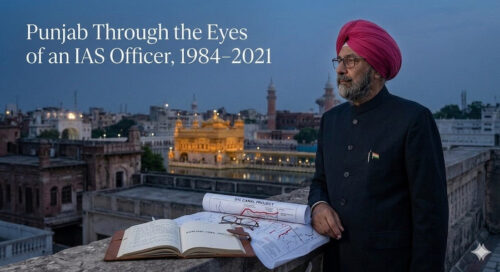
 This Punjabi-language, two-hour-long video interview is a first-hand and contemporaneous account of my journey in the Indian Administrative Service, beginning with my selection in 1984, my training at Mussoorie, district training in Punjab, and my early postings as ADC Patiala and ADC Development Amritsar during 1990–92.
It unfolds against the searing backdrop of Operation Blue Star in June 1984, one of the most egregious and traumatic episodes in modern Sikh and Punjab history, and the convulsive anti-Sikh pogroms that followed the assassination of Prime Minister Mrs Indira Gandhi on 31 October 1984. These events cast a long shadow over Punjab, over the Sikh community, and over the administrative and political life of India.
This is not a partisan recollection. Nor is it a detached academic essay written with the comfort of hindsight. It is an administrator’s first-hand account of events as they unfolded—of what was seen, heard, attempted, resisted, and learned on the ground.
The conversation covers a wide canvas: the atmosphere after Operation Blue Star in June 1984; the assassination of Prime Minister Indira Gandhi on 31 October 1984 and the anti-Sikh violence that followed; the Rajiv–Longowal Accord; the Chandigarh question; the SYL canal and Punjab’s river-waters dispute; the Supreme Court dimension; terrorism and public order; Operation Black Thunder; the role of the civil administration; and the deeply sensitive work around the Darbar Sahib Corridor — the Galliara Project. Originally conceived in security terms, the project was later transformed into a beautification initiative, a contribution for which my role was acknowledged by the late Khushwant Singh in the last edition of A History of the Sikhs.
Many of these details have remained hitherto untold in a single continuous narrative. I offer them here as a contribution to Punjab’s contemporary history: a record of how questions of faith, federalism, terrorism, governance, law, public order, and human dignity intersected during one of the most difficult chapters in the State’s modern life. It is also a reminder that many issues from that era remain unresolved—some still sticking out like sore thumbs, others continuing to fester as raw wounds in Punjab’s collective consciousness: Chandigarh, river waters, SYL, institutional autonomy, federal fairness, the memory of 1984, justice for victims, and the need to restore trust between the State, the Centre, and the people of Punjab.
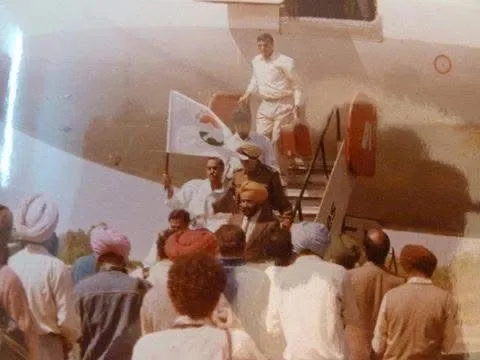
1. Selection to the IAS and the Shadow of 1984
The interview begins with my selection to the IAS in 1984, the experience of Mussoorie training, and the extraordinary national atmosphere shaped by Operation Blue Star and the assassination of Prime Minister Indira Gandhi.
For a young Sikh officer entering the higher civil service in that year, 1984 was not merely a date in the national calendar. It was a rupture. It was a time when personal aspiration, public duty, Sikh identity, and the anxieties of the Indian State converged in a manner that left a lasting imprint on an entire generation.
One of the most searing recollections from that period is of being in the heart of Kanpur city on the afternoon of 31 October 1984, when news of Mrs Indira Gandhi’s assassination began to spread, and suddenly finding oneself exposed to an angry and restive crowd. The experience of escaping from that mob was not merely a personal episode of danger; it was an early and unforgettable glimpse of the convulsion that would soon engulf Sikhs across several parts of India.
2. Mussoorie, District Training, and the Making of an Officer
The conversation reflects on the early years of training, district exposure, and the practical learning of administration—revenue, development, local governance, and public order—in a State passing through deep uncertainty.
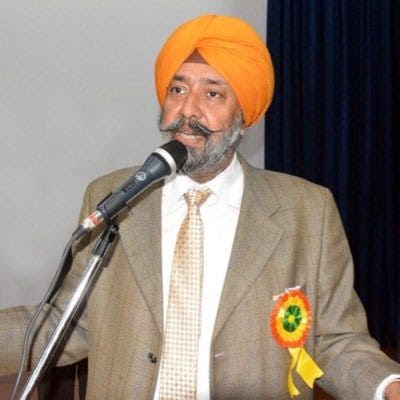
Mussoorie provided the formal foundation, but the real education came from Punjab’s districts: from files and field visits, from patwaris and panchayats, from the working of police and magistracy, and from the quiet discipline required of an officer who had to serve without theatrics in an atmosphere of fear, suspicion, and political turbulence.
3. ADC Patiala and ADC Development Amritsar, 1990–92
The discussion covers my postings as ADC Patiala and ADC Development Amritsar during 1990–92, including work with panchayats, development institutions, rural administration, and the realities of governance during disturbed conditions.
As ADC Development, Amritsar, I had to work in a district which then included Tarn Taran—one of the most sensitive and troubled areas of Punjab. Even routine development administration was never merely routine. Public works, village-level institutions, rural roads, grants, local disputes, and district planning all operated under the shadow of terrorism and public fear.
4. Amritsar and Tarn Taran During Terrorism
As Amritsar district then included Tarn Taran, the interview offers a ground-level account of administration in one of the most sensitive theatres of Punjab, where public service had to continue amid violence, threats, curfews, assassinations, and uncertainty.
The civil administration had to function in circumstances where fear was often invisible but omnipresent. Officers, police personnel, public representatives, contractors, engineers, sarpanches, and ordinary citizens were all vulnerable. Yet governance could not be suspended. The State had to function, public order had to be maintained, and development work had to continue wherever possible.
5. Operation Blue Star, Operation Black Thunder, and Darbar Sahib
The interview discusses the historical rupture caused by Operation Blue Star in June 1984, the later handling of security concerns around Darbar Sahib, Operation Black Thunder, and the need to respect Sikh religious sentiment while dealing with hard questions of public order.
Operation Blue Star was a grave and traumatic assault on Sikh sentiment, and its consequences cannot be understood merely through the language of security. At the same time, the years that followed posed severe administrative and law-and-order challenges. The contrast between different approaches—particularly the later handling of Operation Black Thunder—offers important lessons in restraint, planning, communication, and the necessity of respecting the sanctity of Darbar Sahib while dealing firmly with armed violence.
An extract from the latest edition of Khushwant Singh’s magnum opus, “The Histroy of the Sikhs”
6. The Darbar Sahib Corridor — From Security Belt to Galliara Beautification
The conversation covers the deeply sensitive work around the Darbar Sahib Corridor — the Galliara Project. Originally conceived in security terms, the project was later transformed into a beautification initiative, a contribution for which my role was acknowledged by the late Khushwant Singh in the last edition of A History of the Sikhs.
The area around Darbar Sahib had been acquired and cleared, but for some time it remained neglected, dusty, and undignified. The challenge was to ensure that the surroundings of the holiest Sikh shrine were not treated as a mere security zone, nor allowed to remain in a state of neglect. The effort was to convert the corridor into a space of dignity, reverence, and order—without compromising maryada, without permitting motorable intrusion, and without creating anything that could be seen as competing with the sanctity of the shrine itself.
Hijacker’s Surrender: April, 1993, Rajasansi International Airport, Amritsar.
7. The Hijackings of April 1993 and the Lessons Not Learnt
A separate and significant part of the interview deals with the successful handling of two hijacking incidents at Amritsar in April 1993, when firm and timely administrative, police, and security decisions ensured that the aircraft were not allowed to take off and the passengers were saved.
These episodes are recalled not merely as operational successes, but also as lessons in resolve, clarity of command, and national responsibility. The essential principle was simple: once a hijacked aircraft is on the ground, the State must not allow it to take off again if there is any credible way of preventing it. A hard decision at the right time can save the nation from far greater humiliation and loss later.
Sadly, those lessons appear to have remained unlearnt when, in December 1999, Indian Airlines Flight IC-814 was allowed to take off from Amritsar, eventually reaching Taliban-held Kandahar. That failure culminated in the release of dreaded terrorists from Srinagar jail and the national humiliation of India’s External Affairs Minister personally accompanying them for exchange in Kandahar. The contrast remains stark: what was prevented at Amritsar in 1993 became, six years later, one of the most painful and avoidable episodes in India’s fight against terrorism.
8. The Rajiv–Longowal Accord, Chandigarh, SYL, and Punjab’s River Waters
A major part of the conversation deals with Punjab’s unresolved federal questions: the Rajiv–Longowal Accord, the promised transfer of Chandigarh, the SYL canal, the river-waters dispute, the Eradi Tribunal, Supreme Court proceedings, BBMB, Yamuna waters, and Punjab’s continuing sense of grievance.
The failure to transfer Chandigarh to Punjab as promised, the persistence of the SYL dispute, and the handling of Punjab’s river waters created a deep feeling that solemn commitments to the State were not honoured. The issue is not merely technical or legal. It goes to the heart of federal trust. Punjab’s case has often been weakened not only by the Centre’s approach, but also by successive compromises, omissions, and inconsistencies by Punjab’s own leadership over the decades.
9. The Supreme Court, the November 2016 Verdict, and the Return of Acquired SYL Land
The interview also touches upon the later legal and constitutional developments concerning the SYL issue, including the November 2016 verdict of the five-judge Constitution Bench of the Supreme Court of India, which held against Punjab’s attempt to terminate earlier water-sharing arrangements.
In the aftermath of that verdict, Punjab faced a grave constitutional and political dilemma. On the one hand stood the authority of the Supreme Court and the risk of being seen as defiant of the apex court. On the other stood the political and moral position in Punjab that land acquired for the SYL canal should not remain locked in a project that the State and its people had come to regard as unjust, untenable, and injurious to Punjab’s interests.
It was in that fraught context that Punjab risked the wrath—and possibly the contempt—of the Supreme Court by returning the acquired SYL land to the original landowners. The notification may have appeared, to some, legally flimsy or vulnerable; yet, significantly, it has still not been finally set aside by the Supreme Court. Proceedings continue, and the status quo order stands. That unresolved position itself reflects the peculiar constitutional tension around SYL: a matter where law, federalism, political legitimacy, and Punjab’s historical grievance remain deeply entangled.
10. Why This Account Matters Now
This interview is not merely a personal reminiscence. It is a contemporary administrative record of a period when Punjab was negotiating grief, fear, anger, violence, faith, federal betrayal, and the burdens of governance.
It brings together several strands that are often discussed separately: 1984, terrorism, Darbar Sahib, Amritsar, Tarn Taran, SYL, Chandigarh, river waters, the Supreme Court, the Centre-State relationship, and the role of civil administration. Seen together, they form part of one developing history—Punjab’s long struggle to emerge from trauma without losing its dignity, memory, or sense of justice.
Summing-Up: From Memory to “40 Nuqte”
While Punjab’s recent history cannot be understood without examining responsibility, failure, betrayal, violence, and misjudgement, we cannot remain trapped forever in the blame game—pointing fingers while the State drifts deeper into cynicism and despair.
This interview, therefore, is not merely an exercise in memory. It is also a precursor and curtain-raiser to “40 Nuqte”, which we shall unveil soon as a citizen’s proposed manifesto and policy template for any political party willing