
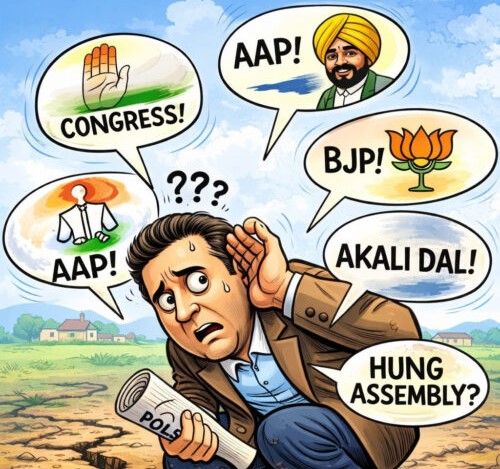
 In Punjab, political parties have now discovered the easiest job in the world criticize each other from morning till night and call it “public service.” One party holds a press conference at 10 AM, the second replies at 12 PM, the third organizes a protest at 2 PM, and by evening all of them appear on television channels shouting like contestants in a wrestling match. Meanwhile, the common citizen keeps waiting for somebody to discuss unemployment, farmers’ debt, migration of youth, drug addiction, collapsing industries, education, healthcare, and the future of Punjab.
Today, Punjab politics looks less like governance and more like a never-ending comedy serial. Every leader claims to be the “saviour of Punjab,” but when people search for actual solutions, they only find slogans, hashtags, posters, and social media videos. One party says the state was ruined by previous governments, another says the current government is destroying Punjab, while a third says both are guilty. By the end of the debate, the people of Punjab are left wondering whether anyone has ever governed the state properly at all.
The funniest part is that every political party suddenly becomes an expert on public welfare only when elections come near. Roads that were invisible for five years suddenly become “important issues.” Farmers become “annadata,” youth become “future of Punjab,” and unemployed people become “our brothers and sisters.” But once the elections are over, these same issues are placed inside cold storage until the next campaign season.
Punjab’s political culture has now become a competition of dramatic statements. One leader calls another corrupt, the second calls the first anti-Punjab, and the third accuses both of betrayal. Public meetings often sound like comedy roast shows instead of discussions about governance. Even recent political exchanges in Punjab have revolved heavily around accusations, mock assemblies, “drama company” remarks, and sarcastic attacks instead of long-term policy discussions.
The tragedy is that Punjab’s real problems are not small. Farmers continue to struggle with rising input costs, debt, and uncertainty. Concerns over drugs, law and order, unemployment, and migration remain central in public discussions. Yet political parties often appear more interested in calculating vote banks than preparing serious roadmaps for the next twenty years.
Sometimes it feels as if Punjab’s leaders are participating in a reality TV show called “Who Will Blame Better?” The winner gets prime-time headlines, viral clips, and social media trends. Governance, however, remains missing like an absent student in a classroom. The opposition says the government has failed; the government says previous governments destroyed everything; and the people say, “Fine, but who will actually fix Punjab?”
Another comic scene in Punjab politics is the sudden transformation of leaders after changing parties. Yesterday’s “most corrupt leader” becomes today’s “respected visionary” immediately after joining another camp. Political washing machines in Punjab work faster than laundry shops. Ideology changes overnight, speeches change instantly, and old accusations disappear magically. The public watches this circus and wonders whether politics is about principles or simply about adjusting chairs before elections.
Punjab also suffers from a dangerous shortage of serious debate. Where are the detailed discussions on industrial investment? On saving groundwater? On reviving government schools? On stopping brain drain? On creating employment so that Punjabi youth do not dream only about Canada, Australia, or Europe? Instead, political energy is wasted on social media trolling, personal attacks, and theatrical statements.
Even ordinary citizens have started reacting sarcastically to politics. Across online discussions, many Punjabis openly express frustration that parties spend more time attacking each other than addressing governance, corruption, unemployment, infrastructure, or administrative reforms. This frustration reflects a growing feeling that Punjab is stuck in a cycle of political drama while other states move forward with long-term planning and development.
Punjab does not need louder slogans. Punjab does not need more political comedians pretending to be revolutionaries. Punjab needs leadership that talks less and works more. The people are tired of hearing who ruined Punjab yesterday; they want to know who will rebuild Punjab tomorrow.
At present, political parties seem united on only one issue — attacking each other. Unfortunately, nobody appears equally united in fighting poverty, unemployment, corruption, farmer distress, or the continuous migration of Punjab’s youth. Until leaders begin discussing real solutions instead of political entertainment, the people of Punjab may continue to remain the audience of a tragic comedy where everyone speaks, but nobody truth
“Disclaimer: The photographic elements used in the accompanying graphic are for symbolic and illustrative purposes only. The individuals depicted do not imply actual endorsement, involvement, or association with substance