
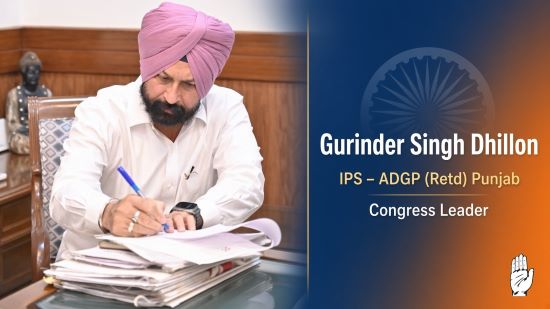
 Chandigarh: Senior Congress leader and former Additional Director General of Police (ADGP) Gurinder Singh Dhillon, IPS (Retd.), has sharply criticised the Punjab government over what he described as the growing tendency to spend public money on activities and projects that do not generate meaningful economic or social returns.
Dhillon has questioned the wisdom of continuing expenditure on what he considers “unproductive” and non-essential activities at a time when Punjab is already under severe financial pressure. His criticism comes amid a wider political debate over the state’s rising debt, increasing expenditure commitments and the need for fiscal discipline.
The former police officer-turned-Congress leader has argued that every rupee spent by the government ultimately comes from the people of Punjab. According to this line of criticism, public money should first be directed towards sectors that can strengthen the state’s economy, create employment, improve infrastructure and provide better public services rather than being spent merely for publicity or short-term political gains.
Dhillon’s intervention is particularly significant because Punjab’s financial condition has become one of the major issues facing the state. With large existing liabilities and continuing expenditure commitments, the government faces increasing pressure to demonstrate that borrowed money is being used productively. His criticism raises a fundamental question: if Punjab is borrowing money to meet its obligations, can the state afford expenditure that does not create a corresponding economic benefit?
The Congress leader has also questioned the government’s priorities. Punjab requires investment in agriculture, industry, education, healthcare, roads, irrigation, employment generation and modern infrastructure. These are the areas, he argues, where scarce government resources should produce long-term returns for the people rather than being diverted towards schemes or activities whose benefits are difficult to measure.
The issue is not simply about how much money the government spends, but where that money is being spent and whether Punjab receives value for every rupee. At a time when ordinary families are facing economic pressures and young Punjabis continue to look outside the state for employment opportunities, government expenditure must be subjected to greater public scrutiny.
Dhillon’s criticism also highlights the need for greater transparency. The Punjab government should publicly disclose the cost, purpose and measurable outcomes of major expenditure programmes. Citizens have a right to know how much money is being spent, who is receiving the contracts, what the expected benefits are and whether those objectives have actually been achieved.
The former ADGP’s remarks therefore put the Bhagwant Mann government on the defensive over a larger question of fiscal responsibility. Political governments may announce new projects and programmes, but ultimately the burden falls on taxpayers and future generations when such spending is financed through borrowing.
The central message of the criticism is straightforward: Punjab cannot borrow endlessly to finance expenditure without ensuring that it strengthens the state’s productive capacity. If money is borrowed, it should ideally create assets, employment, revenue or measurable improvements in public services.
Dhillon’s intervention adds to the growing political pressure on the Punjab government to explain its financial priorities. The opposition is likely to use the issue increasingly as the state moves towards the 2027 Assembly elections, making Punjab’s debt, expenditure and economic management a major part of the political debate.
The question Punjab needs to ask is no longer simply how much money the government is spending, but whether that expenditure is building a stronger Punjab—or merely adding another bill to the state’s already heavy debt burden.
*Dhillon’s recent public commentary has also focused on questions of governance, public expenditure and accountability. Available reporting identifies him as a retired ADGP and notes his recent public-policy writing. *