
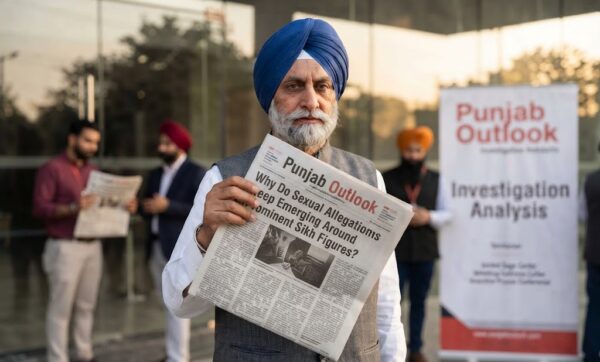
Amritsar (Punjab Outlook Investigative Analysis )The recurrence of sexual misconduct allegations involving prominent religious, political and community figures in Punjab has created an uncomfortable question for Sikh institutions and the wider public: why do such allegations repeatedly emerge around people who possess influence, authority, access to institutions and considerable social standing?
The question, however, needs to be approached carefully. It would be inaccurate and unfair to suggest that Sikh religious leaders or prominent Sikhs as a group are involved in sexual misconduct. The documented cases are different from one another, and their legal outcomes are also different. Some allegations have resulted in convictions; some accused persons have been acquitted; some investigations have recommended cancellation of cases; while other allegations remain under investigation. What the cases do have in common is the difficult relationship between personal power, institutional influence, complainants, public reputation and accountability.
A review of prominent cases over the past two decades shows that the most important issue is not simply the allegation itself. The deeper issue is what happens after an allegation is made: whether the complainant is heard, whether the accused receives due process, whether an institution conducts an independent inquiry, whether political connections influence the response and whether religious disciplinary action is confused with criminal justice.
The 2000 Dhanwant Singh case: when a religious relationship becomes a question of power
One of the older cases to reach a significant legal conclusion concerns Dhanwant Singh, head of the Noor Vishav Ruhani Charitable Trust in Hoshiarpur. According to the prosecution case reported in the Punjab and Haryana High Court’s 2026 judgment, the alleged assault took place during the night of November 25-26, 2000.The complainant was around 20 years old and her family had been followers of Dhanwant Singh, who was described as a religious preacher. The prosecution alleged that she had gone to the dera seeking advice about her nursing course and was subsequently called to his room, where she was sexually assaulted. She later disclosed the incident to her father.
The defence challenged the prosecution’s case, including the delay in reporting and the absence of corroborating witnesses. The trial court nevertheless convicted Singh in 2005 and sentenced him to 10 years’ rigorous imprisonment. The matter remained in litigation for years. In July 2026, the Punjab and Haryana High Court upheld the conviction and the 10-year sentence and awarded the survivor Rs 6 lakh compensation. The court rejected the plea seeking enhancement of the sentence to life imprisonment.
This case is important because it demonstrates why the social status of an accused person cannot substitute for judicial examination of evidence. It also demonstrates another recurring feature of sexual-offence cases: the absence of eyewitnesses does not by itself determine whether an offence occurred. The High Court specifically addressed the evidentiary arguments raised by the defence.
2002-2017: the Gurmeet Ram Rahim Singh case
The most prominent sexual-abuse prosecution involving a religious leader in the Punjab-Haryana region was the case against Gurmeet Ram Rahim Singh, head of Dera Sacha Sauda. It is important to clarify that Dera Sacha Sauda is a separate religious organisation and should not be described as a Sikh institution.The case began with an anonymous letter in 2002 alleging sexual exploitation of women followers at the Dera. The Punjab and Haryana High Court directed an inquiry, and the Central Bureau of Investigation subsequently took over the investigation. The CBI registered the case in December 2002 and later filed a chargesheet alleging sexual exploitation of two women followers between 1999 and 2001. Charges were framed in 2008. The trial continued for years, with the two complainants recording statements before the court.
On August 25, 2017, a special CBI court convicted Ram Rahim of raping two women followers. He was subsequently sentenced to 20 years’ rigorous imprisonment.This case demonstrates the enormous institutional difficulty of dealing with allegations against a religious leader with a large following. It also shows why allegations should not be confused with convictions: the legal status changed substantially over the 15-year period between the first complaint and the trial court judgment.
2017-2018: Sucha Singh Langah — allegation, political shock and acquittal
In September 2017, former Shiromani Akali Dal minister and former SGPC member Sucha Singh Langah became the subject of a rape case filed by a Punjab Police employee. She alleged that Langah had repeatedly raped her since 2009 and provided police with a video that subsequently became public.Police registered a case under provisions relating to rape, extortion, cheating and criminal intimidation. The Shiromani Akali Dal expelled Langah after the case was registered. The Akal Takht also excommunicated him in October 2017.The case, however, ended very differently from the initial public reaction. During the trial, the complainant retracted her allegations and told the court that she had filed the complaint under pressure. In July 2018, the Gurdaspur court acquitted Langah. Twenty-three prosecution witnesses had appeared during the trial.
The Langah case is therefore an essential warning against treating an FIR as a conviction. The allegation was serious, but the final criminal-court outcome was acquittal. In 2022, Langah appeared before the Akal Takht again and received religious punishment, while acknowledging what he described as his “sin”; the earlier rape case itself had already ended in acquittal.
2017-2021: Charanjit Singh Chadha and the Chief Khalsa Diwan controversy
Another major controversy emerged around Charanjit Singh Chadha, then president of the Chief Khalsa Diwan, one of the historic Sikh socio-religious organisations.In December 2017, Chadha and his son were booked for sexual harassment and criminal intimidation following a complaint by a female principal. The controversy intensified after an objectionable video involving Chadha and the woman circulated publicly.In January 2018, the Akal Takht barred Chadha from participating in religious, social, political and educational events for two years. The Sikh clergy treated the matter as a violation of Sikh conduct, while the Chief Khalsa Diwan had already removed him from its leadership.
But the criminal case later took a different direction. Police investigators asked the court to scrap the FIR, stating that Chadha could not be held guilty in the case. In April 2021, the Akal Takht lifted its religious ban after his appeal.This case again demonstrates the difference between three separate processes: public controversy, institutional disciplinary action and criminal adjudication. They should not be presented as though they are interchangeable.
2012-2025: Ranjit Singh Dhadrianwale — a case that changed dramatically
The case involving Sikh preacher Ranjit Singh Dhadrianwale illustrates another important aspect of allegations against prominent religious figures: investigations can produce conclusions very different from the original accusation.The underlying incident concerned a woman who died in 2012 after being found unconscious outside Gurdwara Parmeshwar Dwar in Patiala. Her post-mortem indicated poisoning. The woman’s family initially did not allege foul play, according to the Punjab Police affidavit later placed before the High Court.Years later, the woman’s brother pursued fresh legal action and alleged rape and murder. After intervention by the Punjab and Haryana High Court, an FIR was registered on December 7, 2024, against Dhadrianwale under sections dealing with murder, rape and criminal intimidation. Dhadrianwale denied the allegations and said the matter concerned an old case of suicide.
A three-member Special Investigation Team subsequently investigated the allegations. In May 2025, the SIT recommended cancellation of the FIR, stating that none of the principal accusations could be established. The report said the investigation did not establish murder or rape and found that the property-related allegation was also unsupported. The police indicated that legal opinion and further procedure would follow.This is precisely why responsible journalism must follow the entire timeline rather than stop at the headline announcing an FIR.
2025: Chief Khalsa Diwan office-bearer Harinderpal Singh Sethi
In June 2025, another serious case emerged involving Harinderpal Singh Sethi, additional honorary secretary of the Chief Khalsa Diwan.According to the FIR and media reports, a 17-year-old girl from Delhi alleged that Sethi sexually assaulted her on multiple occasions. She alleged that the first incident occurred in Amritsar in May 2022 and that further incidents occurred in 2023, including one in Delhi. Police registered offences including sexual harassment, criminal intimidation and provisions of the POCSO Act. The girl’s mother was also named as a co-accused in the FIR in relation to the allegations.The Chief Khalsa Diwan suspended Sethi from his position and primary membership after the FIR was registered. An SIT was constituted to investigate the allegations.As with the Chawla case, the important journalistic distinction is that an FIR records an allegation and initiates investigation; it does not itself establish guilt.
2026: Amarjit Singh Chawla and the current controversy
The latest and perhaps most politically sensitive case involves Amarjit Singh Chawla, a senior Shiromani Akali Dal leader and former SGPC member.A Bahrain-based woman from Sangrur district alleged that Chawla raped her during her stay at an SGPC-managed facility in Anandpur Sahib. An FIR was registered on August 21, 2026, under provisions relating to rape, wrongful confinement and criminal intimidation. Chawla has denied the allegations and said he was framed. Reports state that he left for Canada before the controversy intensified.The case quickly became larger than the original criminal allegation because of questions concerning the woman’s prolonged stay in SGPC-run facilities, her contacts with political and religious figures and claims about who brought her to Punjab. The complainant also alleged that she had informed various people about the alleged abuse. The FIR names several individuals in connection with what she says they knew about the allegations; those claims themselves require investigation and should not be presented as established facts.
The SGPC suspended two employees whose names appeared in connection with the case and ordered an inquiry. Later, SGPC president Harjinder Singh Dhami announced a four-member committee to investigate the controversy.On September 20, the Akal Takht excommunicated Chawla and additional head granthi Malkit Singh. Malkit Singh faced separate allegations involving obscene messages. The religious action is an institutional decision and is not equivalent to a criminal conviction.The controversy has subsequently developed into an internal political dispute, with some Akali leaders publicly defending Chawla and questioning the credibility or circumstances of the complainant’s allegations. Other political actors have called for further investigation. The legal process remains crucial to determining what actually happened.
So, why do these allegations repeatedly arise around influential people?
The evidence does not support one simple explanation. But the cases point toward several structural issues that deserve examination.The first is power imbalance. A religious preacher, political leader, office-bearer or institutional authority may have access to people who depend upon that institution for spiritual guidance, employment, accommodation, education, social support or community recognition. That unequal relationship can make it difficult for a complainant to challenge the powerful person or immediately report alleged misconduct.
The second is institutional loyalty. When the accused is a senior figure, supporters may instinctively defend the person because they identify the individual with the institution itself. This can turn a question of individual conduct into a battle between factions. The Chawla controversy demonstrates how quickly an allegation can become entangled with political loyalties and the approaching Punjab election.The third is fear of social consequences. In close-knit religious and community networks, a complainant may fear being labelled, isolated, disbelieved or blamed. That does not mean every delayed complaint is true, nor does delay prove that a complaint is false. It means investigators must examine the circumstances surrounding the delay rather than using delay as an automatic conclusion.
The fourth is the absence of independent complaint mechanisms. If the institution controlled by or closely associated with the accused is responsible for investigating the complaint, questions about independence naturally arise. The response to the Chawla case—where the SGPC established internal inquiries while the criminal investigation proceeded—shows why institutional and legal processes must remain clearly separated.
The fifth is political factionalism. Sexual allegations involving political figures can become weapons in internal party struggles. The Langah case became politically explosive during a by-election period, while the Chawla case has unfolded as Punjab’s political parties prepare for the 2027 Assembly election. That political context does not establish whether an allegation is true or false; it simply means journalists must be particularly careful about distinguishing evidence from political claims.The sixth is the difference between religious discipline and criminal justice. The Akal Takht may impose religious sanctions for conduct considered contrary to Sikh principles. Courts, however, determine criminal guilt according to evidence and law. The Langah, Chadha and Chawla cases demonstrate that these processes can produce different outcomes and should therefore never be conflated.
The larger institutional question
The real issue for Sikh institutions is not whether they should automatically defend a prominent person or automatically condemn him. Their responsibility is to create procedures under which allegations can be examined fairly.A complainant must be able to report alleged misconduct without intimidation. An accused person must be able to defend himself without being presumed guilty. Evidence must be preserved. Witnesses must be protected. Investigations must be independent enough to command public confidence. And religious sanctions should not be presented as substitutes for criminal proceedings.The media has a similar responsibility. An FIR should be described as an FIR. An allegation should be described as an allegation. A chargesheet should be distinguished from a conviction. An acquittal should be reported just as prominently as the original accusation. And where an investigation recommends cancellation of an FIR, that development must be included in the final account.
A timeline that tells the real story
From the 2000 Dhanwant Singh allegation and subsequent conviction, to the long Gurmeet Ram Rahim investigation ending in a 2017 conviction; from the 2017 Langah case ending in acquittal, to the Chadha controversy followed by lifting of the religious ban; from the Dhadrianwale FIR in 2024 followed by an SIT recommendation for cancellation, to the 2025 Sethi case and the 2026 Chawla controversy the record does not show one uniform pattern or one uniform outcome.
What it does show is that influential institutions repeatedly face the same fundamental challenge: how to protect institutional credibility without protecting individuals from legitimate scrutiny.For the Sikh community, this is not merely a question of reputation. It is a question of principles. Sikh religious institutions have historically emphasised moral conduct, equality and accountability. Those principles are tested most seriously when the person facing an allegation is powerful, popular or closely connected to the institution.
Punjab Outlook conclusion: The answer is neither collective condemnation nor automatic defence. The answer is transparent procedure, independent investigation, protection of complainants and witnesses, due process for the accused and accurate reporting of every stage of the case. Prominence should never provide immunity from scrutiny—but an allegation should never become a substitute for evidence either.The credibility of Sikh institutions will ultimately depend not on whether they can prevent allegations from being made, but on whether they can demonstrate that, when allegations arise, the truth is pursued without fear, favour, political pressure or institutional protection.
Disclaimer: This article and accompanying images are for informational and illustrative purposes only. Some visuals may be AI-generated or digitally enhanced and may not depict actual events or persons.Views expressed are based on publicly available information and analysis