
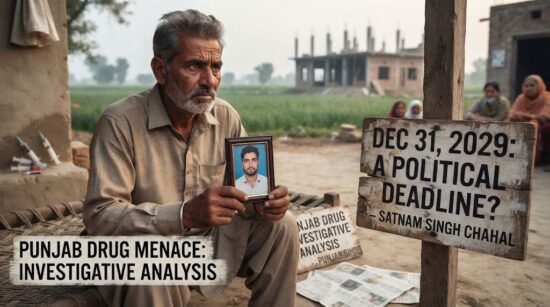
Punjab is once again being offered a familiar political promise: that illegal drugs, particularly “chitta”, can be eliminated from the state by a fixed date. At a rally in Jalandhar on September 30, Union Home Minister Amit Shah promised that nobody would give drugs to Punjab’s children after December 31, 2029, while making “Nasha Mukt Punjab” the BJP’s principal election issue. The promise is politically powerful, but the central question is much more complicated: can an illegal drug economy that has survived years of governments, police operations, arrests, seizures and political promises really be finished by putting a date on the calendar?
The answer requires separating two very different objectives. Reducing drug availability, dismantling trafficking networks, preventing young people from entering addiction and helping dependent users recover are achievable policy goals. But claiming that illegal drugs will completely disappear from an entire state by a particular date is a far more difficult proposition. Punjab’s experience demonstrates why slogans and deadlines cannot substitute for a long-term strategy.
The drug problem is not simply a question of whether police can arrest enough people. It is an ecosystem. There are suppliers, financiers, transporters, local distributors, users, corrupt facilitators, cross-border networks and increasingly sophisticated methods of concealment. When one network is disrupted, another can attempt to replace it. The Narcotics Control Bureau’s own recent actions illustrate the complexity. In 2025, the NCB reported 1,33,965 kg of narcotic drugs seized nationally, 994 traffickers arrested and 265 offenders convicted. Yet the same year still required another major anti-narcotics enforcement effort.
That is the first lesson Punjab needs to understand: a seizure is not the same thing as the end of the market. An arrest is not the same thing as the destruction of a network. A conviction is not the same thing as the disappearance of demand.
The Punjab problem also has a geographical dimension. The state shares an international border with Pakistan, and authorities have repeatedly dealt with alleged cross-border trafficking, including heroin consignments. In one case, the NCB’s Chandigarh unit secured a conviction in a Fazilka case involving 5.958 kg of heroin seized near the India-Pakistan border. The NCB has also described investigations involving trafficking networks operating across borders and, in another 2025 action, alleged that a high-profile trafficker continued orchestrating narcotics activity even while in judicial custody.
This demonstrates why the phrase “finish the drugs” can be misleading. The government is not fighting one criminal gang sitting in one village. It is confronting networks that can change routes, replace couriers, move money through different channels and adapt to enforcement pressure.
There is another uncomfortable reality: supply survives because there is demand. If one substance becomes difficult to obtain, traffickers have an economic incentive to find alternatives. The 2025 World Drug Report described the illicit drug trade as “relentless and adaptive”, with supply responding to demand and changing market conditions. That international evidence matters to Punjab because a local police crackdown operates inside a much larger drug economy.
Therefore, Punjab cannot afford an anti-drug policy that is measured only by the number of FIRs, arrests, raids and kilograms seized. Those numbers are important, but they do not tell the whole story. The real questions are: How many major trafficking networks have been permanently dismantled? How much drug money has actually been confiscated? How many repeat offenders have been prevented from continuing operations? How many addicted people have entered sustained treatment? How many have remained drug-free after treatment? How many young people have been prevented from starting?
These are much harder questions than announcing another campaign.
The health dimension is equally important. Drug dependence is not simply a criminal label. The World Health Organization describes drug-use disorders as complex health conditions involving biological, psychological, social and environmental factors, and says effective prevention, treatment and care require an integrated public-health response. WHO and UNODC have developed international standards specifically to help governments build evidence-based treatment systems.
Punjab’s own treatment infrastructure illustrates the scale of the challenge. The Union Health Ministry reported that the Drug De-addiction Treatment Centre at PGIMER Chandigarh treated 28,410 patients between January and September 2024 when registrations and follow-ups are counted, while also providing specialised services including opioid-substitution therapy and tele-addiction services. That does not represent the entire Punjab drug-using population, but it demonstrates that addiction requires continuing medical and psychosocial intervention rather than a one-time police operation.
A serious anti-drug strategy must therefore have two arms operating simultaneously. The first arm must attack the business: traffickers, financiers, organised networks, corruption, illegal assets, cross-border supply and distribution chains. The second must attack the demand side: prevention, early intervention, treatment, rehabilitation, employment, family support and long-term recovery.
One without the other will leave a vacuum.
If police arrest dealers but treatment capacity remains inadequate, the demand remains. If rehabilitation is expanded but major suppliers continue to operate, the supply remains. If the border is strengthened but local distribution networks are not dismantled, drugs can continue moving through alternative channels. If enforcement is intensified but corruption allows selected operators to survive, the market simply changes hands.
That is why Punjab needs continuity rather than political cycles.
The state has already witnessed repeated political promises concerning drugs. The BJP is now promising a December 31, 2029 deadline, while other political parties have challenged the feasibility and political timing of that promise. Congress leaders have argued that rallies and political yatras cannot by themselves resolve a deep-rooted drug crisis and have questioned the measurable results of anti-drug measures. Those are political claims and should be judged against evidence rather than slogans.
There is also an important lesson in the promises made by different governments: every new government inherits the same problem because addiction and organised trafficking do not change when political power changes hands.
The solution, therefore, should not belong exclusively to the BJP, AAP, Congress or any other political party. Punjab needs a policy that survives governments.
A genuine long-term plan should include an independently audited database of major trafficking networks; financial investigation of drug proceeds; systematic prosecution of financiers and repeat offenders; stronger coordination among Punjab Police, NCB, BSF and other agencies; protection for witnesses and informants; monitoring of prisons to prevent trafficking from inside jails; expansion of evidence-based treatment; school and college prevention programmes; employment and rehabilitation support for recovering users; and transparent public reporting of measurable outcomes.
Most importantly, the government should distinguish between the drug trafficker and the person suffering from addiction. The trafficker who profits from another person’s dependence presents a law-enforcement problem. The addicted person may simultaneously require medical treatment, psychological support and social rehabilitation.
WHO specifically recommends recovery-oriented services such as continuing community care, case management, residential treatment where appropriate and peer support for people with drug dependence. In 2025, WHO also emphasised the importance of accessible, evidence-based prevention, harm reduction, treatment and care for people with opioid dependence.
Punjab should also stop treating rehabilitation as a public-relations photograph. A person leaving a de-addiction centre without employment, family support, follow-up treatment and social reintegration can remain vulnerable to relapse. Recovery is not completed when a patient walks out of a treatment centre. Recovery begins when the person has to return to ordinary life.
This is where political speeches often become easier than governance.
It is easy to announce a deadline. It is much harder to maintain a treatment system for years. It is easy to announce thousands of arrests. It is much harder to ensure that the people financing the trade are identified, prosecuted and deprived of their illegal assets. It is easy to conduct a rally. It is much harder to establish whether fewer young people are actually entering addiction.
Punjab therefore needs a different definition of success.
Success should mean fewer new users, fewer overdose deaths, fewer young people becoming dependent, fewer active trafficking networks, more convictions of major financiers, more illegal assets confiscated, better treatment access, stronger recovery rates and safer communities.
And if those indicators improve year after year, Punjab will have genuine reason for confidence.
But promising that “after December 31, 2029, no one will give drugs to your children” sets an extraordinarily absolute standard. The drug market is not a government department that can be closed at 5 p.m. on a particular day. It is an adaptive criminal economy operating across borders and communities and interacting with addiction and demand. The NCB’s continuing seizures and investigations, including cases involving cross-border trafficking and organised networks, demonstrate why the challenge is persistent.
The message to Punjab’s political class should therefore be simple:
Do not promise the impossible merely because an election is approaching. Promise what can be measured.
Tell Punjab how many major networks will be dismantled. Tell the people how drug money will be traced. Tell families how treatment will be expanded. Tell recovering addicts where they will find employment and continuing support. Tell the public how police corruption will be investigated. Tell the people how the border, prisons and local distribution networks will be monitored.
And then publish the results every six months.
Punjab does not need another slogan. Punjab needs a permanent anti-drug system that continues functioning after the election banners come down.
The objective should be ambitious: drive illegal drugs down, destroy trafficking networks, reduce demand, prevent addiction and expand recovery.
But the honest language is equally important: there is no magic date on which an entrenched illegal drug market simply disappears.
The war against drugs may be politically announced in one rally, but the real fight will have to continue in Punjab’s villages, towns, schools, hospitals, police stations, courts, prisons, border areas and homes for many years.
That is the reality Punjab must confront if it genuinely wants to become safer—not merely during an election campaign, but for the generation growing up after it.
Disclaimer: This article and accompanying images are for informational and illustrative purposes only. Some visuals may be AI-generated or digitally enhanced and may not depict actual events or persons.Views expressed are based on publicly available information and analysis