
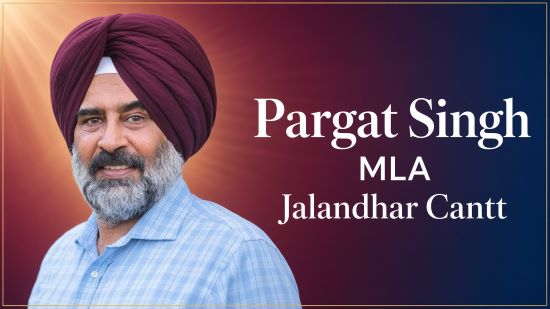
 Chandigarh (Punjab Outlook Political Analysis) The appointment of former Indian hockey captain and Jalandhar Cantonment MLA Pargat Singh as president of the Punjab Pradesh Congress Committee marks a significant change in the state Congress’s leadership ahead of the 2027 Punjab Assembly elections. He replaces Amarinder Singh Raja Warring, who resigned from the post after meeting Rahul Gandhi on October 2. The appointment comes as Congress tries to consolidate its organisation, manage differences among senior leaders, and prepare for an election in which its performance will depend not only on public support but also on the unity and effectiveness of its state leadership.
Pargat Singh’s journey from international hockey to electoral politics has given him a public identity different from that of many conventional politicians. A former Indian hockey captain who represented the country at the 1988 Seoul Olympics, 1992 Barcelona Olympics and 1996 Atlanta Olympics, he established his reputation through sport before entering political life. He received the Arjuna Award in 1989 and the Padma Shri in 1998. His sporting background brings experience of teamwork, discipline and competition, although the challenges of managing a political party are considerably different from those of leading a team on the field.
Pargat entered electoral politics through the Shiromani Akali Dal and won the Jalandhar Cantonment Assembly constituency in 2012. He later joined the Congress and retained the seat in the 2017 and 2022 Assembly elections. His political journey has included ministerial responsibility in the Charanjit Singh Channi government, where he served as a cabinet minister from September 2021 to March 2022. He has also held organisational responsibilities within the Congress, including the post of general secretary (organisation) in the Punjab unit in 2021. These experiences provide him with familiarity with both the legislative process and the party’s internal functioning.
However, becoming the president of a state party is a responsibility of a different magnitude. Pargat Singh must now coordinate leaders who have their own political ambitions, constituencies, supporters and views on the party’s future direction. The Punjab Congress has experienced public disagreements among senior leaders over leadership, candidate selection, organisational decisions and the question of who should lead the party’s campaign. Bringing these leaders onto a common platform will require regular consultation, clear responsibilities and a credible mechanism for resolving disputes before they become public confrontations.
The replacement of Raja Warring should therefore not be viewed merely as a change of face at the top. It raises a larger question about the Congress organisation in Punjab: can the party transform a leadership change into a wider programme of organisational renewal? A new president can provide fresh direction, but the effectiveness of that direction will depend on the cooperation of the state leadership, the support of the central high command and the willingness of senior politicians to place collective organisational interests above individual ambitions.
The coming months will also test Pargat Singh’s ability to reconnect the party with voters who are concerned about employment, agriculture, rural debt, industrial development, education, health services, drug abuse, law and order, migration and the future of young people in Punjab. Political speeches and press statements may attract attention, but voters will increasingly look for a clear explanation of what the Congress proposes to do, how its proposals would be implemented and how the party would be held accountable if it returned to power.
The Congress must also develop a credible approach to Punjab’s financial challenges. Public expectations concerning government employment, social welfare, farmers’ concerns, public services and infrastructure cannot be addressed through slogans alone. The party will need to explain how its promises would be financed, which measures would receive priority and how it would balance welfare commitments with the state’s fiscal responsibilities. A detailed and realistic policy programme could give the organisation a more substantive basis for public debate than personality-driven political exchanges.
Another important responsibility will be to strengthen the party below the state leadership level. Block and district units, local workers, elected representatives and grassroots organisers are essential to maintaining regular contact with voters. If these structures remain weak or function only during election campaigns, even a prominent state president may find it difficult to convert public dissatisfaction with the government into electoral support. The organisation must identify local concerns, listen to workers and ensure that decisions taken in Chandigarh are communicated effectively to the village, town and ward levels.
Pargat Singh’s appointment also places him in the middle of the continuing debate over leadership representation and the aspirations of different social and regional groups within Punjab. The Congress will have to manage these considerations through transparent organisational procedures rather than allowing them to become sources of division. Fair treatment in candidate selection, consultation with local leadership and a clear process for resolving internal disputes will be important to maintaining confidence within the party.
His background in hockey may encourage expectations that he will bring discipline, teamwork and a performance-oriented approach to politics. Yet political leadership cannot be judged by sporting achievements alone. The new president will be assessed on his ability to build a united organisation, establish a coherent public message, maintain constructive relations with the central leadership and ensure that the party’s campaign reflects the concerns of ordinary Punjabis.
The 2027 Assembly election will be the first major electoral test of his leadership in this role. It would be premature to predict the outcome on the basis of his appointment. What can be said is that the change creates an opportunity for the Punjab Congress to review its organisation, define its policy priorities and demonstrate whether it can work as a coordinated political force. The electorate will ultimately judge the party by its proposals, credibility, leadership and record rather than by the announcement of a new president.
For Pargat Singh, the challenge is to move from being a respected former sportsman and experienced legislator to becoming an effective state-level political organiser. His appointment gives him the responsibility to lead; it does not automatically guarantee unity, public confidence or electoral success. Those will have to be earned through decisions, organisation, consistency and accountability.
Punjab Outlook’s assessment: The appointment marks the beginning of a demanding phase for the Punjab Congress. Pargat Singh’s real achievement will not be measured by the position he has received, but by whether he can bring divided leaders together, strengthen the organisation at the grassroots level and present Punjab’s voters with a serious, credible and clearly explained alternative in 2027.