
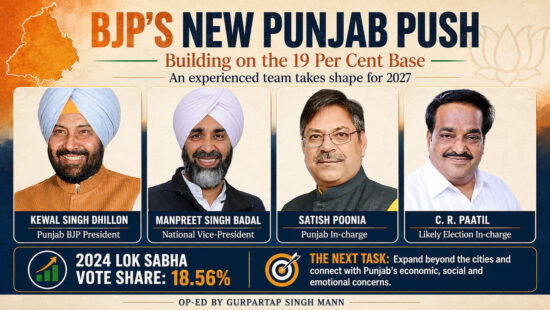
 The Bharatiya Janata Party appears to have entered election mode in Punjab. Its recent appointments are not routine changes; together, they resemble the opening of a campaign command centre.Kewal Singh Dhillon was appointed Punjab BJP president in May. Turbulence followed the reorganisation of district and state office-bearers. A section of the old cadre felt that entrants from other parties were being rewarded while long-serving workers were being pushed aside. The public resentment damaged the new president’s early momentum.
Delhi has responded with three significant moves. Manpreet Singh Badal has been elevated as a national vice-president. Satish Poonia, an experienced organiser, has been appointed Punjab in-charge, filling the space left vacant after Vijay Rupani’s death. C. R. Paatil, Union Jal Shakti Minister, former Gujarat BJP president and a trusted political manager of Prime Minister Narendra Modi, is reported to be the likely election in-charge. The appointment is not yet official, but the proposed deployment conveys seriousness.
The arrangement combines a Jat Sikh state president, an organiser to settle the cadre, a Punjab leader who can speak on economics and, possibly, a hard-driving election manager. It looks formidable, but multiple power centres can create confusion unless authority is clearly defined.
The urgency follows the rise and fall of the BJP’s expectations. In the 2024 Lok Sabha election, it secured 18.56 per cent about 25 lakh votes and led in 24 Assembly segments, its strongest statewide performance, yet won no parliamentary seat. At a Moga rally in March 2026, Amit Shah declared that wherever the BJP reaches 19 per cent, it forms the next government. For a cadre long confined to being the SAD’s junior partner, the claim was electrifying.
But rhetoric is not electoral law. Nineteen per cent is a foundation, not a bridge to 59 seats. Its value depends on its geographical and social spread.
The 2024 figure came in a national election shaped by the Modi factor, with the BJP contesting all 13 seats after its alliance with the SAD ended. Much of its support remained urban and semi-urban. An Assembly election is different: candidates, community equations, rural networks and state leadership carry greater weight. A parliamentary vote can become thinly scattered across 117 constituencies.
This is why the recent People’s Pulse “Mood Punjab Da” survey should neither be dismissed nor treated as scripture. It estimates AAP at 37 per cent and 58–63 seats; Congress at 31 per cent and 36–43 seats; Waris Punjab De at 14 per cent and 4–7 seats; BJP at 8 per cent and 2–6 seats; and SAD at 6 per cent and 2–4 seats.
People’s Pulse says it conducted 8,000 face-to-face interviews across all 117 constituencies between June 20 and July 31. I cannot independently verify its fieldwork, and one early survey is a snapshot, not a prophecy. Its figures are best read as a warning.
The timing matters. AAP’s advantage appears to rest substantially on its welfare architecture what supporters call delivery and opponents call freebies. But the fieldwork ended before the August 7 mass mobilisation of employees and pensioners over 18 per cent pending DA, the Old Pension Scheme and other demands. That escalating pressure is not reflected in the survey.
The leadership findings are equally revealing. Bhagwant Mann is the preferred chief minister at 40 per cent, followed by Charanjit Singh Channi at 33, Amritpal Singh at 13, Sukhbir Singh Badal at 5 and Kewal Singh Dhillon at 4.
Congress has still not converted Channi’s popularity into a clear leadership proposition. I have argued for more than a year that his social and political weight would make him difficult to ignore. I had written way back in April 2025 https://substack.com/@gpsmann/p-161857917 that how Channi can no longer be ignored. That political forecast stands vindicated. The survey reinforces that assessment.
For the BJP, the first challenge remains internal. Its Punjab unit contains three political cultures: the traditional urban cadre, former Congress leaders and leaders from the Akali tradition. Expansion required new faces, but growth cannot come by making the original cadre feel like tenants in its own house. New leaders bring reach and resources; old workers bring loyalty and booth-level endurance. The differences must be ironed out.
Nor should Sunil Jakhar’s contribution be overlooked. Under his presidency, the BJP recorded its highest statewide vote share and led in 24 Assembly segments. He gave it greater acceptability beyond its traditional cadre. Replacing him with Dhillon may reflect a new calculation, but the party cannot afford to marginalise Jakhar or squander the ground gained under him.
The larger challenge is understanding Punjab. It cannot be approached as another state or an extension of neighbouring Haryana. Its politics operates at three levels economic, social and emotional and emotion often overrides arithmetic.
The economic issues are debt, unemployment, agrarian stagnation, weak investment and migration. The social issues are drugs, gangsterism, law and order and eroding confidence. The emotional issues arise from Punjab’s history, Sikh identity, federal grievances and a belief that Delhi does not always understand the state’s sacrifices and claims. Any party that misses this third layer will misread Punjab.
Manpreet Badal brings administrative experience, knowledge of public finance and familiarity with Akali and Congress politics. He can frame an economic argument and provide a recognisable Sikh face nationally. But his usefulness depends on whether he is empowered to articulate a credible Punjab-specific programme.
Punjab faces more than conventional anti-incumbency. Law and order, drugs, unemployment, agricultural stagnation, industrial slowdown and debt are converging into a structural crisis. Outstanding debt is projected to approach Rs 4.48 lakh crore by March 2027 about 45 per cent of GSDP. Debt servicing consumes resources needed for infrastructure and jobs, while manufacturing remains too weak to employ Punjab’s youth.
Farmer anger, youth migration, drugs and gangsterism are not separate illnesses; they are symptoms of an economy no longer generating hope. Punjab needs a ten-year reconstruction plan covering debt, industry, border districts, small enterprises, agricultural research, assured diversification markets, water and above all employment for the youth.
The BJP has both an advantage and a burden. It governs at the Centre, but cannot pretend every problem begins and ends in Chandigarh. Drugs require state police, central agencies and border management to work together. Diversification depends on national procurement, trade, ethanol and pricing policies. “Double engine” will matter only if it produces measurable outcomes.
On Chandigarh, river waters, the BBMB and Bandi Singhs, the BJP cannot rely on ambiguity. As the ruling party at the Centre, it will be asked for answers, not sympathy. It must show that national integration and Punjab’s rights are not competing ideas.
The deepest obstacle is the trust deficit among farmers and much of rural Sikh society after the farm-law agitation. Sikh appointments may help, but symbolism cannot replace policy. The BJP must explain its position on MSP, markets, farm debt, diversification, groundwater and agricultural incomes.
The party also faces a choice over the SAD. Contesting alone may serve long-term expansion; an alliance may improve short-term arithmetic. But the votes of two weakened parties cannot simply be added, particularly when transferability is uncertain and Waris Punjab De is altering the Panthic space.
The appointments show that the BJP high command has begun to take Punjab seriously. Whether Punjab takes the BJP equally seriously will depend on what follows from here. If the BJP treats 19 per cent as an entitlement, even 8 per cent is possible. If it treats it as a starting point, repairs its organisation, respects Punjab’s federal concerns and offers a route out of economic decline, it can expand, beyond expectations because a large segment is looking at it with hope.