
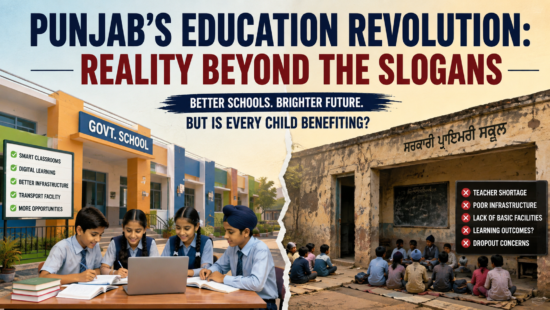
Punjab’s education system has been at the centre of growing public debate, with the state government repeatedly presenting its initiatives as evidence of an education revolution. Better school buildings, modern facilities, technology, Schools of Eminence and improved examination results are being highlighted as signs of transformation. But the larger question remains: Has the education system as a whole really changed for the better?
There is no doubt that some government-school students have achieved remarkable success in competitive examinations and other academic fields. Such achievements deserve recognition. When a student from an ordinary family reaches a prestigious institution or performs exceptionally well in a national examination, it demonstrates the potential that exists within Punjab’s government-school system.
However, individual success stories cannot be the only measurement of an education revolution. The real test lies in the condition of thousands of ordinary government schools across Punjab, particularly those in villages and economically weaker areas.
The government should therefore make comprehensive, district-wise education data available to the public. How many teaching posts are vacant? How many schools have adequate teachers for every subject? What is the teacher-student ratio? How many students drop out before completing secondary education? What are the actual learning outcomes in primary and middle schools? How regularly are schools inspected and infrastructure maintained?
These questions are far more important than photographs of newly renovated buildings or publicity campaigns.Education is not simply about constructing attractive classrooms. A school can have a modern building and still fail if students do not receive quality teaching. Similarly, computers, smart classrooms and other technology are useful only when teachers are properly trained and students are actually benefiting from them.
Punjab also needs to pay particular attention to rural education. Many families in villages depend heavily on government schools. For them, the quality of a nearby government school can determine whether their children receive a meaningful education or are forced to seek expensive alternatives.
Teacher shortages are another critical issue. A school cannot deliver quality education when important subjects do not have permanent and adequately trained teachers. Recruitment, regular training, accountability and professional development must therefore remain at the centre of any genuine education reform.
The government deserves credit wherever measurable improvements have taken place. But credit must be accompanied by transparency. If the education system has genuinely undergone a transformation, the government should have no hesitation in publishing independent data showing improvements in learning outcomes, attendance, examination performance, teacher availability and infrastructure.
At the same time, criticism should not be based merely on political allegations. Punjab needs an objective assessment conducted through facts, independent experts and publicly available statistics.The ultimate beneficiaries of education policies are not politicians or governments. They are Punjab’s children. Their future cannot be measured through slogans, advertisements or political speeches.
The real education revolution will be the day when every child in Punjab whether studying in a government school in a major city or a small village has access to qualified teachers, proper classrooms, modern learning resources and an equal opportunity to succeed.Punjab does not need an education revolution on paper. It needs an education revolution that parents, teachers and students can see, experience and measure in their everyday lives.
Disclaimer: This article and accompanying images are for informational and illustrative purposes only. Some visuals may be AI-generated or digitally enhanced and may not depict actual events or persons.Views expressed are based on publicly available information and analysis