
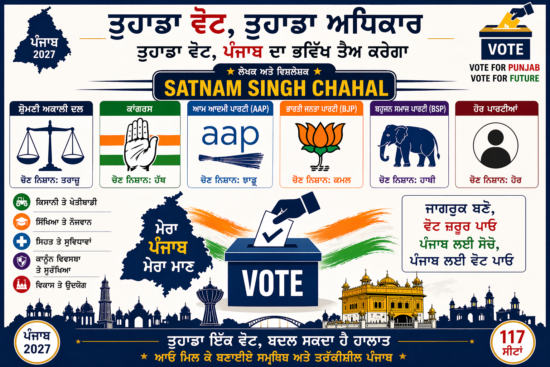
 Punjab’s political battlefield today is defined not merely by party slogans or state-level narratives, but by deeply localised constituency dynamics across its 117 Assembly seats. As the state moves toward the 2027 elections, the shift from a traditional bipolar contest to a four-cornered fight involving the Aam Aadmi Party, Indian National Congress, Shiromani Akali Dal, and Bharatiya Janata Party has made each seat far more competitive and unpredictable. The decisive factor is no longer just party wave—it is the micro-management of caste equations, local leadership credibility, and constituency-specific grievances.
In the Malwa region, which accounts for 69 seats and effectively determines who forms the government, the political mood is undergoing a subtle but important shift. While the Aam Aadmi Party had swept this belt in 2022, signs of anti-incumbency are visible at the constituency level. Complaints related to governance delivery, unemployment, agrarian distress, and the persistent drug issue are beginning to erode the overwhelming support the party once enjoyed. However, this erosion is not translating into a clear wave for any single opposition party. Instead, the vote is fragmenting. The Indian National Congress is regaining some traction in pockets where it retains strong local leaders, particularly in Patiala and parts of Ludhiana, while the Shiromani Akali Dal is slowly rebuilding its rural base in areas like Bathinda, Mansa, and Muktsar by reconnecting with traditional Panthic voters. The Bharatiya Janata Party, though still weak in rural Malwa, is expanding its influence in urban constituencies such as Ludhiana and parts of Patiala, making several seats triangular or even quadrangular contests. As a result, in many Malwa constituencies, victories may come with very narrow margins, often dependent on candidate selection rather than party dominance.
In the Majha region, comprising 25 seats and including politically sensitive districts like Amritsar, Gurdaspur, and Tarn Taran, the contest is expected to be equally intense but shaped by a different set of issues. Here, nationalism, border security, and identity politics play a stronger role. The Indian National Congress retains a historical advantage in several constituencies due to its established leadership and organisational depth. However, the Aam Aadmi Party has managed to maintain a presence, particularly where it has sitting MLAs, though it faces anti-incumbency here as well. The Bharatiya Janata Party is attempting to capitalize on urban Hindu voters, especially in Amritsar city and Gurdaspur, while also leveraging its central leadership appeal. Meanwhile, the Shiromani Akali Dal is trying to consolidate Panthic sentiment in rural Majha, particularly in Tarn Taran, but internal weaknesses and past credibility issues continue to limit its growth. In this region, almost every constituency is expected to witness a multi-cornered fight, making outcomes highly uncertain.
The Doaba region, with its 23 seats, presents a different political picture shaped by its high Dalit population and strong NRI influence. Here, constituency-level outcomes are often influenced by caste alignments and diaspora connections rather than purely party ideology. The Indian National Congress has traditionally held a strong base in Doaba and is expected to remain competitive across many seats. The Aam Aadmi Party, after its 2022 gains, still retains some advantage but faces localized dissatisfaction in certain constituencies. The Bharatiya Janata Party is making strategic inroads, particularly in urban and semi-urban pockets like Jalandhar and Hoshiarpur, while attempting to broaden its social coalition. The alliance or vote-sharing understanding between the Shiromani Akali Dal and BSP, even if informal, could significantly influence outcomes in several Doaba constituencies by consolidating sections of the Dalit vote. This makes Doaba a crucial swing region where even small shifts in vote share can alter results dramatically.
Across all 117 constituencies, one of the most defining features of the upcoming election will be the importance of individual candidates. Unlike previous elections driven by strong waves, the current political environment suggests that voters are increasingly evaluating candidates based on accessibility, performance, and local reputation. This trend benefits parties with strong grassroots leaders but hurts those relying solely on central leadership or broad narratives. The Aam Aadmi Party faces the dual challenge of defending its governance record while countering local dissatisfaction. The Indian National Congress must overcome internal factionalism to convert its residual goodwill into actual seats. The Shiromani Akali Dal is fighting for political revival and relevance, while the Bharatiya Janata Party is attempting to redefine its role from a marginal player to a serious contender.
Another critical constituency-level factor is vote splitting. With four major parties in the fray, many seats are likely to be decided by very slim margins, often less than a few thousand votes. In such a scenario, smaller players and independents can emerge as decisive spoilers, especially in closely contested rural and semi-urban constituencies. This fragmentation reduces the chances of any single party achieving a clear majority and increases the likelihood of a fractured mandate.