
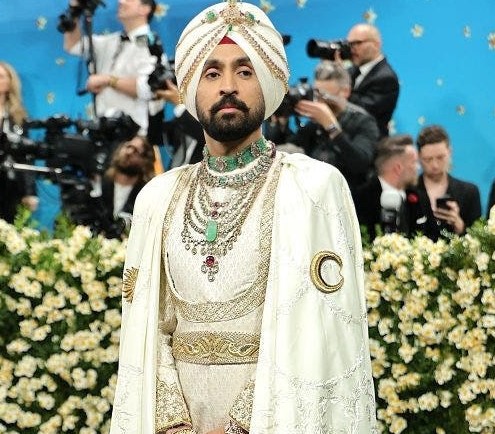
 Diljit Dosanjh at the Met Gala 2025 carrying Punjab and Sikhi to the world’s most watched fashion stage. This morning, with characteristic grace and equal firmness, he rebuffed the Jago .Punjab Manch’s public appeal to assume political leadership of Punjab.Jago Punjab Manch: Noble Intent, But Where Is the Manifesto?This morning, readers of The Tribune opened their newspapers to find a full-page advertisement addressed to Diljit Dosanjh. By mid-morning, Diljit had replied. Three lines. One folded hands emoji. Posted from somewhere on his North American concert tour, it travelled faster than any printing press:
“Kadey v Nhi..
Mera Kam Entertainment Karna
Am Very Happy in My Field
Thank You So Much 🙏”
Never. My work is to entertain. I am very happy in my field. Thank you so much.
He was responding to a Punjabi Tribune tweet asking whether he could be Punjab’s new political face. The reply clocked over 44,000 impressions within hours. It left nothing open to interpretation — no ambiguity for political operators to mine, no coded hesitation for wishful readers to decode. Kadey v Nhi was stated first, plainly, and without elaboration. The matter, from Diljit’s side, is closed.
And yet the advertisement that prompted this exchange — published by the Jago Punjab Manch, signed by decorated veterans and citizens of unimpeachable intent — deserves more than a footnote to Diljit’s refusal. It deserves both the respect it has earned and the honest scrutiny it has not yet received.
First, the Respect
The signatories of this appeal are not adventurers or political opportunists. They are eminent retired officers, decorated soldiers, and citizens of proven integrity. Their concern for Punjab is genuine and their anguish palpable. This is, moreover, not the first time they have taken out such an advertisement. That persistence itself speaks to sincerity rather than sensation.
And their choice of Diljit Dosanjh was not without logic. He is, in many ways, Punjab’s most consequential brand ambassador in a generation — a man who has carried the Punjabi idiom and the Sikh aesthetic across linguistic, national, and passport barriers with grace and without apology. His generous support to the Kisan Andolan of 2020–21 — that extraordinary year-long assertion of agrarian dignity on the outskirts of Delhi — demonstrated that his connection to Punjab’s soil is not merely performative. He is a global Punjabi in the fullest and most unselfconscious sense of that phrase. The Manch’s instinct to reach for such a figure is understandable.
But Diljit has answered. Clearly, graciously, and categorically. We must take him at his word and move on to the harder question.
The Missing Document
These venerable gentlemen — most of them octogenarians, men who gave the best decades of their lives to the nation — have, with evident passion, chronicled Punjab’s wounds. The advertisement is eloquent on decline: fiscal ruin, the drug catastrophe, hollowed institutions, the spiritual diminishment of the Gurdwaras, the exodus of Punjab’s youth. It reaches back, as such laments often do, through decades of perceived injustice — and one could extend that arc further still, to the Anglo-Sikh wars, to the betrayals of the post-independence settlement, to the rivers dispute that has festered for half a century.
Grievance, real and perceived, is not difficult to articulate. Punjab has accumulated enough of it to fill libraries.
What is conspicuously absent from this appeal and from the Manch’s public interventions more broadly is a Citizens’ Manifesto of Governance.
Not a wish list. Not a moral indictment. But a practical, pragmatic, constitutionally grounded document that says: here is what we propose, here is how it can be done, here is what Punjab can realistically demand and realistically achieve within the framework of the Indian Union.
Such a document need not command universal agreement. Manifestos rarely do. But it would create what Punjab’s public discourse currently lacks — a road map that citizens, academics, politicians, and diaspora can engage with, debate, amend, and own. The Manch has not produced this. And its absence is not a minor omission. It is the central weakness of an otherwise well-intentioned intervention.
The Rivers Question
Take the most consequential unresolved issue confronting Punjab: river waters. The Ravi-Beas dispute, the SYL canal, the arithmetic of what Punjab can sustain and what it has already lost — these are not abstract constitutional matters. They are questions of agricultural survival, of demographic futures, of civilisational continuity for a people whose identity is inseparable from their rivers.
The present moment is, in fact, unusually pregnant with possibility. The placing in abeyance of the Indus Waters Treaty in the aftermath of the Pahalgam tragedy and Operation Sindoor has reconfigured the regional hydraulic calculus in ways that have not been fully thought through. New arguments are available. New leverage exists. New frameworks for asserting Punjab’s rightful share are conceivable.
The Jago Punjab Manch has not spelled out its position on any of this. Not a word.
The Soldier’s Silence
There is another silence that is harder to excuse. Many of the signatories are decorated veterans. They know, from direct experience, what military service demands of Punjab’s sons and what Punjab’s families receive in return.
Yet the advertisement says nothing about the Agnipath scheme and its corrosive impact on Agniveer recruitment from Punjab a state that has historically contributed to the armed forces far beyond its demographic proportion. The short-service, no-pension Agniveer model strikes at the very compact between Punjab and the Indian state that the Manch otherwise celebrates. An entire generation of young Punjabis who would once have entered the armed forces on permanent terms, with the dignity of a pensioned career and the lifelong bond between soldier and state — is now being offered a four-year contract and a handshake. These gentlemen, of all people, have both the authority and the moral weight to speak plainly on this. They have chosen silence.
Equally unaddressed is the condition of ex-servicemen’s widows and female dependants in Punjab a constituency that has waited far too long for welfare entitlements that exist on paper but remain unfulfilled in practice. The postwar moment, with Punjab’s defence contribution freshly visible and freshly celebrated by the nation, creates an opportunity to press these claims with new urgency. The Manch has not seized it.
A Question of Transparency
There is one further matter that cannot be passed over, and it is raised here not to impute motive but precisely to protect the Manch’s own credibility.
A full-page advertisement in The Tribune is not exactly small change. From all accounts, the Jago Punjab Manch is not a registered body it has no formal legal existence, no publicly available constitution, no disclosed membership rolls. In the absence of such institutional transparency, the question of who funds such interventions is not merely procedural. It is political.
Punjab is a state with a long and unhappy acquaintance with what are popularly and not always inaccurately referred to as “the agencies.” The mere suspicion that a well-resourced, unregistered body is amplifying certain narratives at certain moments is enough, in Punjab’s febrile political atmosphere, to poison an otherwise legitimate well. It would be entirely in the interest of proactive disclosure — and, more importantly, in the interest of the cause these gentlemen seek to serve — for the Jago Punjab Manch to publicly state the sources of its funding.
To not do so is to hand critics an easy weapon. Worse, it risks arousing precisely the suspicion and mistrust among ordinary Punjabis that would defeat the very purpose these well-meaning citizens seek to achieve. Transparency here is not a bureaucratic nicety. It is a strategic necessity.
What Is To Be Done
None of this negates the sincerity of these citizens or the legitimacy of their anguish. But sincerity is not sufficient. Punjab in 2026 barely months from the Vidhan Sabha election that will determine the direction of the state for the next generation — needs more than moral witness. It needs structured thought.
The Shiromani Punjab Forum has been quietly working precisely in this direction. We are shortly placing in the public domain our Chali Nukte Forty Points for Punjab’s Resurrection.
The name is not chosen lightly. It draws its inspiration from one of the most luminous episodes in Sikh history — the Chali Mukte, the Forty Liberated Ones. These were the warriors who, in a moment of human frailty during the darkest days of Anandpur, had signed the bedawa — a deed of disavowal renouncing their Guru. Yet conscience would not let them rest. They returned. They fought. They fell at Khidrana di Dhab in 1705, watering that parched earth with their blood. And Guru Gobind Singh Ji, in an act of boundless grace that reverberates across the centuries, tore the bedawa with his own hands, liberating them for eternity. That place of redemption — Khidrana became Muktsar: the Pool of Liberation.
The Chali Mukte asked nothing for themselves. They gave everything. And in giving everything, they received everything.
The Chali Nukte ask something infinitely more modest: honest thought, honest governance, and the courage to put practical solutions in black and white. These Forty Points published individually on this Substack and shortly to be consolidated as a single document for wider discussion and debate address governance and fiscal discipline, the water rights crisis, agricultural transformation, the welfare of defence families, the Agnipath injustice, and the civilisational questions that underpin all of the above.
That is the document the Jago Punjab Manch owes Punjab. A charismatic leader, if one were to emerge, would need such a platform to stand on. Without it, even the most compelling personality becomes merely the newest face on the oldest poster.
Punjab does not need another hero. It needs a programme and those who genuinely love this land must move from lamentation to legislation, from the poetry of grievance to the prose of solutions.
Kadey v Nhi is Diljit’s answer. It is an honest one and we respect it unreservedly. The question that now falls to the rest of us is harder: if not him, then what? And if not now, then when?